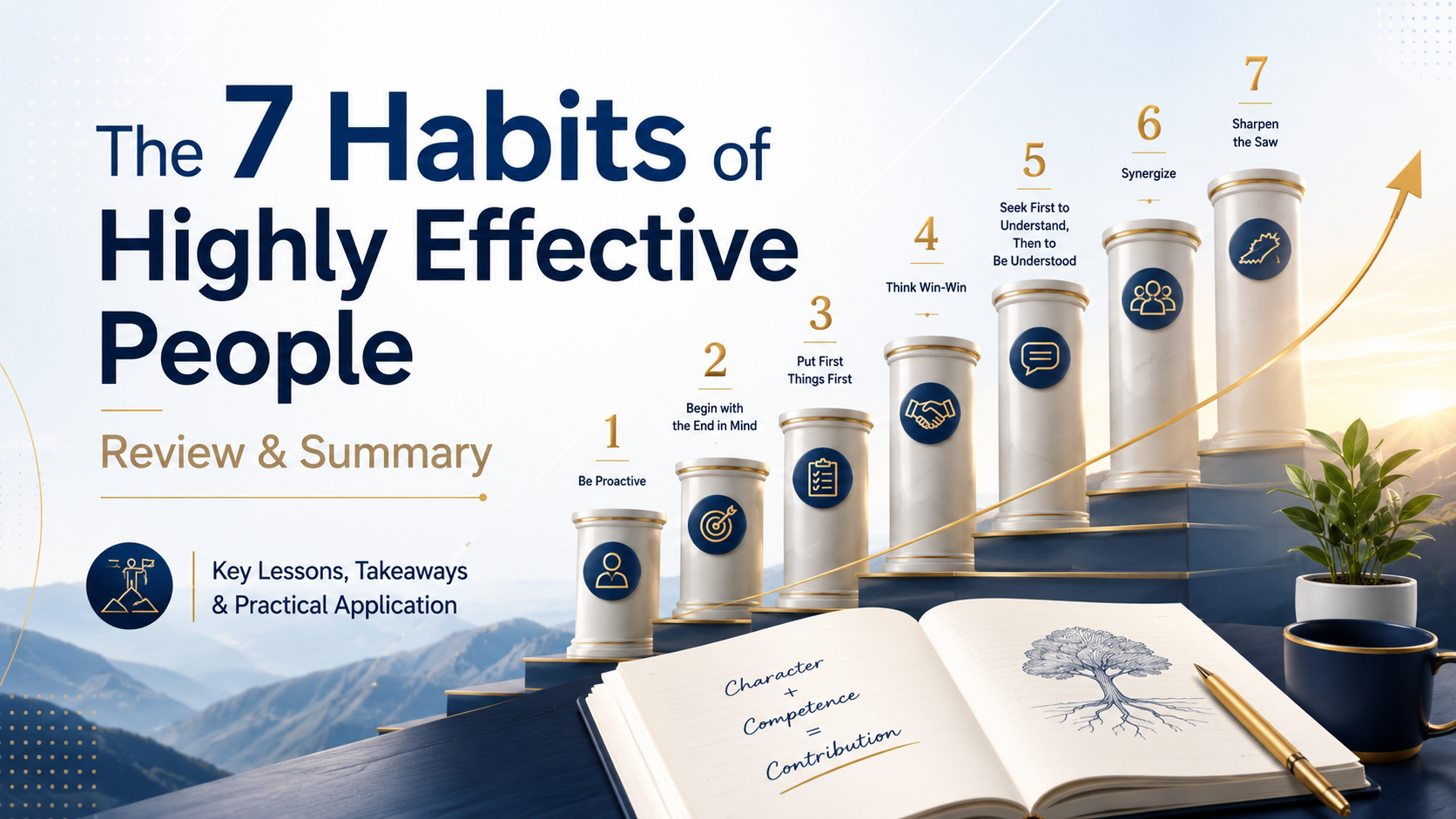
The 7 Habits of Highly Effective People Review & Summary
This 7 Habits review breaks down Stephen R. Covey’s classic book, its key lessons, who it is for, and how to apply the ideas in real life.
AI Snapshot: The 7 Habits of Highly Effective People by Stephen R. Covey is one of the most influential personal development and leadership books ever written. It teaches a principle-centred approach to personal effectiveness, covering responsibility, vision, priorities, relationships, communication, collaboration, and self-renewal.
This 7 Habits review and summary breaks down what the book is about, the main lessons from each habit, who should read it, and how to apply the ideas instead of simply highlighting them and forgetting them a week later.
What Is The 7 Habits of Highly Effective People About?
The 7 Habits of Highly Effective People is a personal development book about becoming more effective from the inside out. Instead of focusing on quick hacks, motivational tricks, or surface-level productivity tips, Stephen R. Covey focuses on character, principles, personal responsibility, and long-term growth.
The book argues that true effectiveness comes from aligning your actions with timeless principles such as integrity, fairness, honesty, service, responsibility, and continuous improvement.
At its core, the book is not just about getting more done. It is about becoming the kind of person who can produce better results consistently — in work, relationships, leadership, family life, and personal goals.
You can view the official FranklinCovey training page for the framework here: FranklinCovey 7 Habits course. You can also view the book’s publisher page here: Simon & Schuster book page.
Who Wrote The 7 Habits of Highly Effective People?
The book was written by Stephen R. Covey, an American author, educator, and leadership thinker. His work became especially influential in business, leadership training, personal growth, and professional development.
The original book was first published in 1989 and has remained one of the best-known personal development books in the world.
Quick Book Details
| Detail | Information |
|---|---|
| Book Title | The 7 Habits of Highly Effective People |
| Author | Stephen R. Covey |
| First Published | 1989 |
| Genre | Personal development, leadership, productivity, self-help |
| Core Theme | Principle-centred personal and interpersonal effectiveness |
| Best For | People who want better discipline, clarity, relationships, and long-term direction |
7 Habits Summary: The Main Lessons
The book is built around seven habits that move a person from dependence, to independence, to interdependence. In simple terms, the first three habits are about mastering yourself, the next three are about working well with others, and the final habit is about renewing yourself so the other habits remain sustainable.
1 Be Proactive
The first habit is about responsibility. Being proactive means recognising that you are not simply a product of your circumstances, mood, upbringing, or environment. You may not control everything that happens to you, but you do control your response.
This shift is massive. It moves you from victim mode to ownership mode.
2 Begin With the End in Mind
The second habit is about vision. Covey argues that everything is created twice: first mentally, then physically. A house starts as a blueprint before it becomes a building. A business starts as a plan before it becomes a company.
This habit asks a serious question: What kind of person are you trying to become?
Not just what do you want to own, earn, buy, or achieve — but who do you want to be?
3 Put First Things First
The third habit is about priorities. If Habit 2 is deciding what matters, Habit 3 is actually living by it.
Many people spend their lives reacting to notifications, problems, deadlines, messages, other people’s demands, and last-minute stress. They feel busy, but not necessarily effective.
4 Think Win-Win
The fourth habit is about relationships and mutual benefit. Win-Win means looking for solutions where both sides can benefit. It is not about being soft, weak, or naïve. It is about rejecting the idea that every relationship has to be a battle where one person wins and the other loses.
In business, family, friendship, and leadership, Win-Win thinking helps build trust.
5 Seek First to Understand, Then to Be Understood
This may be the most important relationship habit in the book. Most people do not listen properly. They wait for their turn to speak. They prepare their reply. They interrupt. They judge. They give advice too early.
Covey teaches that effective communication begins with understanding the other person first. This does not mean agreeing with everything. It means slowing down enough to understand the other person’s perspective before trying to make your own point.
6 Synergize
Synergy is about creative cooperation. The idea is that when people bring different strengths, experiences, perspectives, and ideas together, they can create something better than either person could have created alone.
Instead of thinking, “You disagree with me, so you are wrong,” a synergistic person thinks, “You see something I do not see. What can we create from both perspectives?”
7 Sharpen the Saw
The final habit is about renewal. Covey uses the idea of “sharpening the saw” to explain that you are your greatest asset. If you do not maintain yourself, everything else eventually suffers.
| Area | Meaning |
|---|---|
| Physical | Health, exercise, sleep, nutrition |
| Mental | Reading, learning, thinking, writing |
| Social / Emotional | Relationships, service, empathy, emotional strength |
| Spiritual | Values, purpose, reflection, meaning |
The big lesson is that personal growth is not a one-time event. You need consistent renewal.
The Main Message of the Book
The main message of The 7 Habits of Highly Effective People is simple:
The book is not really about productivity in the shallow sense. It is not just about waking up earlier, making better to-do lists, or using a better planner. It is about becoming more responsible, more intentional, more disciplined, more trustworthy, more understanding, and more balanced.
That is why the book has lasted for decades. Trends change. Apps change. Productivity methods change. But responsibility, vision, discipline, trust, listening, cooperation, and renewal remain relevant.
What Makes the Book So Powerful?
The book works because it is practical and deep at the same time. Some self-help books are motivational but vague. Others are practical but shallow. The 7 Habits gives you both: a big philosophy of life and practical ideas you can apply.
- It focuses on principles, not trends.
- It connects personal success with relationship success.
- It makes you look at your own responsibility.
- It gives language to things people already feel but cannot explain.
- It encourages long-term character growth instead of quick fixes.
Criticism: Is The 7 Habits Overrated?
The book is not perfect. Some readers may find the style old-fashioned, especially compared with modern self-help books that are shorter, faster, and more direct. Some sections can feel repetitive. Others may feel more philosophical than practical unless you actively apply the ideas.
Another issue is that many people read the book passively. They understand the ideas, agree with them, highlight a few pages, and then change nothing.
That is not really the book’s fault, but it is a common problem. The 7 Habits is not a book you should rush. It works best when treated like a personal development programme, not just a reading assignment.
Want to Actually Apply the Book?
Most people read powerful books and then move on without changing anything. That is why we created The 7 Pillars of Effective Living — a practical fillable PDF workbook designed to help you turn responsibility, vision, priorities, trust, listening, collaboration, and renewal into written exercises, weekly planning, and real action.
The goal is simple: do not just read about becoming effective. Practise it.
Get the 7 Pillars WorkbookWho Should Read This Book?
You should read The 7 Habits of Highly Effective People if you want to:
- Take more control over your life.
- Stop reacting emotionally to everything.
- Build better daily discipline.
- Clarify your long-term direction.
- Improve your relationships.
- Become a better listener.
- Manage your time around priorities.
- Build stronger character.
- Become more effective at work or in business.
- Develop a more balanced life.
It is especially useful for entrepreneurs, leaders, parents, students, managers, and anyone who feels busy but not truly effective.
How to Apply the 7 Habits in Real Life
Reading the book is only the first step. The real value comes from applying it.
1. Write down your Circle of Influence
List everything currently stressing you out. Then separate the list into things you can influence and things you cannot control. For the next week, only act on the first list.
2. Create a personal mission statement
Write one paragraph answering: What kind of person do I want to become? What values do I want to live by? What do I want my family, friends, and colleagues to remember about me?
3. Plan your week before it starts
Do not just react to Monday morning. Before the week begins, choose your most important priorities and schedule them.
4. Make one Emotional Bank Account deposit
Choose one important relationship and make a small deposit of trust. That could mean apologising, listening properly, keeping a promise, showing appreciation, or helping without being asked.
5. Practise one real empathic conversation
Have one conversation where your only goal is to understand. Do not interrupt. Do not fix. Do not judge. Ask better questions and reflect back what you hear.
6. Build a weekly renewal routine
Choose one action for each area: physical, mental, social/emotional, and spiritual. Then schedule them like appointments.
7 Habits Review: Final Verdict
Yes — The 7 Habits of Highly Effective People is still worth reading.
It is not the fastest self-help book. It is not the trendiest. It is not built around hacks or shortcuts. But that is exactly why it still matters.
The book teaches something deeper than productivity. It teaches personal leadership. It challenges you to stop blaming, define your values, live by your priorities, build trust, listen better, collaborate more creatively, and renew yourself consistently.
FAQs
What is The 7 Habits of Highly Effective People about?
The 7 Habits of Highly Effective People is about personal and interpersonal effectiveness. It teaches seven habits based on responsibility, vision, priority management, mutual benefit, empathic communication, collaboration, and self-renewal.
Who wrote The 7 Habits of Highly Effective People?
The book was written by Stephen R. Covey and was first published in 1989.
What are the 7 habits?
The seven habits are: Be Proactive, Begin With the End in Mind, Put First Things First, Think Win-Win, Seek First to Understand Then to Be Understood, Synergize, and Sharpen the Saw.
Is The 7 Habits of Highly Effective People still relevant today?
Yes. The book remains relevant because it focuses on timeless principles such as responsibility, integrity, priorities, trust, communication, cooperation, and renewal rather than temporary productivity trends.
Is the book good for entrepreneurs?
Yes. Entrepreneurs can benefit from the book because it teaches self-leadership, long-term thinking, priority management, relationship-building, and renewal — all essential skills for building a sustainable business.
How do I apply the 7 habits?
The best way to apply the book is to turn each habit into written exercises, weekly commitments, relationship actions, and regular reviews. A workbook or journal can help turn the ideas into measurable action.
Turn the Lessons Into Action
Reading the book gives you the ideas. Writing, planning, reviewing, and practising turns those ideas into behaviour.
The 7 Pillars of Effective Living is a fillable PDF workbook you can use on laptop, tablet or mobile to turn personal-development ideas into daily practice.
Start the 7 Pillars Workbook
Leave a Reply