Blog

  • How to Stop Living Paycheck to Paycheck: A Practical 30-Day Reset Plan

    Action Your Future • Money Reset

    How to Stop Living Paycheck to Paycheck

    A practical 30-day plan for taking back control of your money, escaping the monthly panic cycle, and finally creating breathing room between payday and survival.

    30
    days to rebuild your money system from chaos into control.

    Living paycheck to paycheck does not always mean you are lazy, careless, or bad with money. Sometimes it means your income is under pressure, your bills have grown faster than your wages, your debt payments are eating the future before it arrives, or nobody ever taught you a simple system for controlling cash flow.

    But here is the truth: even when the situation is difficult, you still need a plan. Without a plan, every payday becomes a temporary rescue. Money comes in, bills attack it, subscriptions nibble at it, debts swallow it, and within days you are counting down until the next payment lands. That cycle is exhausting because it keeps your nervous system in survival mode.

    The goal is not to become rich overnight. The first goal is much simpler: create a gap. A gap between income and spending. A gap between an unexpected bill and panic. A gap between your old money habits and the person you are becoming.

    The first win is not wealth. The first win is breathing room. Once you have breathing room, you can think clearly. Once you can think clearly, you can make better decisions. And once your decisions improve, your future begins to change.

    Why the Paycheck-to-Paycheck Cycle Feels So Hard to Escape

    Most money advice sounds simple from the outside: spend less, save more, earn more. The problem is that real life is not always that clean. Rent, mortgage payments, food, childcare, energy, transport, insurance, debt, family responsibilities and emergencies can leave very little room to move.

    That is why the solution cannot just be “cut out coffee” or “stop buying takeaways.” Small savings help, but they are not the whole answer. The real answer is to rebuild your financial structure. You need to know what is coming in, what is going out, which bills are dangerous if missed, which spending leaks are optional, and what your first emergency buffer should be.

    MoneyHelper’s free Budget Planner recommends gathering payslips, bank statements, bills and your banking app so you can work out income and spending accurately. It also explains that a useful budget shows what is left over and where you may be able to make savings. That is the foundation of everything in this article.

    The 30-Day Paycheck Reset Plan

    This plan is designed for someone who wants practical control, not fantasy. You do not need to become perfect. You need to become aware, organised and consistent.

    1

    Day 1–3: Face the Numbers Without Shame

    Open your banking app, statements and bills. Write down your monthly take-home income, fixed bills, debt payments, food, fuel, transport, subscriptions and irregular expenses. Do not judge the numbers yet. Just collect the truth.

    2

    Day 4–7: Separate Needs, Debts and Leaks

    Needs are survival costs. Debts are obligations. Leaks are small repeated payments that quietly drain money. Your first job is not to cut everything; it is to see the difference.

    3

    Day 8–14: Create a Survival Budget

    A survival budget is the minimum cost of keeping your life stable for one month. It includes housing, utilities, food, transport, essential phone or internet, debt minimums and basic family needs.

    4

    Day 15–21: Build Your First Buffer

    Before chasing big savings goals, aim for a tiny emergency buffer: £100, then £250, then £500. This buffer is not for shopping. It is there to stop one problem becoming a credit card problem.

    5

    Day 22–30: Automate the New System

    Set up separate pots or accounts for bills, spending and emergency savings. When money lands, give it a job immediately. Do not leave your whole life sitting in one account where everything looks spendable.

    Step One: Build a Real Budget, Not a Fantasy Budget

    A fantasy budget is what you wish you spent. A real budget is what your bank statements prove you spend. Most people fail at budgeting because they guess. They guess food. They guess fuel. They guess subscriptions. They forget annual costs. Then the budget breaks and they assume budgeting does not work.

    Start with the last 60 to 90 days of real spending. Look for the truth. How much did you actually spend on food? How much on takeaways? How much on petrol? How much on Amazon, Klarna, Apple, Google, streaming, gaming, clothes, taxis, lunches, random shops and small treats?

    Category What to include Question to ask
    Survival Rent or mortgage, council tax, energy, water, food, transport, medicine, essential phone/internet. What must be paid to keep my life stable?
    Debt Credit cards, loans, arrears, overdrafts, buy-now-pay-later, family debt. Which debts are urgent and which are draining my cash flow?
    Lifestyle Subscriptions, takeaways, shopping, entertainment, upgrades, impulse spending. Which spending is giving me value and which is just stress relief?
    Future Emergency fund, savings, investing, education, business, pension. Am I paying my future self anything?

    Once you see the numbers clearly, you stop fighting shadows. You can finally make decisions based on reality.

    Step Two: Protect the Essentials First

    If you are behind on bills or juggling debts, not every debt has the same urgency. Citizens Advice explains that “priority debts” are debts that can cause particularly serious problems if you do nothing about them, and that you should identify and deal with those first. Examples include rent arrears, mortgage arrears, gas and electricity bills, court fines, certain tax debts and other debts where the consequences can be severe.

    This matters because many people panic-pay whoever shouts the loudest. That can be a mistake. A credit card company may send scary letters, but missing rent, mortgage, council tax, energy or court payments can create much more serious consequences. When in doubt, get proper debt advice rather than guessing.

    Important: This article is general education, not personalised financial advice. If you are missing essential bills, facing eviction, dealing with bailiffs, or drowning in debt, speak to a free debt advice charity such as StepChange, Citizens Advice, National Debtline or Business Debtline as soon as possible.

    Step Three: Stop Letting Small Leaks Sink the Ship

    Small spending leaks are dangerous because they rarely feel serious in the moment. £4 here. £9 there. £12.99 every month for something you forgot about. A quick takeaway because you are tired. A little online order because you feel stressed. None of it looks like the reason you are broke. But together, it can become the missing gap between survival and progress.

    Go through your bank account and cancel anything that does not support your life right now. Not forever. Just for the reset season. You can bring things back later when your money has breathing room.

    Cancel unused subscriptions: streaming, apps, cloud storage, trials, gaming passes, memberships.
    Reduce convenience spending: takeaways, delivery fees, taxis, daily shop visits, lunches out.
    Pause upgrades: phones, clothes, gadgets, furniture, car extras, premium versions.
    Review contracts: insurance, broadband, phone, energy and other recurring bills.

    Do not make it emotional. You are not saying “I can never enjoy life.” You are saying “I am buying my freedom first.”

    Step Four: Build a Tiny Emergency Fund First

    When you are living paycheck to paycheck, a big emergency fund can feel impossible. So do not start with three months of expenses. Start with £100. Then £250. Then £500. The first emergency fund is not about becoming financially secure forever. It is about stopping small emergencies from throwing you backwards.

    A car tyre, school expense, prescription, repair, parking fine or short week at work can become a disaster when you have no buffer. But when even a small amount is set aside, you start to break the pattern of using debt for every surprise.

    First target: £100
    Next target: £250
    Then target: £500

    Keep this money separate from your normal spending account. If you see it every day, you will be tempted to use it. Hide it from your emotions. Make it slightly inconvenient to access.

    Step Five: Use the “Payday Split” Method

    One of the biggest reasons people run out of money early is that payday creates an illusion. Your account looks full, so your brain relaxes. But that money is not all available. Some of it already belongs to your landlord, mortgage provider, energy supplier, council, lender, insurer and supermarket.

    The payday split method fixes this. The day money comes in, split it immediately:

    A

    Bills Account

    Move all fixed bills and essential payments here first. This account is not for spending. It exists to protect your stability.

    B

    Weekly Spending Pot

    Divide your remaining spending money into weekly amounts. If you have £400 for the month, you do not have £400. You have £100 per week.

    C

    Emergency Buffer

    Move a small amount into savings immediately, even if it is only £5 or £10. The habit matters before the amount grows.

    This method works because it removes confusion. Your main spending account should only show what you are actually allowed to spend.

    Step Six: Attack Debt Without Destroying Your Life

    Debt repayment must be sustainable. If you throw every spare pound at debt but leave yourself no food, no transport and no buffer, you will probably end up borrowing again. The aim is not dramatic repayment for two weeks. The aim is a system you can survive long enough to finish.

    If your debts are manageable, choose a strategy. The debt snowball focuses on paying the smallest debts first for motivation. The debt avalanche focuses on the highest interest debts first to reduce total interest. Both can work. The best method is the one you will actually follow.

    If your debts are not manageable, do not try to solve it alone. StepChange says its free debt advice can help people gather details about income, spending and debts, build a budget, explore ways to reduce spending or increase income, and receive a personal action plan. That kind of support can remove fear and replace guessing with options.

    Step Seven: Increase Income Without Increasing Chaos

    Cutting costs is powerful, but sometimes the gap is simply too small. If your essential bills are close to your income, you may need more income as well as better budgeting. The key is to increase income in a way that does not destroy your health or family life.

    Start with realistic options:

    Ask for extra hours if your job offers them and your life can handle it.
    Sell unused items and use the money only for your emergency buffer or debt.
    Take a weekend skill such as delivery, cleaning, tutoring, repairs, design, writing or admin.
    Improve your main skill so your future income rises, not just your hours.

    The mistake is earning more and immediately upgrading your lifestyle. For the first 90 days, extra income should have one job: create breathing room.

    The Mindset Shift: You Are Not Punishing Yourself

    A lot of people avoid budgeting because it feels like punishment. They think budgeting means restriction, shame and never enjoying money again. But a good budget is not a prison. It is a permission slip. It tells you what you can spend without guilt because your essentials and future are already protected.

    The deeper shift is identity. You are no longer someone who waits for payday to rescue you. You are someone who gives money instructions. You are someone who checks the numbers. You are someone who protects the essentials. You are someone who builds a buffer before buying status.

    This connects to a bigger truth we have explored in our guide on how money really works: money is not just cash. It is behaviour, systems, incentives and decisions repeated over time. And as Stephen Covey’s work reminds us in The 7 Habits of Highly Effective People, your private victories come before your public victories. You fix the hidden system before the outside life changes.

    A Simple Weekly Money Routine

    Once your 30-day reset is complete, keep the system alive with a weekly money check-in. It should take 20 minutes. Same day. Same place. No drama.

    1

    Check balances

    Look at your bills account, spending account, emergency buffer and debt balances.

    2

    Check upcoming bills

    Look seven to fourteen days ahead so nothing surprises you.

    3

    Review spending leaks

    Find any emotional spending, repeated small payments or unnecessary extras.

    4

    Move money with purpose

    Top up the emergency buffer, pay extra toward debt, or prepare for an irregular bill.

    This routine matters because financial control is not a one-time event. It is a weekly relationship with reality.

    What to Do If There Is No Money Left After Bills

    Sometimes people do the budget and discover the painful truth: there is genuinely nothing left. If that is you, do not pretend the answer is just discipline. Discipline matters, but maths matters too.

    At that point, focus on four things: check whether you are entitled to any support, speak to creditors before the situation escalates, get free debt advice, and look for safe ways to increase income. Do not ignore letters. Do not borrow more just to look okay. Do not pay non-essential debts before essential survival costs.

    Financial stress can also affect mental health. If money pressure is making you feel anxious, ashamed, numb or overwhelmed, you are not weak. You are carrying a heavy load. Our guide to mental health conditions and what they can feel like may help you understand the emotional side, but urgent money problems still need practical support from qualified advice organisations.

    Final Thought: Your Future Needs a System

    Stopping the paycheck-to-paycheck cycle is not about one perfect month. It is about building a system that can survive imperfect months. You will still have surprises. You will still make mistakes. Prices may still rise. Life will still happen. But with a budget, a buffer, a payday split and a weekly routine, you are no longer drifting.

    You are taking command.

    Start with the next payday. Before it arrives, write the plan. When it lands, split the money. Protect the essentials. Save something, even if it is small. Cancel one leak. Face one debt. Repeat next week.

    That is how you begin. Not with a miracle. With a decision repeated until your life has proof.

    Your 7-Day Action Plan

    For the next seven days, do not try to fix your whole financial life. Just complete these steps: write down every bill, check your last 60 days of spending, cancel three leaks, create a separate emergency pot, and decide your first savings target. Small control today becomes bigger freedom later.

    FAQ: How to Stop Living Paycheck to Paycheck

    What is the fastest way to stop living paycheck to paycheck?

    The fastest first step is to build a real budget from your bank statements, protect essential bills, cancel obvious spending leaks, and create a small emergency buffer. The goal is to create breathing room before chasing bigger financial goals.

    Should I save money or pay off debt first?

    Many people benefit from building a small emergency buffer first, then paying down debt. Without a buffer, every small emergency can push you back into borrowing. If you have serious arrears or priority debts, get free debt advice.

    How much emergency savings should I start with?

    Start with a target that feels possible. £100 is a good first milestone. Then aim for £250, then £500, then one month of essential expenses. The habit is more important than the first amount.

    What if my income is too low to budget?

    A budget cannot magically fix income that is too low, but it can show the exact size of the problem. If essentials are higher than income, focus on support entitlement, debt advice, creditor communication and safe income increases.

    Helpful UK Resources

    This article is for general education and motivation. It is not regulated financial advice, debt advice or legal advice.
  • Action Your Future Guide

    10 Powerful Negotiation Tactics That Can Change the Outcome of Any Deal

    Negotiation is not just something that happens in boardrooms. You negotiate when you price your work, buy a car, speak to suppliers, handle clients, ask for better terms, or push back against a weak offer.

    Fillable PDF + Editable DOCX Negotiation Mastery Workbook
    • 10 practical negotiation tactics
    • Self-assessment and guided exercises
    • Script cheat sheet and planning pages
    • Built for real deals, quotes, and conversations

    Most people think negotiation is about being aggressive, naturally confident, or clever with words. It is not. Negotiation is usually won by the person who understands psychology better.

    The person who knows when to speak. The person who knows when to stay silent. The person who knows how to frame the conversation before the other side even realises what is happening.

    Below are 10 practical negotiation tactics that can help you protect your position, improve your outcomes, and stop leaving money on the table.

    Business Sales Salary Clients Suppliers Everyday life
    01

    Anchoring: Set the First Number Before They Do

    Anchoring is one of the most important negotiation tactics because the first serious number often controls the rest of the conversation.

    If a company offers you £30,000 for a job, suddenly £32,000 feels like a win and £28,000 feels low. But what if the role was actually worth £40,000? The first number has already pulled your expectations down.

    Example: If you are selling, start higher than what you expect to accept. If you are buying, start lower than what you expect to pay. The key is making sure your number is bold but still believable.

    A bold number gives you room. An absurd number kills trust. The goal is not to insult the other person. The goal is to set the frame.

    02

    Mirroring: Repeat Their Words and Let Them Talk

    Mirroring is simple. You repeat the last few important words someone said, but you say them like a question.

    They say: “I can’t go lower than £500.”
    You respond: “Lower than £500?”

    Then you stay quiet. Most people feel an automatic need to explain themselves. They continue talking, clarify their position, reveal hidden concerns, or even soften their stance without you asking them to.

    Mirroring works because it feels like active listening. The other person feels heard, but at the same time, you are gaining more information. And in negotiation, information is leverage.

    03

    Tactical Silence: Stop Talking After the Offer

    One of the biggest mistakes people make in negotiation is speaking too quickly. Someone gives them a price, an offer, or a demand, and they immediately rush to respond.

    Tactical silence is the art of staying quiet after the other person speaks. Not forever. Not in a rude way. Just long enough to make the silence do some work.

    Use it like this: When someone gives you a number, pause. Breathe. Let the offer sit there. That quiet moment can make the other person question their own position.

    The person who cannot handle silence usually loses ground first. Silence can be more powerful than a counter-argument.

    04

    The Flinch: React Before You Respond

    The flinch is a visible reaction to a number, demand, or condition that feels too high. It might be raised eyebrows, a slight lean back, a pause, or a calm phrase like: “That’s higher than I expected.”

    The point is not to perform like an actor. The point is to show genuine surprise when something feels unreasonable.

    Many people are not fully confident in the number they give you. They are testing the water. If you accept too quickly, they may assume they should have asked for more. If you flinch, they start questioning their own position.

    05

    Good Cop, Bad Cop: Understand When You Are Being Managed

    Good cop, bad cop is one of the oldest negotiation techniques. One person plays the tough, unreasonable role. The other plays the helpful, understanding role.

    In sales, this often sounds like: “I’d love to give you that price, but my manager will never approve it.” The manager becomes the bad cop, even if you never meet them.

    Important reminder: Someone being friendly does not automatically mean they are on your side. They may just be the softer face of the same negotiation strategy.
    06

    Door in the Face: Ask Big, Then Ask for What You Really Want

    The door in the face technique works through contrast. You start with a large request that is likely to be rejected. Then you follow up with a smaller request, which is what you actually wanted.

    The second request feels more reasonable because it is being compared to the first one.

    Big ask: “Can you help me all weekend?”
    Real ask: “Okay, could you help me for two hours on Saturday?”

    The first ask should be ambitious, not absurd. If it feels manipulative or insulting, you lose credibility.

    07

    BATNA: Build Your Backup Plan Before You Negotiate

    BATNA stands for Best Alternative to a Negotiated Agreement. In plain English, it means: what will you do if this deal does not happen?

    That is your real power. If you have another buyer, another job offer, another supplier, or another route forward, you negotiate with more confidence because you are not trapped.

    Before any important negotiation, ask: “If this does not work, what is my next best option?” If the answer is “nothing,” you are exposed.

    The strongest negotiators do not just prepare what they are going to say. They prepare their alternatives.

    08

    The Nibble: Ask for One Small Extra at the End

    The nibble is a small extra request made right at the end of a negotiation. The main deal is already agreed. The price is set. The other person is mentally ready to close.

    Then you ask for one small additional thing: free delivery, installation, an extended warranty, another month of support, or a small bonus.

    The key is to keep it small. If you ask for something big at the finish line, you may damage trust or blow up the deal completely.

    09

    The Ultimatum: Only Use It When You Mean It

    An ultimatum is a hard line: “This is my final offer.” “Take it or leave it.” “I can only do this on these terms.”

    Ultimatums can be powerful, but they are dangerous. They only work when you have genuine leverage and you are truly prepared to walk away.

    Rule: Never threaten to walk away unless you are actually willing to walk away.

    If you are bluffing and the other person calls you on it, your credibility is gone.

    10

    Trading, Not Giving: Never Concede for Free

    One of the most important negotiation principles is this: do not give things away for nothing.

    If someone asks for a discount, faster delivery, better terms, extra work, or more flexibility, do not automatically say yes. Trade instead.

    “If I can reduce the price, would you be able to commit today?”
    “If you need faster delivery, we can do that, but we would need payment upfront.”

    When every concession requires a trade, people respect your position more. Negotiation is not charity. It is exchange.

    Want to practise these tactics properly?

    The Negotiation Mastery Workbook turns these ideas into practical exercises, scripts, planning pages, and real-world prompts so you can apply them before your next deal, quote, salary conversation, or difficult discussion.

    $11.99 $4.99 Launch Offer

    Get the Fillable Workbook
    Negotiation Mastery Workbook

    Fillable PDF + Editable DOCX

    Scripts, worksheets, self-assessment, and action plan.

    Quick Summary: 10 Negotiation Tactics to Remember

    Tactic What It Means Why It Works
    Anchoring Set the first serious number. Frames the rest of the negotiation.
    Mirroring Repeat key words back as a question. Makes the other person reveal more.
    Tactical Silence Stay quiet after an offer. Creates pressure without speaking.
    The Flinch Show surprise at their number. Makes them question their position.
    Good Cop, Bad Cop Recognise role-based pressure. Stops you mistaking friendliness for loyalty.
    Door in the Face Ask big, then ask smaller. Makes the real request feel reasonable.
    BATNA Know your backup plan. Gives you power to walk away.
    The Nibble Ask for a small extra at the end. Uses deal momentum to gain a final win.
    The Ultimatum Draw a final hard line. Forces a decision when used correctly.
    Trading, Not Giving Only concede in exchange for something. Keeps the deal balanced.

    FAQs About Negotiation Tactics

    What is the most important negotiation tactic?

    The most important tactic is having a strong BATNA. If you have a real alternative, you are not desperate. That gives you the confidence to negotiate properly and walk away from bad terms.

    Is anchoring manipulative?

    Anchoring can be manipulative if used dishonestly, but it can also be a normal part of negotiation. The key is to use a number that is ambitious, believable, and connected to real value.

    Why does silence work in negotiation?

    Silence creates discomfort. Many people rush to fill that discomfort by explaining, justifying, or improving their offer. Staying quiet gives the other person space to reveal more information.

    Should you always make the first offer?

    Not always. If you understand the value clearly, making the first offer can help you set the frame. If you are unsure of the market value, ask questions first and gather information.

    When should you walk away from a negotiation?

    You should walk away when the deal is worse than your best alternative, when the other side is acting in bad faith, or when accepting the terms would create more problems than benefits.

    Negotiation is not about tricking people.

    It is about understanding the psychology of the conversation, protecting your position, and making sure you do not give away value without getting value back.

    Get the Negotiation Mastery Workbook
    “`
  • How Money Really Works: Debt, Inflation, Bitcoin & Housing Explained

    How Money Really Works: Debt, Inflation, Bitcoin & Housing Explained

    Action Your Future Money Guide

    How Money Really Works

    Most people are taught how to earn money. Very few are taught how money actually works. This guide breaks down currency, debt, inflation, Bitcoin, housing, investing and the financial system in plain English.

    Workbook launch offer: Was $11.99 Now $4.99
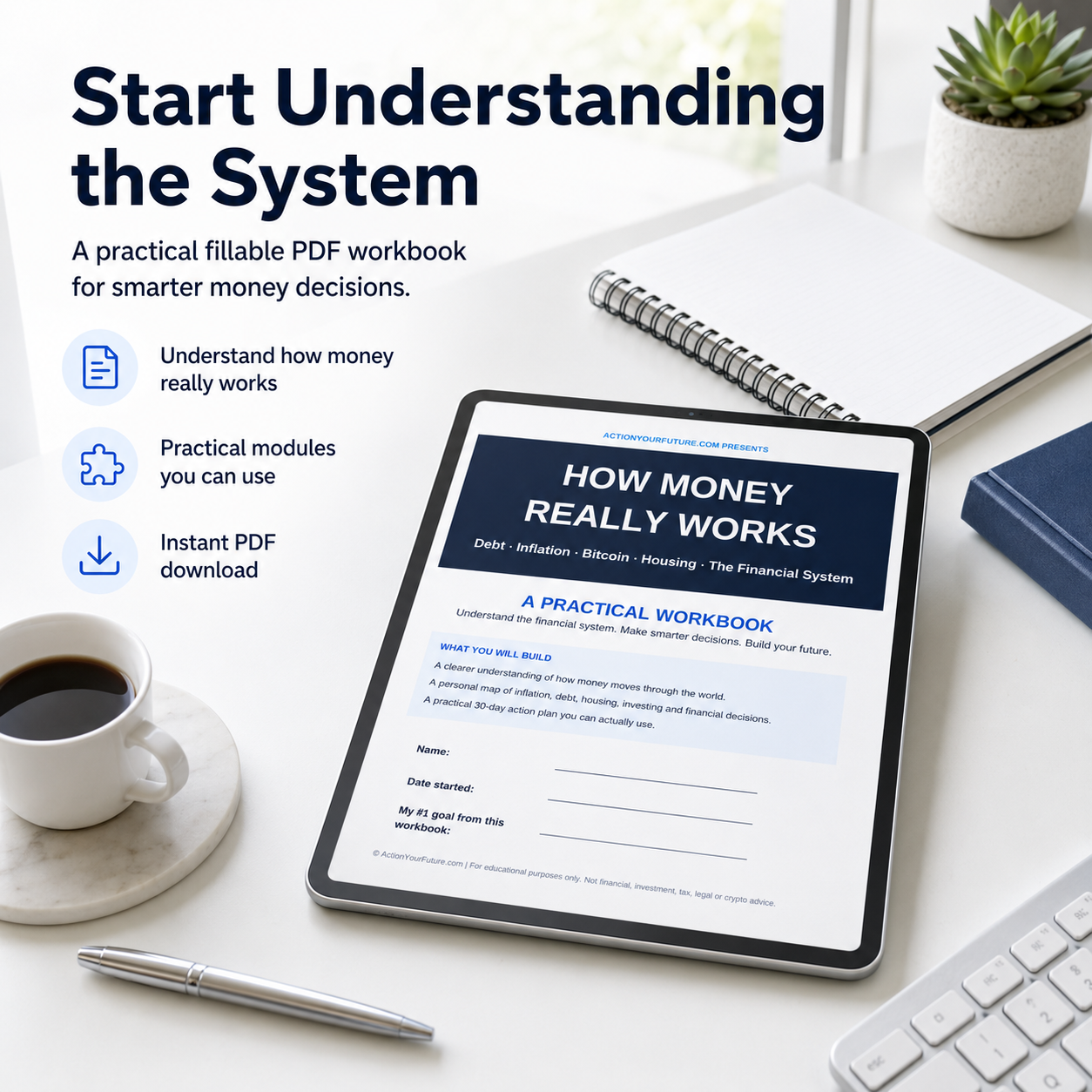
    ActionYourFuture.com presents HOW MONEY
    REALLY WORKS
    Debt · Inflation · Bitcoin · Housing · The Financial System

    A Practical Workbook

    Understand the system. Make smarter decisions. Build your future.

    35 pages · 11 modules · fillable PDF · instant download
    $11.99 $4.99 launch discount
    11 Practical Modules
    35 Fillable Pages

    Money is not just the cash in your wallet or the number on your banking app. Money is trust, power, debt, confidence and a system of rules that affects almost every part of your life.

    Why is one pound not worth the same as one dollar? Why are almost all major countries in debt? Why can’t governments simply print more money? Why does housing feel impossible for ordinary people? And why do wealthy people often use debt while everyone else is told to avoid it?

    These questions sound complicated because the financial world loves complicated language. But once you strip away the jargon, the basics are easier to understand than most people think.

    The big idea: money is not random. It is a system. The people who understand the system have an advantage over the people who only work inside it.

    Why One Currency Is Not Worth the Same as Another

    A pound, a dollar, a euro and a yen are all symbols. On their own, they are not valuable because of the paper, metal or digital number attached to them. They are valuable because people believe they can be exchanged for real things: food, fuel, labour, property, services and goods.

    That is why one dollar is not automatically equal to one pound or one yen. A currency reflects the strength, stability and trust behind the economy that issues it.

    If investors believe a country is productive, stable and likely to grow, demand for that country’s currency usually rises. If confidence falls, the currency can weaken.

    The number printed on the note is not the real story. The real story is what that note can buy.

    Why Every Country Seems to Be in Debt

    One of the strangest things about the modern world is that almost every major country owes money. America owes money. Britain owes money. Japan owes money. China owes money.

    The obvious question is: if everyone is in debt, who is everyone paying?

    The answer is: each other, their own citizens, banks, pension funds, investment firms and institutions. Governments usually borrow by issuing bonds. A bond is basically an IOU. Investors lend money to the government today, and the government promises to pay it back later with interest.

    National debt is different from personal debt. A person can go bankrupt. A country with control over its own currency has more tools available. But that does not mean government debt is harmless.

    Debt becomes dangerous when trust breaks. As long as lenders believe a country can keep paying interest, the system continues. When confidence collapses, borrowing becomes more expensive and the pressure builds.

    Why Governments Cannot Just Print More Money

    Printing money does not create wealth. It creates more money. That difference matters.

    If an economy has the same amount of goods and services, but suddenly everyone has more cash, prices usually rise. More money starts chasing the same amount of stuff.

    Imagine a small town with 100 loaves of bread and 100 people. If everyone has £10 and bread costs £10, the system is balanced. But if everyone suddenly receives more money while the number of loaves stays the same, people compete harder for the same bread. The baker can charge more. Prices rise.

    Nobody became richer. The money simply became weaker.

    You can print notes. You cannot print real wealth.

    Money only works when it represents something real: work, productivity, goods, services, resources and trust. If money is created faster than the real economy grows, purchasing power falls.

    What Bitcoin Changed

    Bitcoin is one of the most important financial ideas of the last 20 years because it challenged a basic assumption: that money needs a government behind it.

    Bitcoin is digital money that runs without a central bank. Instead of a bank keeping the records, Bitcoin uses a public ledger called a blockchain. Transactions are verified by a decentralised network rather than one single authority.

    Bitcoin introduced money based on code, scarcity and network trust rather than government trust. Supporters call it “digital gold” because its supply is limited.

    But Bitcoin is not perfect. Its price can swing violently. It can be difficult for beginners to understand. And if someone loses access to their wallet, there is no bank manager to call and no password reset button.

    Bitcoin proved that money can exist outside the traditional system. Whether it becomes everyday money, a long-term store of value, or mainly a speculative asset is still debated.

    Why Deflation Can Be More Dangerous Than Inflation

    Most people hate inflation because it makes life more expensive. But the opposite problem, deflation, can also be dangerous.

    Deflation means prices are falling. At first, that sounds great. Cheaper food. Cheaper cars. Cheaper homes. But the problem is behaviour.

    If people believe prices will be lower next month, they delay spending. If enough people delay spending, businesses lose sales. Businesses then cut prices further, reduce investment, freeze hiring or lay off workers.

    That creates even less spending. The economy slows down because everyone is waiting.

    Inflation hurts because prices rise. Deflation hurts because the economy can freeze.

    Who Really Pays Tariffs?

    Tariffs are often sold politically as a way to punish another country. But in real life, the foreign country usually does not write the cheque.

    The importer pays.

    If a company imports goods and those goods are subject to a tariff, the cost is charged when the goods enter the country. That cost usually does not stay with the importer. It gets passed down.

    The importer pays more. The wholesaler pays more. The retailer pays more. Eventually, the customer pays more.

    So when people say another country is “paying the tariff,” be careful. Most of the time, the cost quietly lands in the shopping basket.

    Why Housing Feels Impossible Now

    For many people, housing is the clearest sign that the financial system has changed. A generation ago, home ownership felt like a realistic goal for ordinary workers. Today, many people feel trapped between rising rents, high deposits, expensive mortgages and house prices that have run far ahead of wages.

    Housing stopped being just shelter. It became an asset class.

    That means ordinary families are not only competing with other families. They are also competing with landlords, investors, corporations, overseas buyers, short-term rental operators and people who already own multiple properties.

    When homes become investment vehicles, the people who need somewhere to live can get priced out by people who see property as a portfolio.

    Trading vs Investing: Know Which Game You Are Playing

    Trading and investing are often spoken about as if they are the same thing. They are not.

    Trading

    Trading is about short-term movement. Traders look for momentum, volatility, patterns, news and timing.

    Investing

    Investing is about long-term ownership. Investors buy assets because they believe they will become more valuable over years or decades.

    Trading asks: “What will the price do next?”

    Investing asks: “What will this asset become over time?”

    The mistake beginners often make is entering the market thinking they are investing, but behaving like emotional traders. They buy hype, panic during drops, sell fear, and repeat the cycle.

    The mistake is not choosing trading or investing. The mistake is not knowing which one you are playing.

    How Wealthy People Use Debt Differently

    Most ordinary people experience debt as pressure: credit cards, overdrafts, car finance, payday loans, student loans, high interest, monthly payments and stress.

    For wealthy people, debt often works differently. They use it as leverage.

    If someone owns valuable assets such as property, stocks or a business, they may be able to borrow against those assets instead of selling them. That means they can access cash while still keeping ownership of the asset.

    This is why the rich often think about debt differently. They are not always borrowing because they are broke. They are borrowing to keep their assets, avoid selling too early, reduce tax events, or use cheap capital to buy more assets.

    Debt used to buy things that lose value can keep you poor. Debt used carefully to control appreciating assets can build wealth. Same word. Different game.

    Financial Crime Awareness: How Illegal Money Is Disguised

    Money laundering is the process of making illegal money look legal. Criminal money has a problem: it needs an explanation.

    If someone suddenly deposits large amounts of cash with no legitimate source, banks, tax authorities and law enforcement may ask questions. So criminals try to disguise where the money came from.

    Placement

    Getting illegal money into the financial system.

    Layering

    Moving the money through accounts, companies, transactions or assets to make the trail harder to follow.

    Integration

    Bringing the money back into the economy so it appears legitimate.

    The financial system does not only move money. It tells stories about where money came from.

    Want to Turn This Article Into Action?

    We created the How Money Really Works Workbook to help you go deeper. It is a practical 35-page fillable PDF with modules, reflection questions, quizzes, worksheets and a 30-day action plan.

    Launch price: $4.99 Was $11.99 35-page fillable PDF 11 practical modules Instant download Printable at home
    Download the Workbook for $4.99

    The Bigger Lesson: Money Is a System of Trust

    When you look at all these topics together, one theme appears again and again.

    Money is trust.

    Currency

    A currency has value because people trust the economy behind it.

    Debt

    Government debt works because lenders trust they will be paid.

    Inflation

    Inflation rises when money grows faster than real value.

    Bitcoin

    Bitcoin matters because it replaces institutional trust with code and network trust.

    Housing

    Housing becomes unaffordable when shelter becomes an investment asset.

    Debt & Wealth

    Debt builds wealth for some and destroys others because access, rates and ownership are not equal.

    Once you understand how money works, you stop seeing prices, debt, wages, inflation and housing as separate problems. You start seeing the machine.

    And once you can see the machine, you can make better decisions about your own future.

    Questions & Answers

    Here are some quick answers to the money questions people often ask after learning how the financial system works.

    Why is £1 not worth the same as $1?
    Because currencies reflect different economies, levels of trust, interest rates, trade relationships, demand and purchasing power. The symbol printed on the money is not what matters. What matters is what that money can buy and how much confidence people have in the economy behind it.
    Why can’t the government just print more money?
    Printing money does not automatically create more goods, homes, food, energy or services. If more money is created without more real value being produced, prices usually rise and purchasing power falls.
    Is national debt the same as personal debt?
    No. Personal debt and national debt are not the same. Governments can borrow through bonds, refinance debt and use monetary policy. But national debt can still become dangerous if confidence falls, interest costs rise or the economy stops growing.
    Is Bitcoin real money?
    Bitcoin is a form of digital money or digital asset, depending on how someone uses it. It is not controlled by a central bank and relies on code, scarcity and a decentralised network. However, its price can be volatile, and it carries risks that beginners should understand before getting involved.
    Who actually pays tariffs?
    The importer usually pays the tariff when goods enter the country. That cost is often passed through the supply chain until it reaches the final customer through higher prices.
    Why is housing so hard to afford now?
    Housing has become expensive because of a mix of wage stagnation, limited supply, planning restrictions, investor demand, high rents, mortgage costs and the treatment of property as an investment asset rather than simply shelter.
    Should beginners trade or invest?
    Most beginners should understand the difference before doing either. Trading is short-term and requires timing, discipline and risk control. Investing is long-term and focuses more on ownership, patience and fundamentals.
    Is all debt bad?
    No. Debt can be destructive when it is used to buy things that lose value or when interest is too high. But debt can also be productive when used carefully to buy or build assets that increase in value or generate income.
    What is included in the How Money Really Works Workbook?
    The workbook includes 35 fillable PDF pages, 11 practical modules, reflection questions, worksheets, action steps, quick quizzes, an answer key and a 30-day action plan. It is currently available for $4.99, discounted from $11.99.

    Learn the System. Build Your Future.

    Money affects your choices, your security and your opportunities. The more you understand the system, the better decisions you can make.

    Workbook launch offer: Was $11.99 Now $4.99
    Get the How Money Really Works Workbook
  • Untitled post 65
    Action Your Future • Mental Health Guide

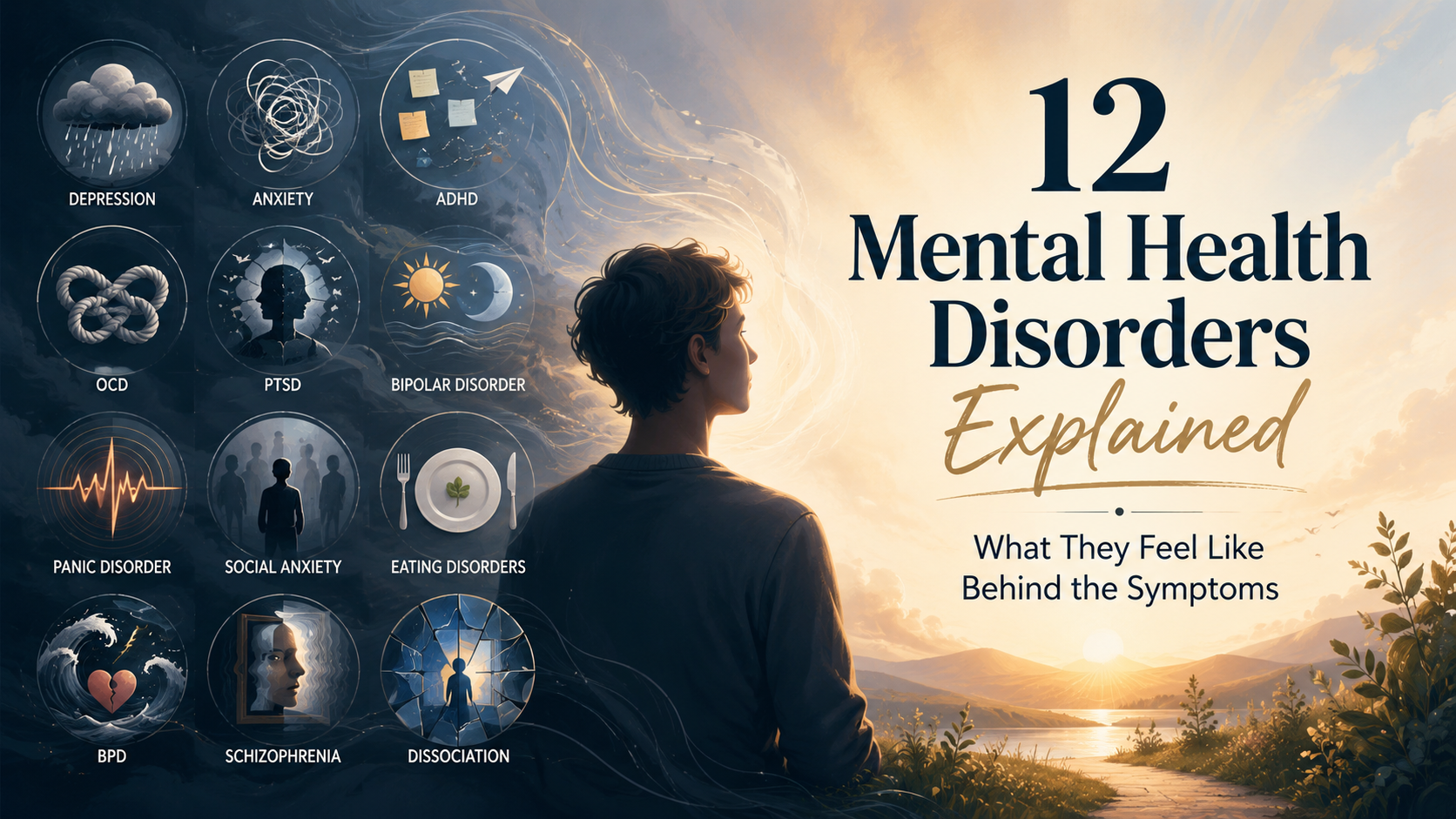
    12 Mental Health Disorders Explained: What They Feel Like Behind the Symptoms

    Mental health conditions are often judged from the outside. This guide looks at what may be happening underneath the surface, in plain English, with compassion instead of shame.

    Mental Health Is Not a Character Flaw

    People often see the behaviour before they understand the battle. They see someone cancel plans, panic, withdraw, overthink, check the door again, struggle to focus, avoid food, eat in secret, or emotionally explode over something that looks small.

    What they do not always see is the invisible pressure underneath: the racing thoughts, the nervous system stuck on high alert, the emotional pain, the shame, the exhaustion, the confusion, or the desperate attempt to feel safe.

    Mental health disorders are not weakness. They are not laziness. They are not attention-seeking. They are real conditions that can affect mood, thoughts, sleep, appetite, behaviour, relationships, motivation, memory and physical health.

    Important medical note

    This article is for education only. It is not a diagnosis, and it does not replace advice from a GP, therapist, psychiatrist or qualified mental health professional.

    12 conditions explained in plain English
    0% judgement, shame or lazy stereotypes
    1 message: struggling does not mean broken

    Quick Map: The Conditions Covered

    Each condition below can look different from person to person. The aim is not to label anyone. The aim is to understand the experience behind the symptoms.

    1
    DepressionWhen life feels heavy, empty or colourless.
    2
    Generalised Anxiety DisorderWhen worry becomes a constant alarm system.
    3
    ADHDWhen intention and action do not line up.
    4
    OCDWhen intrusive thoughts trap the mind in loops.
    5
    PTSDWhen the past keeps feeling present.
    6
    Bipolar DisorderWhen mood states swing into extremes.
    7
    Panic DisorderWhen the body sounds a false danger alarm.
    8
    Social Anxiety DisorderWhen being seen feels unsafe.
    9
    Eating DisordersWhen food becomes tied to control, shame or fear.
    10
    Borderline Personality DisorderWhen emotions feel too intense to hold.
    11
    SchizophreniaWhen reality becomes difficult to trust.
    12
    Dissociative DisordersWhen the mind disconnects to survive.
    01 • Depression

    Depression: When Life Feels Heavy Even When Nothing Is “Wrong”

    Depression is much more than feeling sad. Sadness usually has a story. Something happened. Someone hurt you. You lost something. You are disappointed, grieving or overwhelmed.

    Depression can appear even when life looks fine from the outside. It can make ordinary life feel impossible. You may sleep for hours and still wake up exhausted. Food may taste like nothing. Music may stop moving you. Messages from people you love may sit unanswered, not because you do not care, but because even pretending to be okay feels exhausting.

    • Low mood or emotional numbness
    • Loss of interest in things you once enjoyed
    • Tiredness, sleep changes or low motivation
    • Feelings of hopelessness, guilt or worthlessness

    The cruel part is that depression often speaks in your own voice. It tells you this is who you are now. It tells you everyone else is coping better. It tells you hope is fake and the future will feel exactly like the present.

    Depression is not your identity. It is a condition, and support can help.
    02 • Anxiety

    Generalised Anxiety Disorder: When Your Mind Becomes a 24/7 Alarm System

    Everyone worries sometimes. Generalised anxiety disorder is different. It is not occasional stress before a big event. It is worry that becomes constant, difficult to control and exhausting.

    Your brain starts treating everyday life like a threat. A text message becomes a possible argument. A small mistake becomes proof that everything is falling apart. A future event becomes a full disaster movie before it has even happened.

    • Constant worry that is hard to switch off
    • Muscle tension, restlessness or feeling on edge
    • Difficulty sleeping or concentrating
    • Physical symptoms such as stomach discomfort or a racing heart

    The hardest part is that anxiety can look irrational from the outside, but inside the body it feels real. Your nervous system does not always know the difference between an actual emergency and a feared possibility. It simply reacts.

    That is why “just calm down” rarely helps. Anxiety is not solved by being told there is nothing to worry about. It is helped by support, understanding, coping tools and, where needed, professional treatment.

    03 • ADHD

    ADHD: When Intention and Action Do Not Line Up

    ADHD is one of the most misunderstood conditions. People often think it simply means being hyperactive or unable to pay attention. In reality, ADHD can affect attention regulation, impulse control, organisation, time management and follow-through.

    A person with ADHD may desperately want to finish a task and still feel unable to start. They may care deeply about a conversation but still drift away mentally. They may lose keys, miss deadlines, forget appointments or jump between projects, not because they do not care, but because their brain struggles to regulate focus and action.

    • Difficulty starting or finishing tasks
    • Forgetfulness, distraction or time blindness
    • Impulsive decisions or interrupting conversations
    • Restlessness, fidgeting or feeling internally driven

    One of the most painful parts of ADHD is the gap between knowing and doing. You know what needs to be done. You know why it matters. You know the consequences of not doing it. And still, something in the brain refuses to move.

    ADHD is not a moral failure. It is a neurodevelopmental condition, and many people learn to manage it with the right systems and support.
    04 • OCD

    OCD: When Your Brain Traps You in a Loop

    Obsessive compulsive disorder is not simply liking things clean or organised. Real OCD can be terrifying.

    It often involves obsessions and compulsions. Obsessions are unwanted intrusive thoughts, images or urges that cause distress. Compulsions are repeated behaviours or mental rituals carried out to reduce that distress.

    • Unwanted intrusive thoughts or images
    • Repeated checking, washing, counting or reassurance-seeking
    • Temporary relief followed by returning anxiety
    • Hours lost to rituals or mental reviewing

    Someone may fear contamination and wash their hands repeatedly. Someone else may fear they left the oven on and check it again and again. Another person may experience violent or disturbing intrusive thoughts that horrify them, then perform rituals to feel safe.

    The key word is temporary. The ritual may bring relief for seconds or minutes, but then the fear returns. The brain asks for another check, another wash, another reassurance, another mental review.

    OCD is not being neat. It is being trapped by thoughts you did not ask for and rituals you feel forced to perform.
    05 • PTSD

    PTSD: When the Past Still Feels Present

    Post-traumatic stress disorder can happen after someone experiences or witnesses something deeply frightening, dangerous or overwhelming. The event may be a serious accident, violence, abuse, war, assault, sudden loss or another traumatic experience.

    The body survives the event, but the nervous system does not fully return to safety. PTSD can involve flashbacks, nightmares, intrusive memories, avoidance, emotional numbness, irritability, sleep problems and constantly scanning for danger.

    • Flashbacks or intrusive memories
    • Nightmares and disrupted sleep
    • Avoiding reminders of the trauma
    • Hypervigilance, anger, numbness or feeling unsafe

    A flashback is not just “remembering”. It can feel as if the event is happening again. A smell, sound, place, facial expression or random trigger can throw the body back into survival mode.

    PTSD is not weakness. It is the brain trying to protect someone after danger. The problem is that the alarm system keeps firing long after the threat has passed.

    06 • Bipolar Disorder

    Bipolar Disorder: When Mood States Become Extremes

    Bipolar disorder is often casually described as “mood swings”, but that massively understates what it can involve.

    Bipolar disorder includes episodes of depression and episodes of mania or hypomania. These are not ordinary ups and downs. They are intense mood states that can affect energy, sleep, judgement, behaviour, confidence, speech, spending, risk-taking and relationships.

    • Depressive episodes with low energy and hopelessness
    • Manic or hypomanic episodes with unusually high energy
    • Reduced need for sleep during high mood states
    • Risk-taking, impulsive decisions or racing thoughts

    During mania or hypomania, a person may feel unusually energetic, powerful, creative, restless or invincible. They may sleep very little, talk rapidly, start big projects or take risks that later have consequences.

    The difficult part is that mania can feel positive at first. It may feel like confidence, clarity or a breakthrough. But when it escalates, it can become dangerous, chaotic or disconnected from reality.

    07 • Panic Disorder

    Panic Disorder: When Your Body Feels Like It Is in Danger

    A panic attack can feel like dying. The heart pounds. The chest tightens. Breathing becomes difficult. Hands may tingle. The room may spin. The person may feel detached from their body or convinced they are having a heart attack.

    • Sudden episodes of intense fear
    • Racing heart, shaking, sweating or chest tightness
    • Dizziness, breathlessness or numbness
    • Fear of having another panic attack

    Panic disorder develops when panic attacks become recurring and the person starts fearing the next one. That fear can shrink life.

    You avoid the supermarket because you panicked there once. You avoid driving because you fear being trapped. You avoid crowds because escape feels difficult. You avoid going out because your own body feels unpredictable.

    Panic disorder is not attention-seeking. It is the body’s emergency system firing when there is no immediate danger.
    08 • Social Anxiety

    Social Anxiety Disorder: When Being Seen Feels Unsafe

    Social anxiety disorder is not the same as being shy. Shyness may make someone nervous in social situations. Social anxiety can make ordinary interaction feel threatening.

    A person with social anxiety may fear being judged, embarrassed, criticised, watched or rejected. They may worry about blushing, sweating, shaking, saying the wrong thing, sounding awkward or looking incompetent.

    • Fear of being judged, embarrassed or watched
    • Avoiding conversations, calls, presentations or social events
    • Physical symptoms such as sweating, shaking or a pounding heart
    • Replaying interactions afterwards and magnifying mistakes

    The painful cycle often continues after the interaction ends. Every pause becomes proof they were awkward. Every facial expression becomes evidence they were disliked. Every sentence is examined like a crime scene.

    Social anxiety is not arrogance or rudeness. Many people with social anxiety deeply want connection. They are simply terrified of being negatively seen.

    09 • Eating Disorders

    Eating Disorders: When Food Becomes a Battlefield

    Eating disorders are not vanity. They are serious mental health conditions where food, weight, body image or eating behaviours become tied to control, fear, shame or emotional survival.

    Anorexia may involve severe restriction, fear of weight gain and a distorted view of the body. Bulimia may involve cycles of binge eating and purging. Other eating disorders can involve binge eating, obsessive food rules, compulsive exercise or extreme distress around eating.

    • Restricting food, bingeing, purging or compulsive exercise
    • Intense fear around weight, body shape or eating
    • Shame, secrecy or rigid food rules
    • Physical health risks affecting the heart, bones, digestion or organs

    The outside world may focus on weight, but eating disorders are often about much more than appearance. They can be about control when life feels chaotic, perfectionism, punishment, trying to disappear or trying to feel safe.

    Recovery is possible, but eating disorders deserve proper support, not shame.
    10 • BPD

    Borderline Personality Disorder: When Emotions Feel Too Big to Hold

    Borderline personality disorder, often shortened to BPD, is heavily misunderstood and unfairly judged.

    At its core, BPD can involve intense emotional pain, fear of abandonment, unstable relationships, impulsive behaviour and a fragile or shifting sense of identity.

    • Very intense emotions that shift quickly
    • Fear of abandonment or rejection
    • Unstable relationships and black-and-white thinking
    • Impulsive actions during emotional overwhelm

    For someone with BPD, emotions may not feel like waves. They may feel like storms. A delayed reply can feel like rejection. A cancelled plan can feel like abandonment. A small disagreement can feel like the relationship is ending.

    This does not mean the person is trying to cause chaos. It means their emotional system may react with extreme intensity. Many people with BPD are trying desperately to feel safe, loved and stable while their internal world feels unpredictable.

    11 • Schizophrenia

    Schizophrenia: When Reality Becomes Difficult to Trust

    Schizophrenia is one of the most stigmatised mental health conditions. Films and media often portray it as violent or frightening, but this stereotype is deeply unfair.

    Schizophrenia can involve hallucinations, delusions, confused thoughts, changes in behaviour, withdrawal, reduced motivation and emotional flattening.

    • Hearing, seeing or sensing things others do not
    • Strong beliefs that others may not share or understand
    • Disorganised thoughts or speech
    • Withdrawal, low motivation or reduced emotional expression

    Hallucinations may involve hearing voices or seeing things others do not. Delusions may involve beliefs that feel completely real to the person, even if others cannot see the evidence.

    Imagine not being able to fully trust your own mind. That is the fear many people with schizophrenia live with. The issue is not imagination. The experiences feel real.

    Schizophrenia deserves understanding, proper treatment and less stigma.
    12 • Dissociative Disorders

    Dissociative Disorders: When the Mind Disconnects to Survive

    Dissociation is when someone feels disconnected from themselves, their memories, their body, their emotions or the world around them.

    Dissociative disorders can sometimes develop after trauma, especially when the mind has had to protect itself from experiences that felt overwhelming.

    • Feeling detached from yourself or the world
    • Memory gaps or losing time
    • Feeling as though different parts of self hold different emotions or memories
    • Confusion around identity, behaviour or awareness

    Dissociative identity disorder is one of the most misunderstood forms. It is commonly sensationalised in films, but the reality is usually rooted in pain, survival and trauma.

    This is not “acting”. It is not attention-seeking. It is a complex mental health condition that requires careful professional support.

    Why Understanding Matters

    The biggest mistake people make with mental health is judging symptoms from the outside.

    They see avoidance and call it laziness. They see panic and call it overreacting. They see intrusive thoughts and call it weird. They see emotional intensity and call it drama.

    But mental health disorders are not character defects. They are conditions that can affect the brain, body, nervous system, thoughts, emotions and behaviour.

    Understanding does not fix everything, but it removes shame. And shame is often the thing that keeps people silent.

    What to Do If You Recognise Yourself in This Article

    Do not use this article to diagnose yourself. Use it as a signal.

    If something here feels familiar and it is affecting your daily life, relationships, sleep, work, appetite, safety or ability to function, speak to a professional.

    If you feel at immediate risk

    If you or someone else is in immediate danger, call emergency services now. In the UK, you can call 999 for emergencies.

    UK urgent mental health support

    For urgent mental health help that is not an immediate emergency, use NHS 111 online or call 111 and select the mental health option. If you need someone to talk to, Samaritans can be contacted free at any time on 116 123.

    You are not weak for needing help. You are not broken for struggling. You are not alone because your mind is loud.

    The goal is not to become perfect. The goal is to get support, understand yourself better and take the next step toward a life that feels more manageable.

    FAQs

    What is the difference between sadness and depression?

    Sadness is usually a temporary emotional response to something painful or disappointing. Depression can last longer, affect daily functioning and change sleep, appetite, motivation, energy, concentration and self-worth.

    Can anxiety cause physical symptoms?

    Yes. Anxiety can affect the body as well as the mind. It may cause a racing heart, sweating, dizziness, stomach discomfort, muscle tension, breathlessness and sleep problems.

    Is ADHD just a lack of discipline?

    No. ADHD can affect attention regulation, organisation, impulse control and executive functioning. Many people with ADHD are trying extremely hard but struggle to turn intention into action.

    Is OCD just being clean and organised?

    No. OCD can involve distressing intrusive thoughts and compulsive behaviours or mental rituals. Cleanliness can be part of OCD for some people, but many forms of OCD have nothing to do with being tidy.

    Can people recover from mental health disorders?

    Many people improve significantly with the right support. Recovery may involve therapy, medication, lifestyle changes, support networks, crisis planning, self-help tools or specialist treatment, depending on the condition and the person.

    Helpful UK Support Links

    These links are included for readers who want official information or urgent support.

    NHS Mental Health

    General NHS mental health information, support and services.

    Visit NHS Mental Health
    NHS Urgent Help

    Guidance on where to get urgent help for mental health.

    Get urgent help
    Samaritans

    Free listening support, day or night, on 116 123.

    Contact Samaritans
    Mental Health Pattern Checker | Action Your Future
    Action Your Future
    Need help now?
    Mental health self-check

    What might your symptoms be pointing toward?

    Answer a short set of reflective questions and get a compassionate pattern summary across depression, anxiety, ADHD, OCD, PTSD, bipolar disorder, panic, social anxiety, eating disorders, BPD, schizophrenia-like experiences and dissociation.

    If there is immediate danger, get urgent help now. This tool cannot support a crisis. In the UK, call 999 if you or someone else is in immediate danger. For urgent mental health support that is not an immediate emergency, call NHS 111 and select the mental health option. Samaritans are available free on 116 123.
    UK urgent help

    Self-check questions

    Choose what has been most true for you recently. There are no perfect answers.

    1 / 18

    This app is educational. It does not diagnose, treat, predict risk or replace professional care. If your answers involve safety, psychosis-like experiences, eating-disorder behaviours or major life disruption, please seek real support.

    How this checker works

    The questions map common lived-experience signals to 12 mental health themes from the article. A higher match means your answers resemble that pattern more strongly. It still cannot tell you what condition you have.

    Why it does not diagnose

    Diagnosis depends on duration, severity, medical history, context, risk, exclusions and professional judgement. Online tools can miss important details.

    How to use your result

    Use it as language for a conversation: “These are the patterns I noticed, and this is how they affect my life.”

    What if several patterns appear?

    That can happen. Symptoms overlap across conditions, and stress, trauma, sleep, substances, physical health and life events can all change the picture.

    What if nothing matches?

    You can still deserve help. If you are struggling, overwhelmed or not functioning like yourself, speak to someone qualified.

    Helpful UK support links

    Official information and support options for readers who want a next step.

  • Best Law of Attraction Book: 12 Powerful Reads for Manifesting

    Best Law of Attraction Book: 12 Powerful Reads for Manifesting

    ActionYourFuture Book Guide

    Best Law of Attraction Book: 12 Powerful Reads for Manifesting a Better Life

    If you are looking for the best law of attraction book, this guide breaks down the most useful books for beginners, money, mindset, confidence, spirituality, gratitude, and real personal growth.

    Updated for 2026 Beginner-friendly Manifestation + action 12 book recommendations

    AI Snapshot Quick Answer

    The best law of attraction book for most beginners is The Secret by Rhonda Byrne because it introduces the idea in a simple, inspiring, easy-to-read way.

    But the most useful book depends on what you want: money, love, confidence, mindset, spirituality, or practical self-improvement. The law of attraction is popular because it gives people hope, direction, and a reason to think more intentionally. But the real power comes when belief is combined with action, discipline, emotional awareness, and daily habits.

    The best way to use a law of attraction book: do not treat it like magic. Treat it like a mindset tool that helps you focus, believe differently, act consistently, and become the kind of person who can build the life you want.

    What Is a Law of Attraction Book?

    A law of attraction book is usually a self-help, spiritual, or personal development book built around one core idea: your thoughts, beliefs, emotions, and expectations influence the life you create.

    Supporters of the law of attraction believe that positive thoughts and focused intention can help attract better outcomes. Critics argue that there is no solid scientific proof that thoughts alone can magically change reality. The most balanced approach is to separate the useful parts from the exaggerated claims.

    What It Should Help With Why It Matters
    Clarify what you want Most people are vague about their goals.
    Improve your self-image You act differently when you believe differently.
    Build positive expectation Hope creates movement.
    Notice opportunities Focus changes what you pay attention to.
    Take action Manifestation without action becomes daydreaming.
    Stay consistent Repetition turns ideas into identity.

    The Best Law of Attraction Book Overall: The Secret by Rhonda Byrne

    For most beginners, The Secret is the best place to start.

    It is simple, emotional, memorable, and easy to understand. Its strength is not that it explains everything perfectly. Its strength is that it gives readers a powerful emotional shift.

    It makes people ask: “What if my thoughts matter more than I realise?”

    That question alone can change someone’s behaviour. A person who believes their future can improve is far more likely to start moving differently, choosing differently, and thinking differently.

    Best for Beginners, motivation, confidence, vision boards, positive thinking, and people who want an easy first law of attraction book.
    Not ideal for People who want a scientific, psychological, or heavily practical book.

    12 Best Law of Attraction Books

    Here are the best law of attraction books to read depending on your goal, mindset, and experience level.

    1

    The Secret by Rhonda Byrne

    The most famous modern introduction to the law of attraction. Simple, inspiring, and ideal for beginners.

    Best for: Beginners, vision boards, positive thinking.
    Not ideal for: Readers wanting scientific depth.
    2

    Ask and It Is Given by Esther and Jerry Hicks

    A deeper spiritual law of attraction book focused on emotions, desire, vibration, and alignment.

    Best for: Spiritual readers and emotional alignment.
    Not ideal for: People who dislike channeled teachings.
    3

    Think and Grow Rich by Napoleon Hill

    A success classic focused on desire, belief, persistence, planning, and achievement.

    Best for: Money, business, ambition, discipline.
    Not ideal for: Readers wanting a soft spiritual read.
    4

    The Power of Your Subconscious Mind by Joseph Murphy

    A classic about how subconscious beliefs shape confidence, behaviour, decisions, and life patterns.

    Best for: Self-belief, affirmations, subconscious reprogramming.
    Not ideal for: Readers wanting modern research-heavy psychology.
    5

    Feeling Is the Secret by Neville Goddard

    A short but influential manifestation book about imagination, feeling, identity, and inner assumption.

    Best for: Visualisation, identity change, advanced manifestation.
    Not ideal for: Complete beginners wanting a step-by-step guide.
    6

    The Science of Getting Rich by Wallace D. Wattles

    An older prosperity book about abundance, creative thinking, and acting in a certain way.

    Best for: Money mindset and entrepreneurs.
    Not ideal for: Readers who dislike old-fashioned writing.
    7

    The Power of Positive Thinking by Norman Vincent Peale

    A faith-based personal development classic focused on optimism, confidence, and mental discipline.

    Best for: Confidence, faith, resilience, optimism.
    Not ideal for: Readers wanting a purely secular book.
    8

    The Power of Now by Eckhart Tolle

    Not a traditional law of attraction book, but powerful for presence, anxiety, awareness, and inner peace.

    Best for: Presence, peace, anxiety, spiritual growth.
    Not ideal for: Readers wanting money manifestation techniques.
    9

    The Alchemist by Paulo Coelho

    A spiritual novel about dreams, destiny, signs, purpose, and following your personal path.

    Best for: Inspiration, purpose, life direction.
    Not ideal for: Readers wanting direct exercises.
    10

    You Can Heal Your Life by Louise Hay

    A book focused on affirmations, emotional healing, self-love, and changing inner beliefs.

    Best for: Self-love, affirmations, emotional healing.
    Not ideal for: Anyone likely to turn spiritual ideas into self-blame.
    11

    The Magic by Rhonda Byrne

    A gratitude-focused book that turns positive thinking into a simple daily practice.

    Best for: Gratitude journaling and emotional reset.
    Not ideal for: Readers wanting a complete manifestation theory.
    12

    The Last Law of Attraction Book You’ll Ever Need to Read by Andrew Kap

    A modern, practical law of attraction book for people who want simple daily exercises.

    Best for: Practical manifestation and consistency.
    Not ideal for: Readers wanting classic spiritual texts.

    Which Law of Attraction Book Should You Read First?

    Here is the simple answer based on what you want from the book.

    Your Goal Best Book
    Complete beginner The Secret
    Spiritual manifestation Ask and It Is Given
    Money and success Think and Grow Rich
    Confidence and belief The Power of Your Subconscious Mind
    Visualisation Feeling Is the Secret
    Gratitude The Magic
    Purpose The Alchemist
    Peace and presence The Power of Now
    Practical modern exercises The Last Law of Attraction Book You’ll Ever Need to Read

    If you are completely new, start with The Secret. If you want something deeper, read Ask and It Is Given. If you want money and success, read Think and Grow Rich. If you want to change your self-image, read The Power of Your Subconscious Mind.

    Does the Law of Attraction Actually Work?

    This is where we need to be honest.

    There is no strong scientific proof that simply thinking about something makes the universe deliver it. The magical version of the law of attraction is not proven. However, related practices such as goal-setting, optimism, visualisation, gratitude, and positive self-talk can still be useful when they lead to better action.

    The best version of the law of attraction is not: “Think and wait.” It is: “Think clearly, believe deeply, act consistently, and become the kind of person who can receive the life you say you want.”

    A vision board will not build your business for you. But it may remind you what you are working toward.

    Affirmations will not magically put money in your bank. But they may help you stop speaking to yourself like a failure.

    Visualisation will not replace work. But it can help you rehearse the identity of someone who follows through.

    The ActionYourFuture Method: How to Use Any Law of Attraction Book

    Reading the book is not enough. You need to turn the book into a system.

    Choose one desire

    Do not try to manifest twenty things at once. Choose one area: money, health, love, confidence, business, peace, or purpose.

    Write the goal in one sentence

    Bad goal: “I want a better life.” Better goal: “I am building a calm, profitable, healthy life where I earn £5,000 per month from meaningful work.”

    Identify the belief you need

    Ask yourself: “What would I need to believe for this to feel possible?” Maybe the belief is “I can learn,” “I can become disciplined,” or “I am worthy of being paid well.”

    Create a daily action

    Every manifestation goal needs a matching action. Want money? Track your income and make offers. Want health? Walk, train, and eat better. Want confidence? Keep promises to yourself.

    Review every week

    Ask: What did I do? What did I avoid? What belief helped me? What belief held me back? What is the next step?

    Final Verdict: The Best Law of Attraction Book

    The best law of attraction book for beginners is The Secret because it is simple, inspiring, and easy to start with.

    But the best law of attraction book for real-life transformation may be Think and Grow Rich or The Power of Your Subconscious Mind, because both push you toward belief, identity, and action.

    The book does not change your life. The book changes your focus. Your focus changes your choices. Your choices change your future.

    That is where the real attraction begins.

    FAQs About Law of Attraction Books

    What is the best law of attraction book for beginners?

    The best beginner law of attraction book is usually The Secret by Rhonda Byrne. It explains the basic idea in a simple and motivational way.

    What is the best law of attraction book for money?

    Think and Grow Rich by Napoleon Hill is one of the best books for money, success, and ambition because it connects desire with planning, persistence, and belief.

    Is the law of attraction scientifically proven?

    The magical version of the law of attraction is not scientifically proven. However, related practices such as goal-setting, optimism, visualisation, gratitude, and positive self-talk may help people take more consistent action.

    Should I read The Secret or Ask and It Is Given first?

    Read The Secret first if you want something simple and motivational. Read Ask and It Is Given first if you want a more spiritual and detailed law of attraction book.

    Can a law of attraction book really change your life?

    Yes, but not by magic. A good law of attraction book can change your thoughts, beliefs, habits, and actions. That is what creates real change.

    Sources and Further Reading

    These sources are useful for checking book details, popularity, and balanced discussion around the law of attraction.

    Turn Inspiration Into Action

    Reading a law of attraction book can give you motivation, but the real change happens when you build habits, write things down, review your progress, and take action every week.

    Explore the 7 Pillars Workbook
  • How Lucky Are We to Be Alive Today?

    How Lucky Are We to Be Alive Today?

    Human Evolution • Gratitude • Perspective

    How Lucky Are We to Be Alive Today?

    For millions of years, our ancestors lived with hunger, predators, disease, freezing nights, violence and uncertainty. Today, even with our problems, we live with comforts that would have seemed impossible to almost every human who ever existed.

    Reading Time: 8–10 mins Topic: Human History Theme: Gratitude & Self-Development
    AI Snapshot

    The Human Story Is a Survival Story

    From Australopithecus walking across the African savanna to Neanderthals surviving Ice Age Europe, the story of humanity is not comfortable, clean or guaranteed. It is a story of hunger, adaptation, extinction and survival.

    Understanding what came before us should not make us feel guilty for having modern problems. It should make us more awake, more grateful and more determined not to waste the privilege of being alive today.

    We Forget How Easy Life Has Become

    Most of us wake up annoyed. The phone alarm goes off. The room feels cold. The Wi-Fi is slow. The coffee tastes average. Work feels stressful. Bills need paying. Traffic is irritating.

    But zoom out. Not ten years. Not a thousand years. Zoom out three million years.

    Imagine standing on the African savanna beside Australopithecus afarensis, the species made famous by Lucy. Small-brained, part ape-like, part human-like, walking upright but still built for climbing trees. No house. No doctor. No shoes. No fridge. No clean running water. No safety net.

    Modern life is not normal. It is a rare, fragile and almost unbelievable exception.

    That does not mean modern suffering is fake. Stress, anxiety, financial pressure, grief, illness and struggle are real. But compared with the baseline of human existence, many of us are living in extraordinary conditions.

    Life Before Comfort

    To understand how privileged we are, we need to imagine life without the invisible protections we take for granted.

    No Medicine

    A broken bone, infected tooth, fever or difficult childbirth could easily become fatal.

    No Guaranteed Food

    Calories had to be found, hunted, gathered, carried, cracked open or scavenged.

    No Real Safety

    Predators, rival groups, weather, injury and disease were constant threats.

    Today, we call it a bad day when our takeaway arrives cold. For most of our ancestors, a bad day could mean death.

    The Long Road Before Us

    The human story was not a straight ladder from ape to caveman to modern human. It was messy, branching, experimental and full of extinct relatives.

    Australopithecus afarensis

    Lucy’s species walked upright millions of years ago, but still had ape-like climbing features.

    Homo habilis

    The “handy man” associated with early stone tools and a major shift in survival strategy.

    Homo erectus

    A long-lasting, highly successful human species that left Africa and spread across Asia.

    Neanderthals and Denisovans

    Powerful archaic humans who interbred with Homo sapiens and still live on inside modern DNA.

    Homo sapiens

    Our species became the last human standing, but only after sharing the planet with other humans.

    Lucy and the First Steps Toward Humanity

    One of the most famous early human relatives is Australopithecus afarensis, represented by Lucy, discovered in Ethiopia in 1974.

    Lucy’s body told a fascinating story. Below the waist, she walked upright. Her pelvis and legs show clear evidence of bipedal movement. But above the waist, she still had ape-like features, including curved fingers and a small brain.

    She was not fully ape. She was not fully human. She was a bridge.

    The famous Laetoli footprints in Tanzania show early hominins walking upright through volcanic ash around 3.6 million years ago. Their steps were preserved in stone for millions of years.

    Before cities, nations, money, writing, farming or modern comfort, our ancestors were already walking. Not toward luxury. Toward survival.

    The First Toolmakers

    Then came a major turning point: Homo habilis. The name means “handy man”, and this species is associated with some of the earliest recognised stone tools.

    These tools were not beautiful. They were simple flakes struck from stones. But they changed everything. A sharp stone meant access to meat, marrow and survival.

    Then

    A sharp rock was revolutionary technology.

    Now

    We carry devices that can access almost all recorded human knowledge.

    This is where the mind began to shape the world instead of only reacting to it.

    Evolution Was Not a Straight Line

    One of the biggest lessons from the human family tree is that evolution was not a clean ladder. It was not ape, then caveman, then modern human.

    It was messy. Branching. Experimental. While some hominins developed larger brains and tools, others took different paths, such as developing huge jaws for tough plant foods.

    Evolutionary Strategy What It Meant Modern Lesson
    Walking Upright Freed the hands and changed how early humans moved. Small physical shifts can transform a whole future.
    Tool Use Allowed early humans to cut, break, process and survive better. The right tools multiply human ability.
    Cooperation Group hunting, knowledge sharing and protection improved survival. No one builds a better life completely alone.
    Adaptability Different species tried different ways to survive. The future belongs to people who adapt fastest.

    We are here because one path, through luck, intelligence, cooperation, endurance and chance, continued.

    Homo Erectus: The Great Survivor

    If any early human species deserves respect, it is Homo erectus. This species survived for nearly two million years, making modern humans look young by comparison.

    Homo erectus had a much more human-like body. Tall, lean and long-legged, it was adapted for walking and travelling across open landscapes. It was also the first known hominin to leave Africa and spread deep into Asia.

    They crossed continents on foot. We complain when the delivery driver is late.

    Homo erectus survived longer than we have existed as a species. But their life was hard in a way most of us cannot imagine.

    Ice Age Humans and the World Before Safety

    Later came species such as Homo heidelbergensis, one of the most important archaic humans in our evolutionary story.

    This species had a large brain, made sophisticated tools and likely hunted large animals cooperatively. Wooden spears found in Germany show planning, teamwork and dangerous hunting.

    Imagine hunting large animals with a wooden spear. No rifle. No protective gear. No hospital if something went wrong. No ambulance. No antibiotics.

    Just you, your group, your hunger and a weapon made from wood.

    Neanderthals Were Not Failed Humans

    No extinct human species is more famous than the Neanderthal. For a long time, people imagined Neanderthals as stupid, brutish cave dwellers. Modern science has destroyed that stereotype.

    Neanderthals were strong, skilled, intelligent and adapted to the harsh Ice Age environments of Europe and western Asia. They made tools, hunted, used pigments and may have buried their dead.

    They were not failures. They were humans of another kind.

    And they are still partly with us. Many modern non-African humans carry a small percentage of Neanderthal DNA. That means Neanderthals did not simply vanish into nothing. Some of them became part of us.

    Denisovans: The Ghost Humans in Our DNA

    The Denisovans are even more mysterious. They were identified not from a full skeleton, but from DNA extracted from a tiny finger bone found in Siberia.

    That is astonishing. A whole branch of humanity discovered through genetics.

    We still know very little about what Denisovans looked like, but we know they spread across parts of Asia and interbred with modern humans.

    Some modern populations carry Denisovan ancestry, and one high-altitude adaptation in Tibetan populations appears to have come from Denisovans.

    The past is not dead. It is inside us.

    The Strange Cousins We Lost

    Human evolution also produced some truly surprising species.

    Homo floresiensis

    Nicknamed “the Hobbit”, this tiny island human made tools despite having a small brain.

    Homo luzonensis

    A mysterious human species from the Philippines known from only a small number of bones and teeth.

    Homo naledi

    A small-brained archaic human from South Africa with a surprising mix of ancient and modern traits.

    These species remind us that Earth was once home to many kinds of humans. Different bodies. Different minds. Different strategies. Different endings.

    Today, only one remains.

    Homo Sapiens: The Last Human Standing

    Homo sapiens, our species, appears in the fossil record around 300,000 years ago.

    For most of our existence, we were not alone. We shared the planet with Neanderthals, Denisovans, Homo floresiensis, Homo naledi and possibly other human species still unknown to science.

    Eventually, Homo sapiens became the last human species left.

    Why us? The answer is complicated. Intelligence, language, cooperation, adaptability, symbolic thinking, tools, social networks and luck likely all played a role.

    Being the last human standing should not make us arrogant. It should make us grateful.

    Why Modern Life Is an Unbelievable Privilege

    Here is the uncomfortable truth: most of us live better than kings, chiefs, warriors, hunters and ancestors from almost every previous age.

    1

    We Have Food Without Hunting

    Our ancestors risked injury and death for calories. Today, many of us can walk into a shop and choose from thousands of items.

    2

    We Have Medicine

    A tooth infection or broken bone could once kill you. Today, we have dentists, surgeons, antibiotics, scans and emergency care.

    3

    We Have Shelter and Warmth

    Neanderthals faced Ice Age Europe. We complain when the boiler takes too long to heat the house.

    4

    We Have Knowledge on Demand

    Early humans learned through risk, memory and death. We can learn almost anything from a phone.

    5

    We Have Time to Think About Purpose

    Most ancestors asked: where is food, water and safety? We get to ask: what should I build, become and contribute?

    Gratitude Without Guilt

    This does not mean you should feel guilty for struggling. Modern problems are still real. Debt is real. Anxiety is real. Depression is real. Family stress is real. Business pressure is real. Grief is real.

    The point is not to shame yourself by saying, “My ancestors had it worse, so I have no right to complain.” That is not healthy.

    The point is to hold two truths at the same time:

    Your Struggles Matter

    You are allowed to feel pressure, pain, stress and frustration.

    Your Life Is Still Privileged

    You also live with protections most humans in history never had.

    That balance creates gratitude without denial, ambition without entitlement and perspective without guilt.

    What Our Ancestors Can Teach Us

    The early humans in this story did not survive because life was easy. They survived because they adapted.

    They moved. They learned. They cooperated. They made tools. They endured cold, hunger, fear and uncertainty.

    Ancient Tool Modern Equivalent What It Means Today
    Stone flakes Technology and knowledge Use the tools available to multiply your ability.
    Group survival Community, family and networks Choose people who help you grow and stay grounded.
    Fire and shelter Health, routine and stability Protect your foundation before chasing bigger goals.
    Migration Adaptability and reinvention Move mentally, emotionally or practically when life demands it.

    Your ancestors had stone flakes. You have the internet. Your ancestors had wooden spears. You have access to global knowledge. Your ancestors had to survive the wild. You have to survive distraction, comfort, comparison and wasted potential.

    You Are the Descendant of Survivors

    You are not ordinary. Biologically, historically and statistically, you are the result of an almost impossible chain of survival.

    Every ancestor in your line survived long enough to pass life forward. Through predators. Through droughts. Through Ice Ages. Through disease. Through hunger. Through migration. Through violence. Through uncertainty.

    And now here you are. Reading this on a screen. Warm. Connected. Informed. Alive.

    We are not soft because life is easier. We become soft when we forget what it took to get here.

    So remember Lucy walking across the ancient savanna. Remember Homo habilis striking stone into tools. Remember Homo erectus crossing continents. Remember Neanderthals facing Ice Age Europe. Remember every branch of the human family tree that disappeared.

    Then look at your own life again. The warm room. The clean water. The food. The medicine. The phone. The opportunity. The future.

    You are privileged. Now use it.

    FAQs

    Why should human evolution make us more grateful?

    Human evolution shows how difficult survival was for most of our ancestors. They lived without modern medicine, comfort, security or technology. Understanding their struggle helps us appreciate the safety and opportunity we often take for granted today.

    Were humans always the only human species on Earth?

    No. For much of our history, Homo sapiens shared the planet with other human species, including Neanderthals, Denisovans, Homo floresiensis, Homo naledi and others.

    Does being privileged mean modern problems are not real?

    No. Modern struggles such as stress, anxiety, debt, illness and grief are real. The point is not to dismiss those problems, but to recognise that we also live with comforts most humans in history never had.

    What is the biggest lesson from early humans?

    The biggest lesson is adaptation. Early humans survived by learning, cooperating, moving, making tools and adjusting to brutal environments. Modern humans need the same mindset.

    What does this mean for self-development?

    Self-development is a privilege made possible by safety and stability. Our ancestors focused mainly on survival. Today, many of us have the opportunity to improve our mindset, build skills and create a better future.

    Turn Perspective Into Action

    The fact that we live in a safer, more comfortable age does not mean life should be wasted. Use your privilege to build discipline, purpose, health, confidence and a better future.

  • The 7 Habits of Highly Effective People Review & Summary: Is Stephen Covey’s Book Still Worth Reading?

    The 7 Habits of Highly Effective People Review & Summary: Is Stephen Covey’s Book Still Worth Reading?

    Book Review & Practical Summary

    The 7 Habits of Highly Effective People Review & Summary

    This 7 Habits review breaks down Stephen R. Covey’s classic book, its key lessons, who it is for, and how to apply the ideas in real life.

    Reading time: 10–12 minutes Category: Personal Development Focus: Habits, Leadership, Productivity

    AI Snapshot: The 7 Habits of Highly Effective People by Stephen R. Covey is one of the most influential personal development and leadership books ever written. It teaches a principle-centred approach to personal effectiveness, covering responsibility, vision, priorities, relationships, communication, collaboration, and self-renewal.

    This 7 Habits review and summary breaks down what the book is about, the main lessons from each habit, who should read it, and how to apply the ideas instead of simply highlighting them and forgetting them a week later.

    What Is The 7 Habits of Highly Effective People About?

    The 7 Habits of Highly Effective People is a personal development book about becoming more effective from the inside out. Instead of focusing on quick hacks, motivational tricks, or surface-level productivity tips, Stephen R. Covey focuses on character, principles, personal responsibility, and long-term growth.

    The book argues that true effectiveness comes from aligning your actions with timeless principles such as integrity, fairness, honesty, service, responsibility, and continuous improvement.

    At its core, the book is not just about getting more done. It is about becoming the kind of person who can produce better results consistently — in work, relationships, leadership, family life, and personal goals.

    You can view the official FranklinCovey training page for the framework here: FranklinCovey 7 Habits course. You can also view the book’s publisher page here: Simon & Schuster book page.

    Who Wrote The 7 Habits of Highly Effective People?

    The book was written by Stephen R. Covey, an American author, educator, and leadership thinker. His work became especially influential in business, leadership training, personal growth, and professional development.

    The original book was first published in 1989 and has remained one of the best-known personal development books in the world.

    Quick Book Details

    Detail Information
    Book Title The 7 Habits of Highly Effective People
    Author Stephen R. Covey
    First Published 1989
    Genre Personal development, leadership, productivity, self-help
    Core Theme Principle-centred personal and interpersonal effectiveness
    Best For People who want better discipline, clarity, relationships, and long-term direction

    7 Habits Summary: The Main Lessons

    The book is built around seven habits that move a person from dependence, to independence, to interdependence. In simple terms, the first three habits are about mastering yourself, the next three are about working well with others, and the final habit is about renewing yourself so the other habits remain sustainable.

    1 Be Proactive

    The first habit is about responsibility. Being proactive means recognising that you are not simply a product of your circumstances, mood, upbringing, or environment. You may not control everything that happens to you, but you do control your response.

    A reactive person asks, “Why is this happening to me?” A proactive person asks, “What part of this can I influence?”

    This shift is massive. It moves you from victim mode to ownership mode.

    2 Begin With the End in Mind

    The second habit is about vision. Covey argues that everything is created twice: first mentally, then physically. A house starts as a blueprint before it becomes a building. A business starts as a plan before it becomes a company.

    This habit asks a serious question: What kind of person are you trying to become?

    Not just what do you want to own, earn, buy, or achieve — but who do you want to be?

    3 Put First Things First

    The third habit is about priorities. If Habit 2 is deciding what matters, Habit 3 is actually living by it.

    Many people spend their lives reacting to notifications, problems, deadlines, messages, other people’s demands, and last-minute stress. They feel busy, but not necessarily effective.

    Do not just prioritise your schedule. Schedule your priorities.

    4 Think Win-Win

    The fourth habit is about relationships and mutual benefit. Win-Win means looking for solutions where both sides can benefit. It is not about being soft, weak, or naïve. It is about rejecting the idea that every relationship has to be a battle where one person wins and the other loses.

    In business, family, friendship, and leadership, Win-Win thinking helps build trust.

    5 Seek First to Understand, Then to Be Understood

    This may be the most important relationship habit in the book. Most people do not listen properly. They wait for their turn to speak. They prepare their reply. They interrupt. They judge. They give advice too early.

    Covey teaches that effective communication begins with understanding the other person first. This does not mean agreeing with everything. It means slowing down enough to understand the other person’s perspective before trying to make your own point.

    6 Synergize

    Synergy is about creative cooperation. The idea is that when people bring different strengths, experiences, perspectives, and ideas together, they can create something better than either person could have created alone.

    Instead of thinking, “You disagree with me, so you are wrong,” a synergistic person thinks, “You see something I do not see. What can we create from both perspectives?”

    7 Sharpen the Saw

    The final habit is about renewal. Covey uses the idea of “sharpening the saw” to explain that you are your greatest asset. If you do not maintain yourself, everything else eventually suffers.

    Area Meaning
    Physical Health, exercise, sleep, nutrition
    Mental Reading, learning, thinking, writing
    Social / Emotional Relationships, service, empathy, emotional strength
    Spiritual Values, purpose, reflection, meaning

    The big lesson is that personal growth is not a one-time event. You need consistent renewal.

    The Main Message of the Book

    The main message of The 7 Habits of Highly Effective People is simple:

    Real success starts with character, not tricks.

    The book is not really about productivity in the shallow sense. It is not just about waking up earlier, making better to-do lists, or using a better planner. It is about becoming more responsible, more intentional, more disciplined, more trustworthy, more understanding, and more balanced.

    That is why the book has lasted for decades. Trends change. Apps change. Productivity methods change. But responsibility, vision, discipline, trust, listening, cooperation, and renewal remain relevant.

    What Makes the Book So Powerful?

    The book works because it is practical and deep at the same time. Some self-help books are motivational but vague. Others are practical but shallow. The 7 Habits gives you both: a big philosophy of life and practical ideas you can apply.

    • It focuses on principles, not trends.
    • It connects personal success with relationship success.
    • It makes you look at your own responsibility.
    • It gives language to things people already feel but cannot explain.
    • It encourages long-term character growth instead of quick fixes.

    Criticism: Is The 7 Habits Overrated?

    The book is not perfect. Some readers may find the style old-fashioned, especially compared with modern self-help books that are shorter, faster, and more direct. Some sections can feel repetitive. Others may feel more philosophical than practical unless you actively apply the ideas.

    Another issue is that many people read the book passively. They understand the ideas, agree with them, highlight a few pages, and then change nothing.

    That is not really the book’s fault, but it is a common problem. The 7 Habits is not a book you should rush. It works best when treated like a personal development programme, not just a reading assignment.

    Want to Actually Apply the Book?

    Most people read powerful books and then move on without changing anything. That is why we created The 7 Pillars of Effective Living — a practical fillable PDF workbook designed to help you turn responsibility, vision, priorities, trust, listening, collaboration, and renewal into written exercises, weekly planning, and real action.

    The goal is simple: do not just read about becoming effective. Practise it.

    Get the 7 Pillars Workbook

    Who Should Read This Book?

    You should read The 7 Habits of Highly Effective People if you want to:

    • Take more control over your life.
    • Stop reacting emotionally to everything.
    • Build better daily discipline.
    • Clarify your long-term direction.
    • Improve your relationships.
    • Become a better listener.
    • Manage your time around priorities.
    • Build stronger character.
    • Become more effective at work or in business.
    • Develop a more balanced life.

    It is especially useful for entrepreneurs, leaders, parents, students, managers, and anyone who feels busy but not truly effective.

    How to Apply the 7 Habits in Real Life

    Reading the book is only the first step. The real value comes from applying it.

    1. Write down your Circle of Influence

    List everything currently stressing you out. Then separate the list into things you can influence and things you cannot control. For the next week, only act on the first list.

    2. Create a personal mission statement

    Write one paragraph answering: What kind of person do I want to become? What values do I want to live by? What do I want my family, friends, and colleagues to remember about me?

    3. Plan your week before it starts

    Do not just react to Monday morning. Before the week begins, choose your most important priorities and schedule them.

    4. Make one Emotional Bank Account deposit

    Choose one important relationship and make a small deposit of trust. That could mean apologising, listening properly, keeping a promise, showing appreciation, or helping without being asked.

    5. Practise one real empathic conversation

    Have one conversation where your only goal is to understand. Do not interrupt. Do not fix. Do not judge. Ask better questions and reflect back what you hear.

    6. Build a weekly renewal routine

    Choose one action for each area: physical, mental, social/emotional, and spiritual. Then schedule them like appointments.

    7 Habits Review: Final Verdict

    Yes — The 7 Habits of Highly Effective People is still worth reading.

    It is not the fastest self-help book. It is not the trendiest. It is not built around hacks or shortcuts. But that is exactly why it still matters.

    The book teaches something deeper than productivity. It teaches personal leadership. It challenges you to stop blaming, define your values, live by your priorities, build trust, listen better, collaborate more creatively, and renew yourself consistently.

    If you only read it, you may get inspired for a few days. If you apply it, it can genuinely change how you live.

    FAQs

    What is The 7 Habits of Highly Effective People about?

    The 7 Habits of Highly Effective People is about personal and interpersonal effectiveness. It teaches seven habits based on responsibility, vision, priority management, mutual benefit, empathic communication, collaboration, and self-renewal.

    Who wrote The 7 Habits of Highly Effective People?

    The book was written by Stephen R. Covey and was first published in 1989.

    What are the 7 habits?

    The seven habits are: Be Proactive, Begin With the End in Mind, Put First Things First, Think Win-Win, Seek First to Understand Then to Be Understood, Synergize, and Sharpen the Saw.

    Is The 7 Habits of Highly Effective People still relevant today?

    Yes. The book remains relevant because it focuses on timeless principles such as responsibility, integrity, priorities, trust, communication, cooperation, and renewal rather than temporary productivity trends.

    Is the book good for entrepreneurs?

    Yes. Entrepreneurs can benefit from the book because it teaches self-leadership, long-term thinking, priority management, relationship-building, and renewal — all essential skills for building a sustainable business.

    How do I apply the 7 habits?

    The best way to apply the book is to turn each habit into written exercises, weekly commitments, relationship actions, and regular reviews. A workbook or journal can help turn the ideas into measurable action.

    Turn the Lessons Into Action

    Reading the book gives you the ideas. Writing, planning, reviewing, and practising turns those ideas into behaviour.

    The 7 Pillars of Effective Living is a fillable PDF workbook you can use on laptop, tablet or mobile to turn personal-development ideas into daily practice.

    Start the 7 Pillars Workbook
    Note: This article is an independent review and summary of Stephen R. Covey’s book. Action Your Future is not affiliated with, endorsed by, or sponsored by Stephen R. Covey, FranklinCovey, or the official 7 Habits brand.
  • The Art of Letting Go – Michel de Montaigne

    The Art of Letting Go: What Montaigne Knew About Freedom We’ve Forgotten | Action Your Future
    Action Your Future
    Philosophy · The Examined Life
    An Essay on Inner Freedom

    The Art of Letting Go:
    What Montaigne Knew About Freedom We’ve Forgotten

    Five centuries ago, a Frenchman quit public life, climbed into a tower full of books, and began writing about his own contradictions. What he discovered — that we are imprisoned chiefly by our own minds — is the most useful thing you will read this week.

    Imagine this. You spend your entire life trying to fit in. Striving for approval. Shaping yourself according to expectations that are not even your own. You seek validation, fear judgment, and quietly believe your worth is measured by how others see you. But what if everything you have been taught about caring is the very thing holding you back? What if the key to confidence, to peace, to a life that actually feels like yours, is not in controlling more — but in finally letting go?

    Michel de Montaigne, a French nobleman writing in the late sixteenth century, spent the second half of his life thinking carefully about this question. At thirty-eight he retired from public office, withdrew to a tower on his family estate, and began writing what he called Essais — “attempts.” He was not building a system. He was watching himself. He noticed that most human suffering had nothing to do with real catastrophe. It came from the relentless inner machinery of approval-seeking, image-management, and the doomed effort to control outcomes that were never ours to control.

    His conclusion is the most quietly radical idea in Western thought: the moment you stop caring about the wrong things, your life starts arranging itself around the right ones.

    i.The cage of approval

    Begin honestly. How much of your daily stress comes from trying to satisfy expectations that do not even belong to you? How often do you hold yourself back because you are afraid of being judged? How much of your mental energy is spent rehearsing conversations, replaying small humiliations, or worrying about things that, in the long run, will mean almost nothing?

    Montaigne saw this clearly. He noticed that we are, most of us, prisoners of our own minds — caught in loops of comparison, self-doubt, and imagined audiences. He asked the question almost nobody asks: why do we let the opinions of strangers determine our choices? Why do we cling to control when life is, by its nature, uncertain? Why do we chase definitions of success we did not write?

    The cage feels real because we built it ourselves, slowly, one decision at a time. But cages we build, we can also unlock.

    ii.What “not caring” actually means

    This is where most people misunderstand the idea, so it is worth getting it right. Letting go does not mean indifference. It is not laziness. It is not withdrawing from the world or pretending you have no responsibilities. Montaigne did not become a hermit; he served as mayor of Bordeaux during plague years and negotiated between warring factions in the French Wars of Religion. He was deeply engaged with life. What he refused to be was owned by it.

    Letting go means freeing yourself from three specific weights: the constant need for approval, the fear of rejection, and the exhausting habit of overanalyzing every action. It means engaging with the world fully, but without bleeding for outcomes you cannot guarantee. It means caring deeply about what is yours to care about — your values, the people in front of you, the work in your hands — and letting the rest pass through you.

    iii.The paradox of release

    Think about the most magnetic people you have ever met. The ones whose presence calmed a room. Were they the ones constantly explaining themselves, fishing for reassurance, sanding their personalities down to be liked? Or were they the ones who seemed at ease — unbothered, amused, unapologetically themselves?

    This is the paradox Montaigne saw centuries before modern psychology caught up. Authenticity is magnetic. The moment you stop performing, people lean in. The moment you stop chasing, things start arriving. Detach from the fear of judgment and you gain something more valuable than approval ever could be: freedom. Freedom to take a risk without rehearsing it ten times. Freedom to speak without auditioning your sentence. Freedom to simply exist without weighing yourself on someone else’s scale.

    And the strange consequence is that life — actual material life — begins to improve. Relationships become more honest because you are no longer managing them. Opportunities find you because you are no longer flinching from them. Decisions become easier because you are answering the right question: not what should I want? but what do I actually want?

    iv.Embracing imperfection

    Montaigne wrote, in one form or another, the same sentence many times across his essays: I am myself the matter of my book. What he meant was that he was not going to pretend to be wiser, calmer, or more consistent than he actually was. He admitted to laziness, to fear of pain, to a poor memory, to changing his mind. He wrote about his digestion. He found the whole project of human dignity slightly absurd, including his own.

    This was not modesty. It was strategy. By accepting his own imperfection on the page, he disarmed it. He understood that striving for absolute control over how you appear is an exhausting, unwinnable war. Life is unpredictable; you will fail; you will be misunderstood; you will be ridiculous sometimes. Every great thinker, leader, and artist in history has been. They simply refused to let that fact stop them.

    Imagine how light you would feel if you stopped over-analyzing every decision. If you treated failure not as evidence of your unworthiness but as a fee paid for being alive and trying. This is not a trick of perspective. It is a more accurate view of how the world actually works.

    v.Why detachment deepens connection

    Here is the counter-intuitive part. Letting go does not isolate you from people. It draws them closer. Most of the friction in our relationships is the friction of expectation — the quiet, often unspoken demand that the other person be slightly different than they are. Less anxious. More attentive. More like us.

    Montaigne, who lost his closest friend Étienne de La Boétie in his early thirties and never quite recovered from it, knew something about love. He understood that real connection requires letting the other person be themselves — fully, inconveniently, without our edits. Those who can do this are the ones who tend to be deeply loved in return. They do not suffocate. They do not extract. They are simply present.

    Notice this in your own life. The people who most demand your attention often receive the least of it. The ones at peace with themselves draw others in without trying. This is not a trick of charisma; it is the natural physics of human relationships. You cannot pull someone toward you by gripping. You can only become someone worth moving toward.

    vi.Why we resist

    If letting go is so liberating, why is it so rare? The honest answer is fear. Specifically, the fear that if we loosen our grip even a little, everything we have built will collapse. We have been trained to believe that control equals safety — that worrying hard enough, planning thoroughly enough, and managing impressions carefully enough will somehow keep the universe in line.

    It will not. It never has. No amount of vigilance prevents the unexpected. No amount of replaying a conversation changes what was said. No amount of refreshing the inbox makes the email arrive faster. Worry feels productive. It is not. It is a tax we pay on imagined futures, and the receipt is always the same: nothing.

    Montaigne’s invitation is not recklessness. It is the substitution of anxious control for thoughtful presence. Plan, yes. Care, yes. Then release the result. The future will be what it will be, and the version of you that arrives there will be the one you built today by what you chose to carry — and what you chose to set down.

    vii.The final realization

    The deepest moments of any life — the ones you will remember on your last day — were almost never the ones you scheduled. They were the unguarded conversations, the work that came easily because you stopped strangling it, the love you fell into when you finally stopped looking. Some things in life cannot be forced. They can only be allowed.

    The artist who stops worrying whether the work will be praised, and so makes something true. The entrepreneur who stops fearing failure, takes the risk, and changes an industry. The person who stops searching desperately for love and, in that softer space, becomes lovable. This is not magic. It is what happens when you finally stop standing in your own way.

    So ask the question Montaigne would ask. What are you carrying that no longer serves you? What expectation, fear, or attachment is taking energy you would rather spend elsewhere? And what would your life actually look like if, starting now, you simply set it down?

    You do not need to control everything to be happy. You do not need to prove anything to anyone. You do not need to fear uncertainty, because life is uncertain by nature, and that is precisely what gives it shape. Wisdom, Montaigne knew, is not in trying to conquer life. It is in learning to dance with it — clumsily, honestly, as yourself.

    The moment you stop caring about the wrong things, the right things find their way to you. That is not motivational hyperbole. It is, after five centuries, still true.

    Questions Readers Ask

    Honest answers to the things people wonder when they first encounter Montaigne.

    Doesn’t “not caring” just mean becoming apathetic or lazy?
    No. Montaigne’s philosophy distinguishes between caring about what matters and worrying about what doesn’t. Apathy is disengagement from life; detachment is engagement without anxious attachment to outcomes. You still pursue your work, love your people, and chase your goals — you just stop bleeding energy into approval-seeking, image management, and the futile desire to control everything.
    How do I stop caring what other people think of me?
    Start by noticing how often you adjust yourself for an imagined audience. Montaigne’s practice was honest self-observation: he wrote essays about himself precisely to study his own contradictions. Begin small — say what you actually think in one low-stakes conversation a day. Notice that the catastrophic consequences you feared rarely arrive. Confidence is built by accumulating evidence that you can survive being yourself.
    Who was Michel de Montaigne and why does his philosophy still matter?
    Michel de Montaigne (1533–1592) was a French Renaissance nobleman who, at 38, retired to his tower library and began writing what he called Essais — literally “attempts.” He invented the personal essay as a literary form. His relevance today is that he was the first major Western thinker to treat ordinary self-doubt, anxiety, and uncertainty as worthy subjects of serious philosophy. He’s the antidote to performative self-help.
    Isn’t trying to control my life just being responsible?
    There’s a difference between responsibility and control. Responsibility is doing your part with care. Control is the fantasy that you can guarantee outcomes. Montaigne accepted that life is fundamentally uncertain — illness, loss, and surprise are guaranteed. Planning is wise; pretending you can engineer reality is exhausting and ultimately delusional. Letting go means doing your work and releasing the result.
    How is this different from Stoicism?
    Montaigne read the Stoics deeply and shares their distinction between what we can and can’t control. But where the Stoics often aim for a heroic, unshakeable mind, Montaigne is gentler and more humanist. He embraces inconsistency, sensual pleasure, doubt, and even his own laziness. He’s less about discipline and more about self-acceptance. If Stoicism is a workout, Montaigne is a long honest conversation with yourself.
    What’s one thing I can do today to start practicing this?
    Pick one worry currently occupying your mind and ask Montaigne’s question: “Will this matter in a year?” If the honest answer is no, deliberately set it down. Not solve it — set it down. Repeat tomorrow. The skill of letting go is built through small, repeated acts of noticing what you’re carrying and choosing not to carry it.

    Further ReadingReferences & Sources

    1. Montaigne, Michel de. The Complete Essays. Translated by M. A. Screech, Penguin Classics, 1993. The definitive English edition of the Essais, originally published in three books between 1580 and 1595.
    2. Bakewell, Sarah. How to Live: A Life of Montaigne in One Question and Twenty Attempts at an Answer. Other Press, 2010. The most widely-read modern biography; warm, accessible, and faithful to Montaigne’s spirit.
    3. Frame, Donald M. Montaigne: A Biography. Harcourt, Brace & World, 1965. The standard scholarly biography in English, by Montaigne’s most important twentieth-century translator.
    4. Zweig, Stefan. Montaigne. Translated by Will Stone, Pushkin Press, 2015. A short, urgent biographical essay written under the shadow of war — Zweig saw Montaigne as a model for keeping one’s mind free in unfree times.
    5. Compagnon, Antoine. A Summer with Montaigne. Translated by Tina Kover, Europa Editions, 2019. Forty short broadcasts on Montaigne’s enduring relevance, originally aired on French radio.
    6. Stanford Encyclopedia of Philosophy, “Michel de Montaigne.” A rigorous, free, and continuously updated overview of his thought. Available at plato.stanford.edu.
  • Dog Spiritual Teacher: Find Peace in the Present

    Dog Spiritual Teacher: Find Peace in the Present

    Your Dog is Your Greatest Spiritual Teacher

    Your Dog is Your Greatest Spiritual Teacher

    Finding Peace in the Present Moment

    Welcome back to Action Your Future. Here, we believe that healing, prosperity, and a grounded mindset often come from the most unexpected places. Today, let’s talk about the silent, loving guides living right inside our homes. You might not realize it, but you likely have a dog spiritual teacher right in your living room.

    We often think we bring a dog into our homes to care for them. We provide the food, the shelter, and the walks. But if you look a little closer, you might realize a profound truth: the universe actually sent them to care for you.

    In our fast-paced modern world, it is so easy to become trapped in the anxieties of yesterday or the fears of tomorrow. But a dog is a creature that lives entirely, beautifully, in the now. They do not carry the heavy weight of the past, nor do they stress about the future. They are absolute masters of the present moment—and by observing them, we can learn to be, too.

    The Mirror to Your Soul

    In many wisdom traditions, the dog is seen as a mirror. I learned this the hard way just last month. I was sitting at my desk, completely lost in a storm of work deadlines and what-ifs, my shoulders tight and my mind racing. My golden retriever, Luna, who is usually the calmest soul in the house, suddenly started pacing back and forth, whining softly, and nudging my leg.

    The moment I noticed and stopped what I was doing, she froze too. When I finally slid down onto the floor, took a deep breath, and let my body relax, Luna let out a huge sigh, flopped down beside me, and rested her head on my lap. In that quiet moment I realized: she wasn’t just anxious—she was showing me exactly how anxious I had become.

    Dogs do not listen to the words we say; they listen to our energy. They are a direct reflection of our internal state. When we commit to our own healing and calmness, we create a sanctuary not just for ourselves, but for our faithful companions.

    A Healing Practice for Your Nervous System

    If you are feeling stressed, overwhelmed, or simply need to hit the “reset” button on your day, try this beautiful mindfulness practice. It is a technique rooted in deep spiritual tradition, designed to help you tap into the present moment alongside your furry friend:

    1. Find a quiet space Sit comfortably next to your dog.
    2. Make the connection Gently place your hand over your dog’s heart.
    3. Turn inward Close your eyes.
    4. Breathe together Slowly match the rhythm of your breath to theirs. Inhale when they inhale; exhale when they exhale.

    This is the ultimate soul connection. By syncing your breathing, you are sending a powerful, biological signal to your nervous system that you are completely safe. In this shared space, there is no work, no stress, and no worry. There is only this exact moment.

    From Pet to Dog Spiritual Teacher

    The West often calls them simply “pets.” But here at Action Your Future, we invite you to look at them differently. Call them teachers. They teach us boundless joy, unconditional love, and the profound healing power of living fully in the present.

    We want to hear from you! 🐾

    If you share your life with one of these beautiful teachers, drop a comment below. Let us know your dog’s name, and tell us where you and your faithful companion are reading from today. Let’s see how far this message of healing can reach!

    Explore More at ActionYourFuture.com
  • The Paradox of Attraction

    The Paradox of Attraction: 7 Psychological Principles of Magnetic Men

    The Paradox of Attraction

    7 Psychological Principles of Magnetic Men
    Psychology & Relationship Dynamics  |  8 Min Read

    Over 500 years ago, Niccolò Machiavelli observed a psychological paradox in the royal courts of Europe that remains disturbingly relevant today. It explains why some men naturally command attention and respect, while others—despite their best intentions—are consistently ignored or placed in the friend zone.

    The paradox is simple to explain, but brutal to accept:

    Women are not attracted to what you do for them. They are attracted to who you are without them.

    Social appearances are often just theater. There is a massive gap between what people consciously say they want and what their deep, evolutionary psychology actually responds to. Attraction isn’t rational; it is visceral.

    When you stop speaking the language of shallow social expectations and start speaking the language of authentic attraction, your relationships will transform. Here are seven psychological principles to help you cultivate that magnetic presence.

    The 7 Principles

    1. Independent Wholeness

    This is the foundation, and it is the principle most men violate daily. You must be psychologically complete before seeking a relationship. Not almost complete—completely complete.

    Your happiness, purpose, and self-worth cannot depend on external validation. When someone detects that you need them to feel whole, evolutionary instincts shut down attraction. A man who needs a partner to feel complete cannot provide security or stability; psychologically, he is searching for a mother, not an equal.

    How to build it: Cultivate a life that works perfectly without a relationship. Build strong friendships, pursue passions that energize you, and chase goals that push you forward. When you have a world that is already in motion, you stop chasing. You simply invite people to join a life that is already fascinating.

    2. Polarizing Authenticity

    Modern society teaches us to be agreeable, avoid conflict, and please everyone. Machiavelli understood that the man who tries to please everyone ends up pleasing no one. When you smooth out your rough edges and hide your strong opinions, you become flavorless and forgettable.

    Polarizing authenticity means having clear opinions, expressing your values without apologizing, and being willing to lose the approval of those who don’t align with you.

    Women are not looking for perfection; they are looking for reality. When you hold your own position with calm respect (“I understand your point of view, but I see it completely differently”), you create intellectual tension and deep respect.

    3. Calibrated Presence

    Most men operate in a binary mode: they are either completely absent and cold, or they are suffocating and available 24/7. Both extremes kill attraction. Total absence communicates disinterest, while constant presence communicates desperation.

    Calibrated presence is the art of dynamic balance. Your availability should naturally fluctuate based on what is genuinely happening in your life. When you are launching a project, your replies are naturally more spaced out. When you accomplish a goal, you have more space for connection.

    The catch: This cannot be faked. If you pretend to be busy while counting the minutes by your phone, people will feel it. Let a genuinely rich, varied life dictate your availability.

    4. The Unshakeable Standard

    Many men have vague preferences and timid wishes that disappear the moment they receive minimal attention. They tolerate bad behavior and sacrifice their own needs out of a fear of loneliness.

    An unshakeable standard means knowing exactly what you accept and what you do not. When a boundary is crossed, you don’t react with anger or drama; you act with clarity.

    It is better to be respected than adored, because adoration without respect eventually breeds contempt. If your standards are repeatedly ignored, you must be willing to walk away. This willingness to be alone rather than poorly accompanied communicates massive self-worth.

    5. Productive Tension

    There is a massive misconception that healthy relationships must always be harmonious. In reality, relationships without tension are dead.

    Productive tension is the creative friction that keeps a dynamic alive. It is the space between two strong individuals who maintain their integrity rather than dissolving into one another. When two people always agree, one of them has disappeared and is wearing a mask to maintain artificial peace.

    Don’t rush to fix every discomfort or smooth over every disagreement immediately. Allow tension to breathe. Creating space after a disagreement leads to more authentic, mature resolutions than rushed, fearful compromises.

    6. Proportional Investment

    Invest your emotional energy and time proportionally to what you receive in return. This is not cynical calculation; it is self-respect.

    Many men invest massively from day one, offering levels of effort and attention that should be earned gradually. This either overwhelms the other person or creates a toxic imbalance.

    Instead, start modestly. Offer basic attention, respect, and curiosity. If she invests too, you increase your investment. If she takes without giving, you reduce it. This protects your emotional resources and establishes a dynamic where your presence is valued, not guaranteed.

    7. Total Self-Acceptance

    This final principle is the most powerful. You must accept yourself completely—including the parts of you that society labels as negative.

    Most people live in a constant state of self-rejection, judging themselves against impossible ideals. This internal shame leaks into every interaction, creating an energy of begging for external approval.

    Total self-acceptance means recognizing you are a complex human being with light and shadow. You can work to improve yourself while fully accepting who you are right now. When you stop hiding your flaws and stop needing validation, you become unapologetically real. In a world full of people wearing masks, that total authenticity makes you a fascinating, magnetic rarity.

    The Core Takeaway

    These seven principles are not techniques to apply mechanically; they are states of being to cultivate. When you truly integrate them into your character, you no longer have to chase attraction. You embody it.

    Who Was Niccolò Machiavelli?

    Niccolò Machiavelli was a 16th-century Florentine diplomat, philosopher, and historian, best known for his political treatise, The Prince. Today, the term “Machiavellian” is often unfairly reduced to mean ruthless manipulation or deceit. In reality, Machiavelli was simply the ultimate realist. He stripped away the idealism and polite fictions of society to observe human nature and power dynamics exactly as they are, rather than how we wish them to be.

    His writings shocked his contemporaries because they exposed the uncomfortable truth: that respect, influence, and devotion are not earned through blind altruism or people-pleasing, but through strength, boundaries, and a clear-eyed understanding of human psychology. By applying his pragmatic observations to our modern lives, we stop falling victim to social conditioning and start navigating relationships with clarity, self-respect, and genuine magnetic power.

    Frequently Asked Questions

    Q: Isn’t being “polarizing” just an excuse to be a jerk or start arguments?

    A: Not at all. Polarizing authenticity is not about insulting people, being a contrarian for the sake of it, or seeking out conflict. It is simply about having the intellectual and emotional backbone to state your true perspective respectfully. It’s the difference between attacking someone’s beliefs (being a jerk) and calmly stating, “I understand your view, but I see it completely differently” (being polarizing).

    Q: How do I know if I’m practicing “calibrated presence” or just playing hard to get?

    A: Intention and reality are the key differences. Playing hard to get is a manipulative game where you sit on your couch staring at your phone, deliberately waiting two hours to text back just to create fake anxiety. Calibrated presence requires no acting because it flows naturally from the first principle: independent wholeness. You aren’t pretending to be busy; you are genuinely engaged in a project, a passion, or a friendship, meaning your delayed reply is an honest reflection of your life.

    Q: Is it too late to establish an “unshakeable standard” if I’ve already let someone cross my boundaries for months?

    A: It is never too late, but you must be prepared for the productive tension that will inevitably follow. When you suddenly draw a line after months of being overly accommodating, the other person will likely push back or accuse you of acting “cold.” You cannot perform your way out of this discomfort. Hold your ground calmly. They will either adjust to respect your newly enforced standard, or the relationship will end—saving you from further emotional drain.

    Q: Does “proportional investment” mean I should be keeping score in my relationships?

    A: Proportional investment isn’t about maintaining a rigid, petty scorecard (e.g., “I paid for dinner, so she must buy the movie tickets”). It is about matching energy and effort on a macro level. Are you the only one initiating conversations? Are you rearranging your schedule while she only sees you when it’s perfectly convenient for her? If the broad dynamic is heavily skewed, you step back and adjust your investment until the effort becomes mutual.

    Q: If I fully accept myself, won’t I just become lazy and stop trying to improve?

    A: This is a common misconception. Total self-acceptance does not mean complacency; it means operating from a foundation of truth rather than a foundation of shame. When you hate a part of yourself, your attempts to “fix” it are driven by a desperate need for external validation. When you accept yourself, your growth is driven by genuine self-respect. You can absolutely work on building a better physique, a sharper mind, or a stronger business while simultaneously accepting exactly who you are right now.

    References & Further Reading

    • Machiavelli, N. (1532). The Prince. The foundational text on power dynamics, human nature, and the realities of leadership and influence.
      Read the full text on Project Gutenberg
    • Skinner, B. F. (1956). Schedules of Reinforcement. Skinner’s foundational work on behavioral psychology explains the mechanics behind “Intermittent Reinforcement”—the exact psychological concept that makes calibrated presence and variable reward so engaging.
      Learn more about Reinforcement Theory
    • Manson, M. (2011). Models: Attract Women Through Honesty. A modern, highly regarded psychological approach to dating that heavily emphasizes “polarizing authenticity,” vulnerability, and the absolute necessity of being non-needy.
      Visit the author’s official book page
    • Glover, R. (2003). No More Mr. Nice Guy. A clinical look into the dangers of people-pleasing, covert contracts, and why suppressing your true self to avoid conflict ultimately destroys respect and attraction.
      Explore Dr. Glover’s resources
    • Bowen, M. Family Systems Theory (Differentiation of Self). Bowen’s psychological framework perfectly explains the concept of “Independent Wholeness”—the ability to maintain your own identity, standards, and emotional baseline while staying connected to someone else.
      Read the overview at the Bowen Center