Author: dannyrasul@gmail.com

  • How to Stop Living Paycheck to Paycheck: A Practical 30-Day Reset Plan

    Action Your Future • Money Reset

    How to Stop Living Paycheck to Paycheck

    A practical 30-day plan for taking back control of your money, escaping the monthly panic cycle, and finally creating breathing room between payday and survival.

    30
    days to rebuild your money system from chaos into control.

    Living paycheck to paycheck does not always mean you are lazy, careless, or bad with money. Sometimes it means your income is under pressure, your bills have grown faster than your wages, your debt payments are eating the future before it arrives, or nobody ever taught you a simple system for controlling cash flow.

    But here is the truth: even when the situation is difficult, you still need a plan. Without a plan, every payday becomes a temporary rescue. Money comes in, bills attack it, subscriptions nibble at it, debts swallow it, and within days you are counting down until the next payment lands. That cycle is exhausting because it keeps your nervous system in survival mode.

    The goal is not to become rich overnight. The first goal is much simpler: create a gap. A gap between income and spending. A gap between an unexpected bill and panic. A gap between your old money habits and the person you are becoming.

    The first win is not wealth. The first win is breathing room. Once you have breathing room, you can think clearly. Once you can think clearly, you can make better decisions. And once your decisions improve, your future begins to change.

    Why the Paycheck-to-Paycheck Cycle Feels So Hard to Escape

    Most money advice sounds simple from the outside: spend less, save more, earn more. The problem is that real life is not always that clean. Rent, mortgage payments, food, childcare, energy, transport, insurance, debt, family responsibilities and emergencies can leave very little room to move.

    That is why the solution cannot just be “cut out coffee” or “stop buying takeaways.” Small savings help, but they are not the whole answer. The real answer is to rebuild your financial structure. You need to know what is coming in, what is going out, which bills are dangerous if missed, which spending leaks are optional, and what your first emergency buffer should be.

    MoneyHelper’s free Budget Planner recommends gathering payslips, bank statements, bills and your banking app so you can work out income and spending accurately. It also explains that a useful budget shows what is left over and where you may be able to make savings. That is the foundation of everything in this article.

    The 30-Day Paycheck Reset Plan

    This plan is designed for someone who wants practical control, not fantasy. You do not need to become perfect. You need to become aware, organised and consistent.

    1

    Day 1–3: Face the Numbers Without Shame

    Open your banking app, statements and bills. Write down your monthly take-home income, fixed bills, debt payments, food, fuel, transport, subscriptions and irregular expenses. Do not judge the numbers yet. Just collect the truth.

    2

    Day 4–7: Separate Needs, Debts and Leaks

    Needs are survival costs. Debts are obligations. Leaks are small repeated payments that quietly drain money. Your first job is not to cut everything; it is to see the difference.

    3

    Day 8–14: Create a Survival Budget

    A survival budget is the minimum cost of keeping your life stable for one month. It includes housing, utilities, food, transport, essential phone or internet, debt minimums and basic family needs.

    4

    Day 15–21: Build Your First Buffer

    Before chasing big savings goals, aim for a tiny emergency buffer: £100, then £250, then £500. This buffer is not for shopping. It is there to stop one problem becoming a credit card problem.

    5

    Day 22–30: Automate the New System

    Set up separate pots or accounts for bills, spending and emergency savings. When money lands, give it a job immediately. Do not leave your whole life sitting in one account where everything looks spendable.

    Step One: Build a Real Budget, Not a Fantasy Budget

    A fantasy budget is what you wish you spent. A real budget is what your bank statements prove you spend. Most people fail at budgeting because they guess. They guess food. They guess fuel. They guess subscriptions. They forget annual costs. Then the budget breaks and they assume budgeting does not work.

    Start with the last 60 to 90 days of real spending. Look for the truth. How much did you actually spend on food? How much on takeaways? How much on petrol? How much on Amazon, Klarna, Apple, Google, streaming, gaming, clothes, taxis, lunches, random shops and small treats?

    Category What to include Question to ask
    Survival Rent or mortgage, council tax, energy, water, food, transport, medicine, essential phone/internet. What must be paid to keep my life stable?
    Debt Credit cards, loans, arrears, overdrafts, buy-now-pay-later, family debt. Which debts are urgent and which are draining my cash flow?
    Lifestyle Subscriptions, takeaways, shopping, entertainment, upgrades, impulse spending. Which spending is giving me value and which is just stress relief?
    Future Emergency fund, savings, investing, education, business, pension. Am I paying my future self anything?

    Once you see the numbers clearly, you stop fighting shadows. You can finally make decisions based on reality.

    Step Two: Protect the Essentials First

    If you are behind on bills or juggling debts, not every debt has the same urgency. Citizens Advice explains that “priority debts” are debts that can cause particularly serious problems if you do nothing about them, and that you should identify and deal with those first. Examples include rent arrears, mortgage arrears, gas and electricity bills, court fines, certain tax debts and other debts where the consequences can be severe.

    This matters because many people panic-pay whoever shouts the loudest. That can be a mistake. A credit card company may send scary letters, but missing rent, mortgage, council tax, energy or court payments can create much more serious consequences. When in doubt, get proper debt advice rather than guessing.

    Important: This article is general education, not personalised financial advice. If you are missing essential bills, facing eviction, dealing with bailiffs, or drowning in debt, speak to a free debt advice charity such as StepChange, Citizens Advice, National Debtline or Business Debtline as soon as possible.

    Step Three: Stop Letting Small Leaks Sink the Ship

    Small spending leaks are dangerous because they rarely feel serious in the moment. £4 here. £9 there. £12.99 every month for something you forgot about. A quick takeaway because you are tired. A little online order because you feel stressed. None of it looks like the reason you are broke. But together, it can become the missing gap between survival and progress.

    Go through your bank account and cancel anything that does not support your life right now. Not forever. Just for the reset season. You can bring things back later when your money has breathing room.

    Cancel unused subscriptions: streaming, apps, cloud storage, trials, gaming passes, memberships.
    Reduce convenience spending: takeaways, delivery fees, taxis, daily shop visits, lunches out.
    Pause upgrades: phones, clothes, gadgets, furniture, car extras, premium versions.
    Review contracts: insurance, broadband, phone, energy and other recurring bills.

    Do not make it emotional. You are not saying “I can never enjoy life.” You are saying “I am buying my freedom first.”

    Step Four: Build a Tiny Emergency Fund First

    When you are living paycheck to paycheck, a big emergency fund can feel impossible. So do not start with three months of expenses. Start with £100. Then £250. Then £500. The first emergency fund is not about becoming financially secure forever. It is about stopping small emergencies from throwing you backwards.

    A car tyre, school expense, prescription, repair, parking fine or short week at work can become a disaster when you have no buffer. But when even a small amount is set aside, you start to break the pattern of using debt for every surprise.

    First target: £100
    Next target: £250
    Then target: £500

    Keep this money separate from your normal spending account. If you see it every day, you will be tempted to use it. Hide it from your emotions. Make it slightly inconvenient to access.

    Step Five: Use the “Payday Split” Method

    One of the biggest reasons people run out of money early is that payday creates an illusion. Your account looks full, so your brain relaxes. But that money is not all available. Some of it already belongs to your landlord, mortgage provider, energy supplier, council, lender, insurer and supermarket.

    The payday split method fixes this. The day money comes in, split it immediately:

    A

    Bills Account

    Move all fixed bills and essential payments here first. This account is not for spending. It exists to protect your stability.

    B

    Weekly Spending Pot

    Divide your remaining spending money into weekly amounts. If you have £400 for the month, you do not have £400. You have £100 per week.

    C

    Emergency Buffer

    Move a small amount into savings immediately, even if it is only £5 or £10. The habit matters before the amount grows.

    This method works because it removes confusion. Your main spending account should only show what you are actually allowed to spend.

    Step Six: Attack Debt Without Destroying Your Life

    Debt repayment must be sustainable. If you throw every spare pound at debt but leave yourself no food, no transport and no buffer, you will probably end up borrowing again. The aim is not dramatic repayment for two weeks. The aim is a system you can survive long enough to finish.

    If your debts are manageable, choose a strategy. The debt snowball focuses on paying the smallest debts first for motivation. The debt avalanche focuses on the highest interest debts first to reduce total interest. Both can work. The best method is the one you will actually follow.

    If your debts are not manageable, do not try to solve it alone. StepChange says its free debt advice can help people gather details about income, spending and debts, build a budget, explore ways to reduce spending or increase income, and receive a personal action plan. That kind of support can remove fear and replace guessing with options.

    Step Seven: Increase Income Without Increasing Chaos

    Cutting costs is powerful, but sometimes the gap is simply too small. If your essential bills are close to your income, you may need more income as well as better budgeting. The key is to increase income in a way that does not destroy your health or family life.

    Start with realistic options:

    Ask for extra hours if your job offers them and your life can handle it.
    Sell unused items and use the money only for your emergency buffer or debt.
    Take a weekend skill such as delivery, cleaning, tutoring, repairs, design, writing or admin.
    Improve your main skill so your future income rises, not just your hours.

    The mistake is earning more and immediately upgrading your lifestyle. For the first 90 days, extra income should have one job: create breathing room.

    The Mindset Shift: You Are Not Punishing Yourself

    A lot of people avoid budgeting because it feels like punishment. They think budgeting means restriction, shame and never enjoying money again. But a good budget is not a prison. It is a permission slip. It tells you what you can spend without guilt because your essentials and future are already protected.

    The deeper shift is identity. You are no longer someone who waits for payday to rescue you. You are someone who gives money instructions. You are someone who checks the numbers. You are someone who protects the essentials. You are someone who builds a buffer before buying status.

    This connects to a bigger truth we have explored in our guide on how money really works: money is not just cash. It is behaviour, systems, incentives and decisions repeated over time. And as Stephen Covey’s work reminds us in The 7 Habits of Highly Effective People, your private victories come before your public victories. You fix the hidden system before the outside life changes.

    A Simple Weekly Money Routine

    Once your 30-day reset is complete, keep the system alive with a weekly money check-in. It should take 20 minutes. Same day. Same place. No drama.

    1

    Check balances

    Look at your bills account, spending account, emergency buffer and debt balances.

    2

    Check upcoming bills

    Look seven to fourteen days ahead so nothing surprises you.

    3

    Review spending leaks

    Find any emotional spending, repeated small payments or unnecessary extras.

    4

    Move money with purpose

    Top up the emergency buffer, pay extra toward debt, or prepare for an irregular bill.

    This routine matters because financial control is not a one-time event. It is a weekly relationship with reality.

    What to Do If There Is No Money Left After Bills

    Sometimes people do the budget and discover the painful truth: there is genuinely nothing left. If that is you, do not pretend the answer is just discipline. Discipline matters, but maths matters too.

    At that point, focus on four things: check whether you are entitled to any support, speak to creditors before the situation escalates, get free debt advice, and look for safe ways to increase income. Do not ignore letters. Do not borrow more just to look okay. Do not pay non-essential debts before essential survival costs.

    Financial stress can also affect mental health. If money pressure is making you feel anxious, ashamed, numb or overwhelmed, you are not weak. You are carrying a heavy load. Our guide to mental health conditions and what they can feel like may help you understand the emotional side, but urgent money problems still need practical support from qualified advice organisations.

    Final Thought: Your Future Needs a System

    Stopping the paycheck-to-paycheck cycle is not about one perfect month. It is about building a system that can survive imperfect months. You will still have surprises. You will still make mistakes. Prices may still rise. Life will still happen. But with a budget, a buffer, a payday split and a weekly routine, you are no longer drifting.

    You are taking command.

    Start with the next payday. Before it arrives, write the plan. When it lands, split the money. Protect the essentials. Save something, even if it is small. Cancel one leak. Face one debt. Repeat next week.

    That is how you begin. Not with a miracle. With a decision repeated until your life has proof.

    Your 7-Day Action Plan

    For the next seven days, do not try to fix your whole financial life. Just complete these steps: write down every bill, check your last 60 days of spending, cancel three leaks, create a separate emergency pot, and decide your first savings target. Small control today becomes bigger freedom later.

    FAQ: How to Stop Living Paycheck to Paycheck

    What is the fastest way to stop living paycheck to paycheck?

    The fastest first step is to build a real budget from your bank statements, protect essential bills, cancel obvious spending leaks, and create a small emergency buffer. The goal is to create breathing room before chasing bigger financial goals.

    Should I save money or pay off debt first?

    Many people benefit from building a small emergency buffer first, then paying down debt. Without a buffer, every small emergency can push you back into borrowing. If you have serious arrears or priority debts, get free debt advice.

    How much emergency savings should I start with?

    Start with a target that feels possible. £100 is a good first milestone. Then aim for £250, then £500, then one month of essential expenses. The habit is more important than the first amount.

    What if my income is too low to budget?

    A budget cannot magically fix income that is too low, but it can show the exact size of the problem. If essentials are higher than income, focus on support entitlement, debt advice, creditor communication and safe income increases.

    Helpful UK Resources

    This article is for general education and motivation. It is not regulated financial advice, debt advice or legal advice.
  • Action Your Future Guide

    10 Powerful Negotiation Tactics That Can Change the Outcome of Any Deal

    Negotiation is not just something that happens in boardrooms. You negotiate when you price your work, buy a car, speak to suppliers, handle clients, ask for better terms, or push back against a weak offer.

    Fillable PDF + Editable DOCX Negotiation Mastery Workbook
    • 10 practical negotiation tactics
    • Self-assessment and guided exercises
    • Script cheat sheet and planning pages
    • Built for real deals, quotes, and conversations

    Most people think negotiation is about being aggressive, naturally confident, or clever with words. It is not. Negotiation is usually won by the person who understands psychology better.

    The person who knows when to speak. The person who knows when to stay silent. The person who knows how to frame the conversation before the other side even realises what is happening.

    Below are 10 practical negotiation tactics that can help you protect your position, improve your outcomes, and stop leaving money on the table.

    Business Sales Salary Clients Suppliers Everyday life
    01

    Anchoring: Set the First Number Before They Do

    Anchoring is one of the most important negotiation tactics because the first serious number often controls the rest of the conversation.

    If a company offers you £30,000 for a job, suddenly £32,000 feels like a win and £28,000 feels low. But what if the role was actually worth £40,000? The first number has already pulled your expectations down.

    Example: If you are selling, start higher than what you expect to accept. If you are buying, start lower than what you expect to pay. The key is making sure your number is bold but still believable.

    A bold number gives you room. An absurd number kills trust. The goal is not to insult the other person. The goal is to set the frame.

    02

    Mirroring: Repeat Their Words and Let Them Talk

    Mirroring is simple. You repeat the last few important words someone said, but you say them like a question.

    They say: “I can’t go lower than £500.”
    You respond: “Lower than £500?”

    Then you stay quiet. Most people feel an automatic need to explain themselves. They continue talking, clarify their position, reveal hidden concerns, or even soften their stance without you asking them to.

    Mirroring works because it feels like active listening. The other person feels heard, but at the same time, you are gaining more information. And in negotiation, information is leverage.

    03

    Tactical Silence: Stop Talking After the Offer

    One of the biggest mistakes people make in negotiation is speaking too quickly. Someone gives them a price, an offer, or a demand, and they immediately rush to respond.

    Tactical silence is the art of staying quiet after the other person speaks. Not forever. Not in a rude way. Just long enough to make the silence do some work.

    Use it like this: When someone gives you a number, pause. Breathe. Let the offer sit there. That quiet moment can make the other person question their own position.

    The person who cannot handle silence usually loses ground first. Silence can be more powerful than a counter-argument.

    04

    The Flinch: React Before You Respond

    The flinch is a visible reaction to a number, demand, or condition that feels too high. It might be raised eyebrows, a slight lean back, a pause, or a calm phrase like: “That’s higher than I expected.”

    The point is not to perform like an actor. The point is to show genuine surprise when something feels unreasonable.

    Many people are not fully confident in the number they give you. They are testing the water. If you accept too quickly, they may assume they should have asked for more. If you flinch, they start questioning their own position.

    05

    Good Cop, Bad Cop: Understand When You Are Being Managed

    Good cop, bad cop is one of the oldest negotiation techniques. One person plays the tough, unreasonable role. The other plays the helpful, understanding role.

    In sales, this often sounds like: “I’d love to give you that price, but my manager will never approve it.” The manager becomes the bad cop, even if you never meet them.

    Important reminder: Someone being friendly does not automatically mean they are on your side. They may just be the softer face of the same negotiation strategy.
    06

    Door in the Face: Ask Big, Then Ask for What You Really Want

    The door in the face technique works through contrast. You start with a large request that is likely to be rejected. Then you follow up with a smaller request, which is what you actually wanted.

    The second request feels more reasonable because it is being compared to the first one.

    Big ask: “Can you help me all weekend?”
    Real ask: “Okay, could you help me for two hours on Saturday?”

    The first ask should be ambitious, not absurd. If it feels manipulative or insulting, you lose credibility.

    07

    BATNA: Build Your Backup Plan Before You Negotiate

    BATNA stands for Best Alternative to a Negotiated Agreement. In plain English, it means: what will you do if this deal does not happen?

    That is your real power. If you have another buyer, another job offer, another supplier, or another route forward, you negotiate with more confidence because you are not trapped.

    Before any important negotiation, ask: “If this does not work, what is my next best option?” If the answer is “nothing,” you are exposed.

    The strongest negotiators do not just prepare what they are going to say. They prepare their alternatives.

    08

    The Nibble: Ask for One Small Extra at the End

    The nibble is a small extra request made right at the end of a negotiation. The main deal is already agreed. The price is set. The other person is mentally ready to close.

    Then you ask for one small additional thing: free delivery, installation, an extended warranty, another month of support, or a small bonus.

    The key is to keep it small. If you ask for something big at the finish line, you may damage trust or blow up the deal completely.

    09

    The Ultimatum: Only Use It When You Mean It

    An ultimatum is a hard line: “This is my final offer.” “Take it or leave it.” “I can only do this on these terms.”

    Ultimatums can be powerful, but they are dangerous. They only work when you have genuine leverage and you are truly prepared to walk away.

    Rule: Never threaten to walk away unless you are actually willing to walk away.

    If you are bluffing and the other person calls you on it, your credibility is gone.

    10

    Trading, Not Giving: Never Concede for Free

    One of the most important negotiation principles is this: do not give things away for nothing.

    If someone asks for a discount, faster delivery, better terms, extra work, or more flexibility, do not automatically say yes. Trade instead.

    “If I can reduce the price, would you be able to commit today?”
    “If you need faster delivery, we can do that, but we would need payment upfront.”

    When every concession requires a trade, people respect your position more. Negotiation is not charity. It is exchange.

    Want to practise these tactics properly?

    The Negotiation Mastery Workbook turns these ideas into practical exercises, scripts, planning pages, and real-world prompts so you can apply them before your next deal, quote, salary conversation, or difficult discussion.

    $11.99 $4.99 Launch Offer

    Get the Fillable Workbook
    Negotiation Mastery Workbook

    Fillable PDF + Editable DOCX

    Scripts, worksheets, self-assessment, and action plan.

    Quick Summary: 10 Negotiation Tactics to Remember

    Tactic What It Means Why It Works
    Anchoring Set the first serious number. Frames the rest of the negotiation.
    Mirroring Repeat key words back as a question. Makes the other person reveal more.
    Tactical Silence Stay quiet after an offer. Creates pressure without speaking.
    The Flinch Show surprise at their number. Makes them question their position.
    Good Cop, Bad Cop Recognise role-based pressure. Stops you mistaking friendliness for loyalty.
    Door in the Face Ask big, then ask smaller. Makes the real request feel reasonable.
    BATNA Know your backup plan. Gives you power to walk away.
    The Nibble Ask for a small extra at the end. Uses deal momentum to gain a final win.
    The Ultimatum Draw a final hard line. Forces a decision when used correctly.
    Trading, Not Giving Only concede in exchange for something. Keeps the deal balanced.

    FAQs About Negotiation Tactics

    What is the most important negotiation tactic?

    The most important tactic is having a strong BATNA. If you have a real alternative, you are not desperate. That gives you the confidence to negotiate properly and walk away from bad terms.

    Is anchoring manipulative?

    Anchoring can be manipulative if used dishonestly, but it can also be a normal part of negotiation. The key is to use a number that is ambitious, believable, and connected to real value.

    Why does silence work in negotiation?

    Silence creates discomfort. Many people rush to fill that discomfort by explaining, justifying, or improving their offer. Staying quiet gives the other person space to reveal more information.

    Should you always make the first offer?

    Not always. If you understand the value clearly, making the first offer can help you set the frame. If you are unsure of the market value, ask questions first and gather information.

    When should you walk away from a negotiation?

    You should walk away when the deal is worse than your best alternative, when the other side is acting in bad faith, or when accepting the terms would create more problems than benefits.

    Negotiation is not about tricking people.

    It is about understanding the psychology of the conversation, protecting your position, and making sure you do not give away value without getting value back.

    Get the Negotiation Mastery Workbook
    “`
  • How Money Really Works: Debt, Inflation, Bitcoin & Housing Explained

    How Money Really Works: Debt, Inflation, Bitcoin & Housing Explained

    Action Your Future Money Guide

    How Money Really Works

    Most people are taught how to earn money. Very few are taught how money actually works. This guide breaks down currency, debt, inflation, Bitcoin, housing, investing and the financial system in plain English.

    Workbook launch offer: Was $11.99 Now $4.99
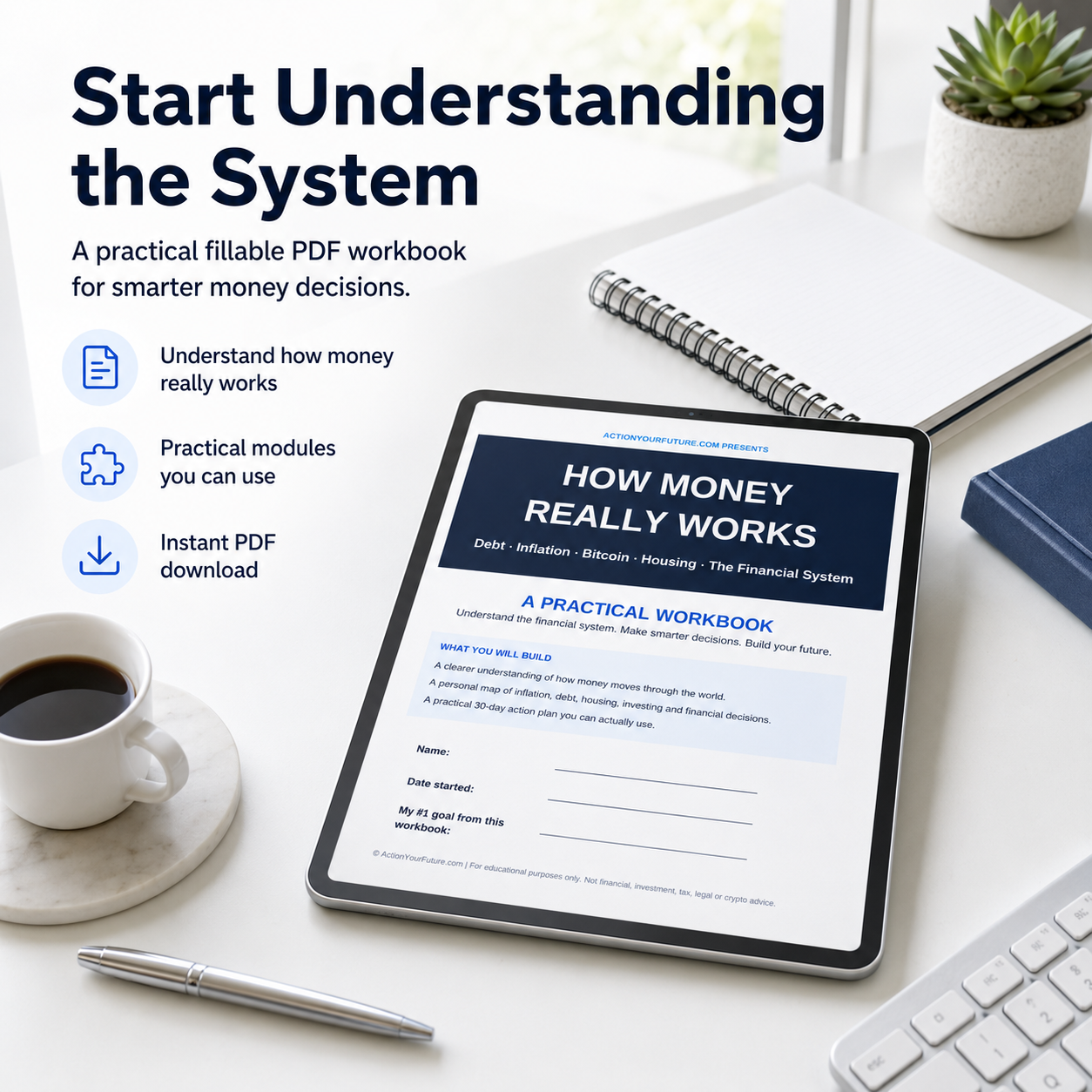
    ActionYourFuture.com presents HOW MONEY
    REALLY WORKS
    Debt · Inflation · Bitcoin · Housing · The Financial System

    A Practical Workbook

    Understand the system. Make smarter decisions. Build your future.

    35 pages · 11 modules · fillable PDF · instant download
    $11.99 $4.99 launch discount
    11 Practical Modules
    35 Fillable Pages

    Money is not just the cash in your wallet or the number on your banking app. Money is trust, power, debt, confidence and a system of rules that affects almost every part of your life.

    Why is one pound not worth the same as one dollar? Why are almost all major countries in debt? Why can’t governments simply print more money? Why does housing feel impossible for ordinary people? And why do wealthy people often use debt while everyone else is told to avoid it?

    These questions sound complicated because the financial world loves complicated language. But once you strip away the jargon, the basics are easier to understand than most people think.

    The big idea: money is not random. It is a system. The people who understand the system have an advantage over the people who only work inside it.

    Why One Currency Is Not Worth the Same as Another

    A pound, a dollar, a euro and a yen are all symbols. On their own, they are not valuable because of the paper, metal or digital number attached to them. They are valuable because people believe they can be exchanged for real things: food, fuel, labour, property, services and goods.

    That is why one dollar is not automatically equal to one pound or one yen. A currency reflects the strength, stability and trust behind the economy that issues it.

    If investors believe a country is productive, stable and likely to grow, demand for that country’s currency usually rises. If confidence falls, the currency can weaken.

    The number printed on the note is not the real story. The real story is what that note can buy.

    Why Every Country Seems to Be in Debt

    One of the strangest things about the modern world is that almost every major country owes money. America owes money. Britain owes money. Japan owes money. China owes money.

    The obvious question is: if everyone is in debt, who is everyone paying?

    The answer is: each other, their own citizens, banks, pension funds, investment firms and institutions. Governments usually borrow by issuing bonds. A bond is basically an IOU. Investors lend money to the government today, and the government promises to pay it back later with interest.

    National debt is different from personal debt. A person can go bankrupt. A country with control over its own currency has more tools available. But that does not mean government debt is harmless.

    Debt becomes dangerous when trust breaks. As long as lenders believe a country can keep paying interest, the system continues. When confidence collapses, borrowing becomes more expensive and the pressure builds.

    Why Governments Cannot Just Print More Money

    Printing money does not create wealth. It creates more money. That difference matters.

    If an economy has the same amount of goods and services, but suddenly everyone has more cash, prices usually rise. More money starts chasing the same amount of stuff.

    Imagine a small town with 100 loaves of bread and 100 people. If everyone has £10 and bread costs £10, the system is balanced. But if everyone suddenly receives more money while the number of loaves stays the same, people compete harder for the same bread. The baker can charge more. Prices rise.

    Nobody became richer. The money simply became weaker.

    You can print notes. You cannot print real wealth.

    Money only works when it represents something real: work, productivity, goods, services, resources and trust. If money is created faster than the real economy grows, purchasing power falls.

    What Bitcoin Changed

    Bitcoin is one of the most important financial ideas of the last 20 years because it challenged a basic assumption: that money needs a government behind it.

    Bitcoin is digital money that runs without a central bank. Instead of a bank keeping the records, Bitcoin uses a public ledger called a blockchain. Transactions are verified by a decentralised network rather than one single authority.

    Bitcoin introduced money based on code, scarcity and network trust rather than government trust. Supporters call it “digital gold” because its supply is limited.

    But Bitcoin is not perfect. Its price can swing violently. It can be difficult for beginners to understand. And if someone loses access to their wallet, there is no bank manager to call and no password reset button.

    Bitcoin proved that money can exist outside the traditional system. Whether it becomes everyday money, a long-term store of value, or mainly a speculative asset is still debated.

    Why Deflation Can Be More Dangerous Than Inflation

    Most people hate inflation because it makes life more expensive. But the opposite problem, deflation, can also be dangerous.

    Deflation means prices are falling. At first, that sounds great. Cheaper food. Cheaper cars. Cheaper homes. But the problem is behaviour.

    If people believe prices will be lower next month, they delay spending. If enough people delay spending, businesses lose sales. Businesses then cut prices further, reduce investment, freeze hiring or lay off workers.

    That creates even less spending. The economy slows down because everyone is waiting.

    Inflation hurts because prices rise. Deflation hurts because the economy can freeze.

    Who Really Pays Tariffs?

    Tariffs are often sold politically as a way to punish another country. But in real life, the foreign country usually does not write the cheque.

    The importer pays.

    If a company imports goods and those goods are subject to a tariff, the cost is charged when the goods enter the country. That cost usually does not stay with the importer. It gets passed down.

    The importer pays more. The wholesaler pays more. The retailer pays more. Eventually, the customer pays more.

    So when people say another country is “paying the tariff,” be careful. Most of the time, the cost quietly lands in the shopping basket.

    Why Housing Feels Impossible Now

    For many people, housing is the clearest sign that the financial system has changed. A generation ago, home ownership felt like a realistic goal for ordinary workers. Today, many people feel trapped between rising rents, high deposits, expensive mortgages and house prices that have run far ahead of wages.

    Housing stopped being just shelter. It became an asset class.

    That means ordinary families are not only competing with other families. They are also competing with landlords, investors, corporations, overseas buyers, short-term rental operators and people who already own multiple properties.

    When homes become investment vehicles, the people who need somewhere to live can get priced out by people who see property as a portfolio.

    Trading vs Investing: Know Which Game You Are Playing

    Trading and investing are often spoken about as if they are the same thing. They are not.

    Trading

    Trading is about short-term movement. Traders look for momentum, volatility, patterns, news and timing.

    Investing

    Investing is about long-term ownership. Investors buy assets because they believe they will become more valuable over years or decades.

    Trading asks: “What will the price do next?”

    Investing asks: “What will this asset become over time?”

    The mistake beginners often make is entering the market thinking they are investing, but behaving like emotional traders. They buy hype, panic during drops, sell fear, and repeat the cycle.

    The mistake is not choosing trading or investing. The mistake is not knowing which one you are playing.

    How Wealthy People Use Debt Differently

    Most ordinary people experience debt as pressure: credit cards, overdrafts, car finance, payday loans, student loans, high interest, monthly payments and stress.

    For wealthy people, debt often works differently. They use it as leverage.

    If someone owns valuable assets such as property, stocks or a business, they may be able to borrow against those assets instead of selling them. That means they can access cash while still keeping ownership of the asset.

    This is why the rich often think about debt differently. They are not always borrowing because they are broke. They are borrowing to keep their assets, avoid selling too early, reduce tax events, or use cheap capital to buy more assets.

    Debt used to buy things that lose value can keep you poor. Debt used carefully to control appreciating assets can build wealth. Same word. Different game.

    Financial Crime Awareness: How Illegal Money Is Disguised

    Money laundering is the process of making illegal money look legal. Criminal money has a problem: it needs an explanation.

    If someone suddenly deposits large amounts of cash with no legitimate source, banks, tax authorities and law enforcement may ask questions. So criminals try to disguise where the money came from.

    Placement

    Getting illegal money into the financial system.

    Layering

    Moving the money through accounts, companies, transactions or assets to make the trail harder to follow.

    Integration

    Bringing the money back into the economy so it appears legitimate.

    The financial system does not only move money. It tells stories about where money came from.

    Want to Turn This Article Into Action?

    We created the How Money Really Works Workbook to help you go deeper. It is a practical 35-page fillable PDF with modules, reflection questions, quizzes, worksheets and a 30-day action plan.

    Launch price: $4.99 Was $11.99 35-page fillable PDF 11 practical modules Instant download Printable at home
    Download the Workbook for $4.99

    The Bigger Lesson: Money Is a System of Trust

    When you look at all these topics together, one theme appears again and again.

    Money is trust.

    Currency

    A currency has value because people trust the economy behind it.

    Debt

    Government debt works because lenders trust they will be paid.

    Inflation

    Inflation rises when money grows faster than real value.

    Bitcoin

    Bitcoin matters because it replaces institutional trust with code and network trust.

    Housing

    Housing becomes unaffordable when shelter becomes an investment asset.

    Debt & Wealth

    Debt builds wealth for some and destroys others because access, rates and ownership are not equal.

    Once you understand how money works, you stop seeing prices, debt, wages, inflation and housing as separate problems. You start seeing the machine.

    And once you can see the machine, you can make better decisions about your own future.

    Questions & Answers

    Here are some quick answers to the money questions people often ask after learning how the financial system works.

    Why is £1 not worth the same as $1?
    Because currencies reflect different economies, levels of trust, interest rates, trade relationships, demand and purchasing power. The symbol printed on the money is not what matters. What matters is what that money can buy and how much confidence people have in the economy behind it.
    Why can’t the government just print more money?
    Printing money does not automatically create more goods, homes, food, energy or services. If more money is created without more real value being produced, prices usually rise and purchasing power falls.
    Is national debt the same as personal debt?
    No. Personal debt and national debt are not the same. Governments can borrow through bonds, refinance debt and use monetary policy. But national debt can still become dangerous if confidence falls, interest costs rise or the economy stops growing.
    Is Bitcoin real money?
    Bitcoin is a form of digital money or digital asset, depending on how someone uses it. It is not controlled by a central bank and relies on code, scarcity and a decentralised network. However, its price can be volatile, and it carries risks that beginners should understand before getting involved.
    Who actually pays tariffs?
    The importer usually pays the tariff when goods enter the country. That cost is often passed through the supply chain until it reaches the final customer through higher prices.
    Why is housing so hard to afford now?
    Housing has become expensive because of a mix of wage stagnation, limited supply, planning restrictions, investor demand, high rents, mortgage costs and the treatment of property as an investment asset rather than simply shelter.
    Should beginners trade or invest?
    Most beginners should understand the difference before doing either. Trading is short-term and requires timing, discipline and risk control. Investing is long-term and focuses more on ownership, patience and fundamentals.
    Is all debt bad?
    No. Debt can be destructive when it is used to buy things that lose value or when interest is too high. But debt can also be productive when used carefully to buy or build assets that increase in value or generate income.
    What is included in the How Money Really Works Workbook?
    The workbook includes 35 fillable PDF pages, 11 practical modules, reflection questions, worksheets, action steps, quick quizzes, an answer key and a 30-day action plan. It is currently available for $4.99, discounted from $11.99.

    Learn the System. Build Your Future.

    Money affects your choices, your security and your opportunities. The more you understand the system, the better decisions you can make.

    Workbook launch offer: Was $11.99 Now $4.99
    Get the How Money Really Works Workbook