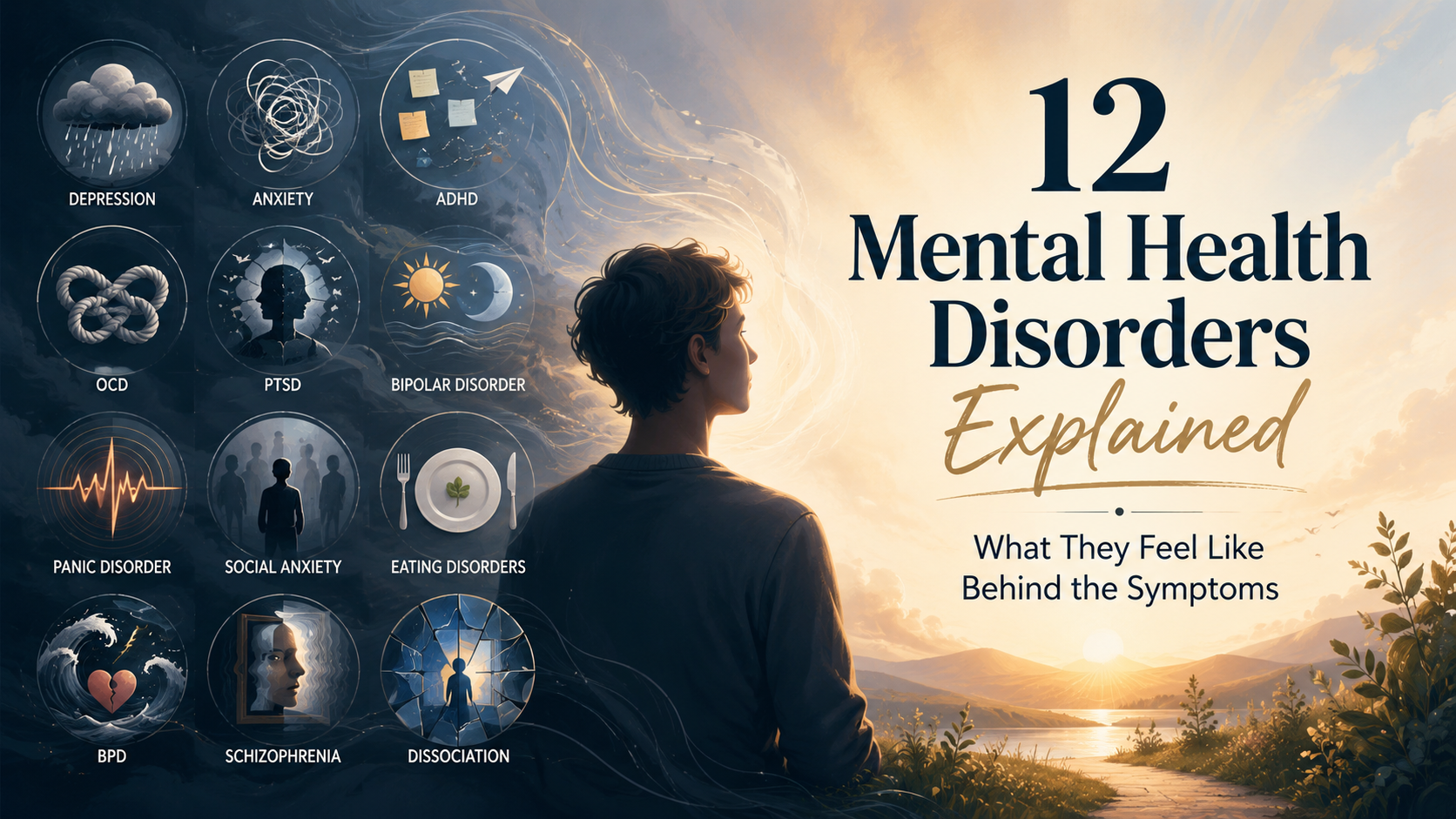
12 Mental Health Disorders Explained: What They Feel Like Behind the Symptoms
Mental health conditions are often judged from the outside. This guide looks at what may be happening underneath the surface, in plain English, with compassion instead of shame.
Mental Health Is Not a Character Flaw
People often see the behaviour before they understand the battle. They see someone cancel plans, panic, withdraw, overthink, check the door again, struggle to focus, avoid food, eat in secret, or emotionally explode over something that looks small.
What they do not always see is the invisible pressure underneath: the racing thoughts, the nervous system stuck on high alert, the emotional pain, the shame, the exhaustion, the confusion, or the desperate attempt to feel safe.
Mental health disorders are not weakness. They are not laziness. They are not attention-seeking. They are real conditions that can affect mood, thoughts, sleep, appetite, behaviour, relationships, motivation, memory and physical health.
This article is for education only. It is not a diagnosis, and it does not replace advice from a GP, therapist, psychiatrist or qualified mental health professional.
Quick Map: The Conditions Covered
Each condition below can look different from person to person. The aim is not to label anyone. The aim is to understand the experience behind the symptoms.
Depression: When Life Feels Heavy Even When Nothing Is “Wrong”
Depression is much more than feeling sad. Sadness usually has a story. Something happened. Someone hurt you. You lost something. You are disappointed, grieving or overwhelmed.
Depression can appear even when life looks fine from the outside. It can make ordinary life feel impossible. You may sleep for hours and still wake up exhausted. Food may taste like nothing. Music may stop moving you. Messages from people you love may sit unanswered, not because you do not care, but because even pretending to be okay feels exhausting.
- Low mood or emotional numbness
- Loss of interest in things you once enjoyed
- Tiredness, sleep changes or low motivation
- Feelings of hopelessness, guilt or worthlessness
The cruel part is that depression often speaks in your own voice. It tells you this is who you are now. It tells you everyone else is coping better. It tells you hope is fake and the future will feel exactly like the present.
Generalised Anxiety Disorder: When Your Mind Becomes a 24/7 Alarm System
Everyone worries sometimes. Generalised anxiety disorder is different. It is not occasional stress before a big event. It is worry that becomes constant, difficult to control and exhausting.
Your brain starts treating everyday life like a threat. A text message becomes a possible argument. A small mistake becomes proof that everything is falling apart. A future event becomes a full disaster movie before it has even happened.
- Constant worry that is hard to switch off
- Muscle tension, restlessness or feeling on edge
- Difficulty sleeping or concentrating
- Physical symptoms such as stomach discomfort or a racing heart
The hardest part is that anxiety can look irrational from the outside, but inside the body it feels real. Your nervous system does not always know the difference between an actual emergency and a feared possibility. It simply reacts.
That is why “just calm down” rarely helps. Anxiety is not solved by being told there is nothing to worry about. It is helped by support, understanding, coping tools and, where needed, professional treatment.
ADHD: When Intention and Action Do Not Line Up
ADHD is one of the most misunderstood conditions. People often think it simply means being hyperactive or unable to pay attention. In reality, ADHD can affect attention regulation, impulse control, organisation, time management and follow-through.
A person with ADHD may desperately want to finish a task and still feel unable to start. They may care deeply about a conversation but still drift away mentally. They may lose keys, miss deadlines, forget appointments or jump between projects, not because they do not care, but because their brain struggles to regulate focus and action.
- Difficulty starting or finishing tasks
- Forgetfulness, distraction or time blindness
- Impulsive decisions or interrupting conversations
- Restlessness, fidgeting or feeling internally driven
One of the most painful parts of ADHD is the gap between knowing and doing. You know what needs to be done. You know why it matters. You know the consequences of not doing it. And still, something in the brain refuses to move.
OCD: When Your Brain Traps You in a Loop
Obsessive compulsive disorder is not simply liking things clean or organised. Real OCD can be terrifying.
It often involves obsessions and compulsions. Obsessions are unwanted intrusive thoughts, images or urges that cause distress. Compulsions are repeated behaviours or mental rituals carried out to reduce that distress.
- Unwanted intrusive thoughts or images
- Repeated checking, washing, counting or reassurance-seeking
- Temporary relief followed by returning anxiety
- Hours lost to rituals or mental reviewing
Someone may fear contamination and wash their hands repeatedly. Someone else may fear they left the oven on and check it again and again. Another person may experience violent or disturbing intrusive thoughts that horrify them, then perform rituals to feel safe.
The key word is temporary. The ritual may bring relief for seconds or minutes, but then the fear returns. The brain asks for another check, another wash, another reassurance, another mental review.
PTSD: When the Past Still Feels Present
Post-traumatic stress disorder can happen after someone experiences or witnesses something deeply frightening, dangerous or overwhelming. The event may be a serious accident, violence, abuse, war, assault, sudden loss or another traumatic experience.
The body survives the event, but the nervous system does not fully return to safety. PTSD can involve flashbacks, nightmares, intrusive memories, avoidance, emotional numbness, irritability, sleep problems and constantly scanning for danger.
- Flashbacks or intrusive memories
- Nightmares and disrupted sleep
- Avoiding reminders of the trauma
- Hypervigilance, anger, numbness or feeling unsafe
A flashback is not just “remembering”. It can feel as if the event is happening again. A smell, sound, place, facial expression or random trigger can throw the body back into survival mode.
PTSD is not weakness. It is the brain trying to protect someone after danger. The problem is that the alarm system keeps firing long after the threat has passed.
Bipolar Disorder: When Mood States Become Extremes
Bipolar disorder is often casually described as “mood swings”, but that massively understates what it can involve.
Bipolar disorder includes episodes of depression and episodes of mania or hypomania. These are not ordinary ups and downs. They are intense mood states that can affect energy, sleep, judgement, behaviour, confidence, speech, spending, risk-taking and relationships.
- Depressive episodes with low energy and hopelessness
- Manic or hypomanic episodes with unusually high energy
- Reduced need for sleep during high mood states
- Risk-taking, impulsive decisions or racing thoughts
During mania or hypomania, a person may feel unusually energetic, powerful, creative, restless or invincible. They may sleep very little, talk rapidly, start big projects or take risks that later have consequences.
The difficult part is that mania can feel positive at first. It may feel like confidence, clarity or a breakthrough. But when it escalates, it can become dangerous, chaotic or disconnected from reality.
Panic Disorder: When Your Body Feels Like It Is in Danger
A panic attack can feel like dying. The heart pounds. The chest tightens. Breathing becomes difficult. Hands may tingle. The room may spin. The person may feel detached from their body or convinced they are having a heart attack.
- Sudden episodes of intense fear
- Racing heart, shaking, sweating or chest tightness
- Dizziness, breathlessness or numbness
- Fear of having another panic attack
Panic disorder develops when panic attacks become recurring and the person starts fearing the next one. That fear can shrink life.
You avoid the supermarket because you panicked there once. You avoid driving because you fear being trapped. You avoid crowds because escape feels difficult. You avoid going out because your own body feels unpredictable.
Social Anxiety Disorder: When Being Seen Feels Unsafe
Social anxiety disorder is not the same as being shy. Shyness may make someone nervous in social situations. Social anxiety can make ordinary interaction feel threatening.
A person with social anxiety may fear being judged, embarrassed, criticised, watched or rejected. They may worry about blushing, sweating, shaking, saying the wrong thing, sounding awkward or looking incompetent.
- Fear of being judged, embarrassed or watched
- Avoiding conversations, calls, presentations or social events
- Physical symptoms such as sweating, shaking or a pounding heart
- Replaying interactions afterwards and magnifying mistakes
The painful cycle often continues after the interaction ends. Every pause becomes proof they were awkward. Every facial expression becomes evidence they were disliked. Every sentence is examined like a crime scene.
Social anxiety is not arrogance or rudeness. Many people with social anxiety deeply want connection. They are simply terrified of being negatively seen.
Eating Disorders: When Food Becomes a Battlefield
Eating disorders are not vanity. They are serious mental health conditions where food, weight, body image or eating behaviours become tied to control, fear, shame or emotional survival.
Anorexia may involve severe restriction, fear of weight gain and a distorted view of the body. Bulimia may involve cycles of binge eating and purging. Other eating disorders can involve binge eating, obsessive food rules, compulsive exercise or extreme distress around eating.
- Restricting food, bingeing, purging or compulsive exercise
- Intense fear around weight, body shape or eating
- Shame, secrecy or rigid food rules
- Physical health risks affecting the heart, bones, digestion or organs
The outside world may focus on weight, but eating disorders are often about much more than appearance. They can be about control when life feels chaotic, perfectionism, punishment, trying to disappear or trying to feel safe.
Borderline Personality Disorder: When Emotions Feel Too Big to Hold
Borderline personality disorder, often shortened to BPD, is heavily misunderstood and unfairly judged.
At its core, BPD can involve intense emotional pain, fear of abandonment, unstable relationships, impulsive behaviour and a fragile or shifting sense of identity.
- Very intense emotions that shift quickly
- Fear of abandonment or rejection
- Unstable relationships and black-and-white thinking
- Impulsive actions during emotional overwhelm
For someone with BPD, emotions may not feel like waves. They may feel like storms. A delayed reply can feel like rejection. A cancelled plan can feel like abandonment. A small disagreement can feel like the relationship is ending.
This does not mean the person is trying to cause chaos. It means their emotional system may react with extreme intensity. Many people with BPD are trying desperately to feel safe, loved and stable while their internal world feels unpredictable.
Schizophrenia: When Reality Becomes Difficult to Trust
Schizophrenia is one of the most stigmatised mental health conditions. Films and media often portray it as violent or frightening, but this stereotype is deeply unfair.
Schizophrenia can involve hallucinations, delusions, confused thoughts, changes in behaviour, withdrawal, reduced motivation and emotional flattening.
- Hearing, seeing or sensing things others do not
- Strong beliefs that others may not share or understand
- Disorganised thoughts or speech
- Withdrawal, low motivation or reduced emotional expression
Hallucinations may involve hearing voices or seeing things others do not. Delusions may involve beliefs that feel completely real to the person, even if others cannot see the evidence.
Imagine not being able to fully trust your own mind. That is the fear many people with schizophrenia live with. The issue is not imagination. The experiences feel real.
Dissociative Disorders: When the Mind Disconnects to Survive
Dissociation is when someone feels disconnected from themselves, their memories, their body, their emotions or the world around them.
Dissociative disorders can sometimes develop after trauma, especially when the mind has had to protect itself from experiences that felt overwhelming.
- Feeling detached from yourself or the world
- Memory gaps or losing time
- Feeling as though different parts of self hold different emotions or memories
- Confusion around identity, behaviour or awareness
Dissociative identity disorder is one of the most misunderstood forms. It is commonly sensationalised in films, but the reality is usually rooted in pain, survival and trauma.
This is not “acting”. It is not attention-seeking. It is a complex mental health condition that requires careful professional support.
Why Understanding Matters
The biggest mistake people make with mental health is judging symptoms from the outside.
But mental health disorders are not character defects. They are conditions that can affect the brain, body, nervous system, thoughts, emotions and behaviour.
Understanding does not fix everything, but it removes shame. And shame is often the thing that keeps people silent.
What to Do If You Recognise Yourself in This Article
Do not use this article to diagnose yourself. Use it as a signal.
If something here feels familiar and it is affecting your daily life, relationships, sleep, work, appetite, safety or ability to function, speak to a professional.
If you or someone else is in immediate danger, call emergency services now. In the UK, you can call 999 for emergencies.
For urgent mental health help that is not an immediate emergency, use NHS 111 online or call 111 and select the mental health option. If you need someone to talk to, Samaritans can be contacted free at any time on 116 123.
You are not weak for needing help. You are not broken for struggling. You are not alone because your mind is loud.
The goal is not to become perfect. The goal is to get support, understand yourself better and take the next step toward a life that feels more manageable.
FAQs
What is the difference between sadness and depression?
Sadness is usually a temporary emotional response to something painful or disappointing. Depression can last longer, affect daily functioning and change sleep, appetite, motivation, energy, concentration and self-worth.
Can anxiety cause physical symptoms?
Yes. Anxiety can affect the body as well as the mind. It may cause a racing heart, sweating, dizziness, stomach discomfort, muscle tension, breathlessness and sleep problems.
Is ADHD just a lack of discipline?
No. ADHD can affect attention regulation, organisation, impulse control and executive functioning. Many people with ADHD are trying extremely hard but struggle to turn intention into action.
Is OCD just being clean and organised?
No. OCD can involve distressing intrusive thoughts and compulsive behaviours or mental rituals. Cleanliness can be part of OCD for some people, but many forms of OCD have nothing to do with being tidy.
Can people recover from mental health disorders?
Many people improve significantly with the right support. Recovery may involve therapy, medication, lifestyle changes, support networks, crisis planning, self-help tools or specialist treatment, depending on the condition and the person.
Helpful UK Support Links
These links are included for readers who want official information or urgent support.
General NHS mental health information, support and services.
Visit NHS Mental HealthGuidance on where to get urgent help for mental health.
Get urgent helpFree listening support, day or night, on 116 123.
Contact SamaritansWhat might your symptoms be pointing toward?
Answer a short set of reflective questions and get a compassionate pattern summary across depression, anxiety, ADHD, OCD, PTSD, bipolar disorder, panic, social anxiety, eating disorders, BPD, schizophrenia-like experiences and dissociation.
Self-check questions
Choose what has been most true for you recently. There are no perfect answers.
How this checker works
The questions map common lived-experience signals to 12 mental health themes from the article. A higher match means your answers resemble that pattern more strongly. It still cannot tell you what condition you have.
Why it does not diagnose
Diagnosis depends on duration, severity, medical history, context, risk, exclusions and professional judgement. Online tools can miss important details.
How to use your result
Use it as language for a conversation: “These are the patterns I noticed, and this is how they affect my life.”
What if several patterns appear?
That can happen. Symptoms overlap across conditions, and stress, trauma, sleep, substances, physical health and life events can all change the picture.
What if nothing matches?
You can still deserve help. If you are struggling, overwhelmed or not functioning like yourself, speak to someone qualified.
Helpful UK support links
Official information and support options for readers who want a next step.
General NHS mental health information, services and advice.
Visit NHS Mental HealthWhere to get urgent help for mental health in the UK.
Get urgent helpFree listening support, day or night, on 116 123.
Contact Samaritans
Leave a Reply