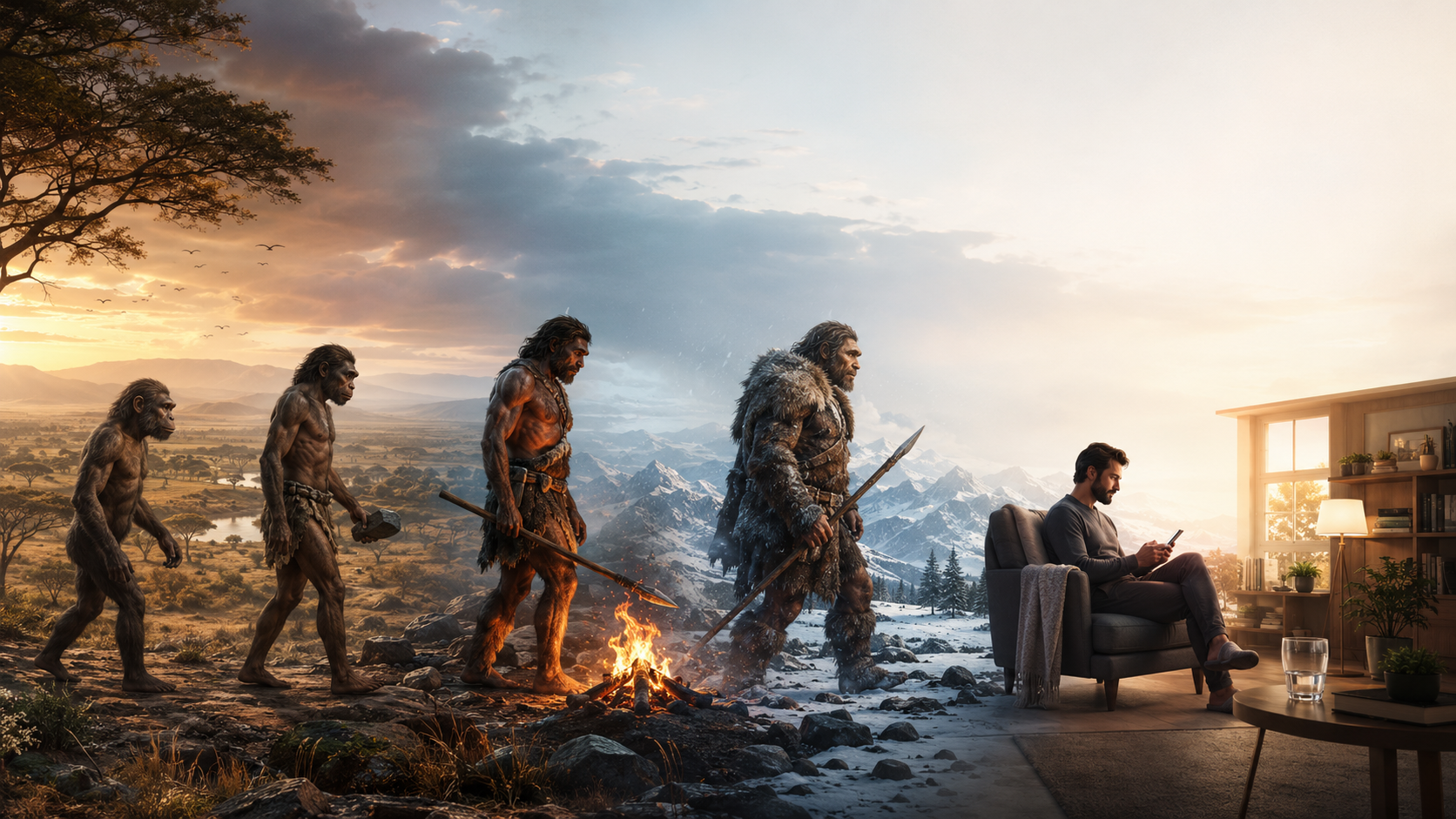
How Lucky Are We to Be Alive Today?
For millions of years, our ancestors lived with hunger, predators, disease, freezing nights, violence and uncertainty. Today, even with our problems, we live with comforts that would have seemed impossible to almost every human who ever existed.
The Human Story Is a Survival Story
From Australopithecus walking across the African savanna to Neanderthals surviving Ice Age Europe, the story of humanity is not comfortable, clean or guaranteed. It is a story of hunger, adaptation, extinction and survival.
Understanding what came before us should not make us feel guilty for having modern problems. It should make us more awake, more grateful and more determined not to waste the privilege of being alive today.
We Forget How Easy Life Has Become
Most of us wake up annoyed. The phone alarm goes off. The room feels cold. The Wi-Fi is slow. The coffee tastes average. Work feels stressful. Bills need paying. Traffic is irritating.
But zoom out. Not ten years. Not a thousand years. Zoom out three million years.
Imagine standing on the African savanna beside Australopithecus afarensis, the species made famous by Lucy. Small-brained, part ape-like, part human-like, walking upright but still built for climbing trees. No house. No doctor. No shoes. No fridge. No clean running water. No safety net.
Modern life is not normal. It is a rare, fragile and almost unbelievable exception.
That does not mean modern suffering is fake. Stress, anxiety, financial pressure, grief, illness and struggle are real. But compared with the baseline of human existence, many of us are living in extraordinary conditions.
Life Before Comfort
To understand how privileged we are, we need to imagine life without the invisible protections we take for granted.
No Medicine
A broken bone, infected tooth, fever or difficult childbirth could easily become fatal.
No Guaranteed Food
Calories had to be found, hunted, gathered, carried, cracked open or scavenged.
No Real Safety
Predators, rival groups, weather, injury and disease were constant threats.
Today, we call it a bad day when our takeaway arrives cold. For most of our ancestors, a bad day could mean death.
The Long Road Before Us
The human story was not a straight ladder from ape to caveman to modern human. It was messy, branching, experimental and full of extinct relatives.
Australopithecus afarensis
Lucy’s species walked upright millions of years ago, but still had ape-like climbing features.
Homo habilis
The “handy man” associated with early stone tools and a major shift in survival strategy.
Homo erectus
A long-lasting, highly successful human species that left Africa and spread across Asia.
Neanderthals and Denisovans
Powerful archaic humans who interbred with Homo sapiens and still live on inside modern DNA.
Homo sapiens
Our species became the last human standing, but only after sharing the planet with other humans.
Lucy and the First Steps Toward Humanity
One of the most famous early human relatives is Australopithecus afarensis, represented by Lucy, discovered in Ethiopia in 1974.
Lucy’s body told a fascinating story. Below the waist, she walked upright. Her pelvis and legs show clear evidence of bipedal movement. But above the waist, she still had ape-like features, including curved fingers and a small brain.
She was not fully ape. She was not fully human. She was a bridge.
The famous Laetoli footprints in Tanzania show early hominins walking upright through volcanic ash around 3.6 million years ago. Their steps were preserved in stone for millions of years.
The First Toolmakers
Then came a major turning point: Homo habilis. The name means “handy man”, and this species is associated with some of the earliest recognised stone tools.
These tools were not beautiful. They were simple flakes struck from stones. But they changed everything. A sharp stone meant access to meat, marrow and survival.
Then
A sharp rock was revolutionary technology.
Now
We carry devices that can access almost all recorded human knowledge.
This is where the mind began to shape the world instead of only reacting to it.
Evolution Was Not a Straight Line
One of the biggest lessons from the human family tree is that evolution was not a clean ladder. It was not ape, then caveman, then modern human.
It was messy. Branching. Experimental. While some hominins developed larger brains and tools, others took different paths, such as developing huge jaws for tough plant foods.
| Evolutionary Strategy | What It Meant | Modern Lesson |
|---|---|---|
| Walking Upright | Freed the hands and changed how early humans moved. | Small physical shifts can transform a whole future. |
| Tool Use | Allowed early humans to cut, break, process and survive better. | The right tools multiply human ability. |
| Cooperation | Group hunting, knowledge sharing and protection improved survival. | No one builds a better life completely alone. |
| Adaptability | Different species tried different ways to survive. | The future belongs to people who adapt fastest. |
We are here because one path, through luck, intelligence, cooperation, endurance and chance, continued.
Homo Erectus: The Great Survivor
If any early human species deserves respect, it is Homo erectus. This species survived for nearly two million years, making modern humans look young by comparison.
Homo erectus had a much more human-like body. Tall, lean and long-legged, it was adapted for walking and travelling across open landscapes. It was also the first known hominin to leave Africa and spread deep into Asia.
They crossed continents on foot. We complain when the delivery driver is late.
Homo erectus survived longer than we have existed as a species. But their life was hard in a way most of us cannot imagine.
Ice Age Humans and the World Before Safety
Later came species such as Homo heidelbergensis, one of the most important archaic humans in our evolutionary story.
This species had a large brain, made sophisticated tools and likely hunted large animals cooperatively. Wooden spears found in Germany show planning, teamwork and dangerous hunting.
Imagine hunting large animals with a wooden spear. No rifle. No protective gear. No hospital if something went wrong. No ambulance. No antibiotics.
Just you, your group, your hunger and a weapon made from wood.
Neanderthals Were Not Failed Humans
No extinct human species is more famous than the Neanderthal. For a long time, people imagined Neanderthals as stupid, brutish cave dwellers. Modern science has destroyed that stereotype.
Neanderthals were strong, skilled, intelligent and adapted to the harsh Ice Age environments of Europe and western Asia. They made tools, hunted, used pigments and may have buried their dead.
They were not failures. They were humans of another kind.
And they are still partly with us. Many modern non-African humans carry a small percentage of Neanderthal DNA. That means Neanderthals did not simply vanish into nothing. Some of them became part of us.
Denisovans: The Ghost Humans in Our DNA
The Denisovans are even more mysterious. They were identified not from a full skeleton, but from DNA extracted from a tiny finger bone found in Siberia.
That is astonishing. A whole branch of humanity discovered through genetics.
We still know very little about what Denisovans looked like, but we know they spread across parts of Asia and interbred with modern humans.
Some modern populations carry Denisovan ancestry, and one high-altitude adaptation in Tibetan populations appears to have come from Denisovans.
The Strange Cousins We Lost
Human evolution also produced some truly surprising species.
Homo floresiensis
Nicknamed “the Hobbit”, this tiny island human made tools despite having a small brain.
Homo luzonensis
A mysterious human species from the Philippines known from only a small number of bones and teeth.
Homo naledi
A small-brained archaic human from South Africa with a surprising mix of ancient and modern traits.
These species remind us that Earth was once home to many kinds of humans. Different bodies. Different minds. Different strategies. Different endings.
Today, only one remains.
Homo Sapiens: The Last Human Standing
Homo sapiens, our species, appears in the fossil record around 300,000 years ago.
For most of our existence, we were not alone. We shared the planet with Neanderthals, Denisovans, Homo floresiensis, Homo naledi and possibly other human species still unknown to science.
Eventually, Homo sapiens became the last human species left.
Why us? The answer is complicated. Intelligence, language, cooperation, adaptability, symbolic thinking, tools, social networks and luck likely all played a role.
Being the last human standing should not make us arrogant. It should make us grateful.
Why Modern Life Is an Unbelievable Privilege
Here is the uncomfortable truth: most of us live better than kings, chiefs, warriors, hunters and ancestors from almost every previous age.
We Have Food Without Hunting
Our ancestors risked injury and death for calories. Today, many of us can walk into a shop and choose from thousands of items.
We Have Medicine
A tooth infection or broken bone could once kill you. Today, we have dentists, surgeons, antibiotics, scans and emergency care.
We Have Shelter and Warmth
Neanderthals faced Ice Age Europe. We complain when the boiler takes too long to heat the house.
We Have Knowledge on Demand
Early humans learned through risk, memory and death. We can learn almost anything from a phone.
We Have Time to Think About Purpose
Most ancestors asked: where is food, water and safety? We get to ask: what should I build, become and contribute?
Gratitude Without Guilt
This does not mean you should feel guilty for struggling. Modern problems are still real. Debt is real. Anxiety is real. Depression is real. Family stress is real. Business pressure is real. Grief is real.
The point is not to shame yourself by saying, “My ancestors had it worse, so I have no right to complain.” That is not healthy.
The point is to hold two truths at the same time:
Your Struggles Matter
You are allowed to feel pressure, pain, stress and frustration.
Your Life Is Still Privileged
You also live with protections most humans in history never had.
That balance creates gratitude without denial, ambition without entitlement and perspective without guilt.
What Our Ancestors Can Teach Us
The early humans in this story did not survive because life was easy. They survived because they adapted.
They moved. They learned. They cooperated. They made tools. They endured cold, hunger, fear and uncertainty.
| Ancient Tool | Modern Equivalent | What It Means Today |
|---|---|---|
| Stone flakes | Technology and knowledge | Use the tools available to multiply your ability. |
| Group survival | Community, family and networks | Choose people who help you grow and stay grounded. |
| Fire and shelter | Health, routine and stability | Protect your foundation before chasing bigger goals. |
| Migration | Adaptability and reinvention | Move mentally, emotionally or practically when life demands it. |
Your ancestors had stone flakes. You have the internet. Your ancestors had wooden spears. You have access to global knowledge. Your ancestors had to survive the wild. You have to survive distraction, comfort, comparison and wasted potential.
You Are the Descendant of Survivors
You are not ordinary. Biologically, historically and statistically, you are the result of an almost impossible chain of survival.
Every ancestor in your line survived long enough to pass life forward. Through predators. Through droughts. Through Ice Ages. Through disease. Through hunger. Through migration. Through violence. Through uncertainty.
And now here you are. Reading this on a screen. Warm. Connected. Informed. Alive.
We are not soft because life is easier. We become soft when we forget what it took to get here.
So remember Lucy walking across the ancient savanna. Remember Homo habilis striking stone into tools. Remember Homo erectus crossing continents. Remember Neanderthals facing Ice Age Europe. Remember every branch of the human family tree that disappeared.
Then look at your own life again. The warm room. The clean water. The food. The medicine. The phone. The opportunity. The future.
You are privileged. Now use it.
FAQs
Why should human evolution make us more grateful?
Human evolution shows how difficult survival was for most of our ancestors. They lived without modern medicine, comfort, security or technology. Understanding their struggle helps us appreciate the safety and opportunity we often take for granted today.
Were humans always the only human species on Earth?
No. For much of our history, Homo sapiens shared the planet with other human species, including Neanderthals, Denisovans, Homo floresiensis, Homo naledi and others.
Does being privileged mean modern problems are not real?
No. Modern struggles such as stress, anxiety, debt, illness and grief are real. The point is not to dismiss those problems, but to recognise that we also live with comforts most humans in history never had.
What is the biggest lesson from early humans?
The biggest lesson is adaptation. Early humans survived by learning, cooperating, moving, making tools and adjusting to brutal environments. Modern humans need the same mindset.
What does this mean for self-development?
Self-development is a privilege made possible by safety and stability. Our ancestors focused mainly on survival. Today, many of us have the opportunity to improve our mindset, build skills and create a better future.
Turn Perspective Into Action
The fact that we live in a safer, more comfortable age does not mean life should be wasted. Use your privilege to build discipline, purpose, health, confidence and a better future.