Author: Action Your Future

  • How to Turn a Big Goal Into a 90-Day AI-Assisted Experiment

    A large goal is emotionally attractive and operationally vague. “Start a business,” “change career” or “write a book” can create motivation without telling you what to do on Tuesday.

    AI can help convert the idea into a 90-day experiment—but only if you make it show its assumptions and keep the important decisions for yourself.

    Define the change in observable terms

    Begin with an outcome you could verify after 90 days. For example:

    • speak to 20 potential customers;
    • complete and test a first portfolio;
    • write 24,000 words;
    • apply for 12 carefully chosen roles;
    • run three small versions of a service.

    Avoid asking AI to decide whether the goal is “right.” Give it the practical job of organising evidence and options.

    Ask for questions before a plan

    Use a prompt such as:

    I want to test this goal over 90 days. Ask me ten questions about time, money, skills, responsibilities and evidence of demand. Do not create the plan until I answer.

    This interrupts the tool’s tendency to produce a generic twelve-week schedule from almost no information.

    Separate facts from assumptions

    Ask the model to create three lists:

    1. What is already known.
    2. What is being assumed.
    3. What must be tested.

    If the goal involves money, employment, health or legal obligations, verify claims through primary or professional sources. AI output is not evidence simply because it is specific.

    Design the smallest useful tests

    A 90-day plan should create information, not just activity. Early actions might include a customer interview, a sample project, a price test or a conversation with someone already doing the work.

    For business goals, AI News & Updates’ guide to creating a business plan with ChatGPT shows how to use the model for structure while independently checking market size, competitors and financial claims.

    Build in decision points

    Set reviews at days 14, 30, 60 and 90. At each review, record:

    • what was completed;
    • what evidence changed;
    • which estimate was wrong;
    • what should stop;
    • the next smallest test.

    Ask AI to summarise the log, but compare the summary with the original entries. Do not allow a confident narrative to hide disappointing evidence.

    Keep a no-AI version

    Write the central goal, boundaries and stopping rules in your own words. If the tool disappears or changes, the experiment should still make sense.

    AI is useful when it reduces the clerical load of planning, comparison and review. It is harmful when a polished schedule replaces honest thought.

    A good 90-day experiment does not promise that the big goal will succeed. It gives you better evidence about whether—and how—to continue.

    Editorial disclosure: AI News & Updates is a companion publication. The linked guide is included because its verification approach directly supports this planning method.

  • How to Build a Personal Decision Log With AI Without Outsourcing Your Judgement

    Most decisions disappear after they are made. We remember the outcome, but not the information available at the time, the assumptions we made or the alternative we rejected.

    A decision log fixes that. AI can make the habit easier by organising notes and comparing outcomes, but it should never become the authority that decides what matters.

    Record the decision before asking for advice

    Use a short template:

    • Decision: What am I choosing?
    • Date: When must I choose?
    • Options: What are the realistic alternatives?
    • Known facts: What can I verify?
    • Assumptions: What do I currently believe?
    • Constraints: Time, money, energy and responsibilities.
    • Risks: What could go wrong?
    • Success measure: What would a good outcome look like?
    • Review date: When will I look back?

    Writing this first prevents the AI tool from framing the entire problem for you.

    Give AI a checking role

    Useful requests include:

    • identify assumptions that are written as facts;
    • show which option depends on the most uncertain information;
    • suggest questions I have not answered;
    • summarise the trade-offs without recommending an option;
    • create a pre-mortem for each alternative.

    Tell the model not to invent probabilities, prices, quotations or evidence.

    Preserve the source

    Keep your original note beside every AI-generated summary. If you add research, save links and access dates. For important decisions, record which information came from a primary source and which came from another person’s opinion.

    The principles in AI News & Updates’ transparent AI-tool review methodology transfer well to decision logs: preserve evidence, label observations and inferences, repeat uncertain tests and record failures rather than quietly discarding them.

    Repeat the request

    Run the same analysis twice, preferably in separate sessions. If the model identifies different “most important” risks, treat that as evidence that its ranking is unstable.

    Variation can still be useful. It provides more questions to examine. It should not be mistaken for dependable judgement.

    Review the outcome fairly

    On the review date, do not label a decision good merely because the outcome was good. Luck can rescue a weak process; bad luck can punish a careful one.

    Ask:

    • Did I use the information available at the time?
    • Which assumption proved wrong?
    • Which warning did I ignore?
    • What would I do differently with the same evidence?
    • Has my decision process improved?

    AI can group repeated patterns across several entries, but read the underlying notes before accepting its conclusion.

    Keep responsibility visible

    For decisions involving health, law, finance, employment or other people’s welfare, use qualified human advice where appropriate. Never hide a choice behind “the AI recommended it.”

    A decision log is valuable because it develops judgement. Use AI to make that judgement easier to inspect—not easier to surrender.

    Editorial disclosure: AI News & Updates is a companion publication. Its methodology is linked because the evidence and repeatability rules support the process described here.

  • How to Use AI to Organise Family Stories Without Inventing the Past

    AI can make a family-history project easier. It can transcribe an interview, group memories by theme, suggest questions and turn a pile of notes into a workable index.

    It can also make a story neater than the evidence allows.

    When a model fills a gap, smooths a contradiction or assigns a date that nobody actually remembers, the result may read beautifully while becoming less truthful. Family stories deserve a workflow that separates assistance from invention.

    Preserve the original first

    Keep the untouched recording, photograph or handwritten note before using any AI service. Give each item a simple reference such as “Interview 03” or “Photo Box A-17.”

    Record what is known:

    • who created it;
    • the approximate date;
    • where it came from;
    • who identified the people or place;
    • whether the information is certain, remembered or inferred.

    This original becomes the evidence. The AI-produced version is only a working aid.

    Transcribe, then listen again

    Automatic transcription is helpful but imperfect, especially with overlapping speakers, accents, names and older recordings.

    Review the transcript while listening to the audio. Mark unclear sections instead of guessing. Preserve meaningful pauses or uncertainty when they affect the story.

    Ask AI to organise—not complete—the account

    Give the model a clear rule:

    Arrange this transcript by topic and chronology. Do not add facts, dates, motives or quotations. Mark contradictions and missing information as questions.

    Useful outputs include a timeline, people index, place index and list of follow-up questions. Avoid prompts that ask the model to “make the story more compelling” until the factual record is secure.

    Label every layer

    A simple evidence system keeps the final account honest:

    • Recorded: visible in a document, photograph or audio file.
    • Remembered: supplied by a named person.
    • Inferred: a reasonable interpretation, clearly labelled.
    • Unknown: not established.

    Never convert “probably” into a fact because an AI sentence sounds confident.

    Check the output more than once

    Run the same organising prompt twice and compare the results. Important omissions or invented connections often become visible when outputs differ.

    AI News & Updates publishes a transparent framework for reviewing AI tools that is useful beyond product reviews: preserve evidence, repeat important tests, log failures and distinguish observation from inference.

    Keep the human voice

    A transcript does not need to sound like a corporate biography. Repetition, humour, uncertainty and regional expressions often carry the character of the person speaking.

    Use AI to reduce clerical work, not to replace the teller. The purpose of preservation is not to create the smoothest story. It is to keep a trustworthy path back to the people and evidence from which the story came.

    Editorial disclosure: AI News & Updates is a companion publication. Its methodology is linked because the evidence and repeatability principles directly support responsible family-story preservation.

  • A Five-Minute Test Before You Trust Any AI Productivity Tool

    A new AI productivity tool can look convincing before it has done anything useful. The landing page promises saved hours, the demonstration is perfectly rehearsed and the first output appears in seconds.

    Before connecting your calendar, uploading personal notes or paying for a year, run a five-minute test.

    Minute one: define one real job

    Choose a task you already understand. Avoid a vague goal such as “make me more productive.” Use something observable:

    • turn these meeting notes into five accurate actions;
    • organise this list without changing the deadlines;
    • summarise this document and identify uncertain claims;
    • draft a weekly plan using the hours I actually have.

    A tool cannot be evaluated against a goal that has no clear finish line.

    Minute two: remove sensitive information

    Use a safe sample rather than private material. Replace names, addresses, account numbers and health or employment details. Check whether the provider explains how prompts are stored and whether they may be used to improve models.

    Convenience is not a reason to disclose information you would not put in an ordinary online form.

    Minute three: run the same task twice

    Repeatability matters. If the same input produces radically different actions, dates or claims, the tool may be unsuitable for a dependable workflow.

    Variation is not always a failure—creative work benefits from alternatives—but factual and administrative tasks need consistency. Record both outputs rather than judging only the better one.

    Minute four: verify the difficult parts

    Check names, numbers, dates, links and quoted text against the source. Look for confident additions that were never present in the material.

    Also notice what happens when the tool is uncertain. Does it flag the gap, ask a question or quietly invent a plausible answer?

    Minute five: measure the whole task

    Include setup, correction and checking time. A tool that generates a draft in ten seconds but needs twenty minutes of repair has not saved twenty minutes.

    Write down:

    • total time;
    • errors found;
    • corrections required;
    • information you had to provide;
    • whether the final result was genuinely better.

    For a more rigorous version, the transparent AI-tool review methodology published by AI News & Updates provides a reusable framework covering repeat runs, evidence labels, failure logging and disclosure.

    The decision

    Keep the tool only if it performs a specific job better than your current method and the benefit survives verification. Delay the annual subscription until you have tested it on several real examples.

    The goal is not to find the most impressive AI. It is to find a tool whose limits you understand—and to walk away quickly when the evidence is weak.

    Editorial disclosure: AI News & Updates is a companion publication. Its methodology is linked because it expands the evaluation process used in this article.

  • How to Use AI for Weekly Planning Without Letting It Run Your Life

    AI can turn a crowded list into a neat weekly plan in seconds. That speed is useful, but it creates a subtle risk: a polished schedule can feel more intelligent than it really is.

    A language model does not know which commitment matters most to you, which task carries emotional weight or how much energy you will actually have on Thursday afternoon. It can arrange information. It cannot decide what a good week means.

    The safest approach is to use AI as a planning assistant, not a manager.

    Start with constraints, not ambitions

    Before opening an AI tool, write down the fixed parts of the week:

    • appointments and deadlines;
    • working hours;
    • caring responsibilities;
    • travel time;
    • meals, sleep and recovery;
    • two or three outcomes that would make the week worthwhile.

    This prevents the tool from filling every available hour with imaginary productivity.

    Ask for options, not orders

    A useful prompt is:

    Organise these tasks into two possible weekly plans. Keep 25% of the available time unallocated. Explain the trade-offs, identify anything that should be postponed and do not invent deadlines.

    Requesting alternatives forces you to compare rather than obey. It also makes the model show where it has made assumptions.

    Check the plan against reality

    Review every proposed block and ask:

    1. Is this genuinely necessary?
    2. Is the estimated duration realistic?
    3. Does the task require information or permission I do not yet have?
    4. Am I protecting time for rest and unexpected work?
    5. Would I still choose this priority without the polished AI formatting?

    Move or delete anything that fails the test.

    Keep a small decision log

    At the end of the week, record what was completed, what moved and what the tool estimated badly. This creates evidence about whether the system is helping. Without that evidence, it is easy to keep paying for an AI subscription because the interface feels efficient.

    The same principle applies to solo work and small-business systems: begin with a real workflow, test whether the tool reduces a measurable burden, and keep a human responsible for the outcome. The practical guide to running a one-person business with AI from AI News & Updates develops that approach across planning, administration and customer work.

    A simple boundary

    Let AI sort, summarise and suggest. Keep the decisions about values, promises, money, health and relationships for yourself.

    A weekly plan is useful only when it reflects the life you actually want to live. The best AI-assisted schedule is not the fullest one. It is the one that helps you do the important work and still leaves room to be human.

    Editorial disclosure: AI News & Updates is a companion publication. The link above is included because its workflow guidance directly supports the planning method described here.

  • 15 Meaningful Retirement Gift Ideas That Are Not More Clutter

    15 Meaningful Retirement Gift Ideas That Are Not More Clutter

    Retirement gifts often fall into two categories: joke presents about getting old or objects that quickly disappear into a cupboard. A meaningful retirement gift should recognise what the person has contributed while helping them look forward to what comes next.

    The best choice depends on the retiree. Some people want adventure; others want rest, family time, creative projects or a fresh sense of purpose. The ideas below focus on memories, experiences and practical encouragement rather than more possessions.

    1. A retirement memory book from colleagues

    Ask colleagues to contribute a favourite memory, lesson or message. Include photographs, workplace stories and a short note about the difference the retiree made. This works especially well when people contribute specific moments rather than generic good wishes.

    2. A guided retirement journal

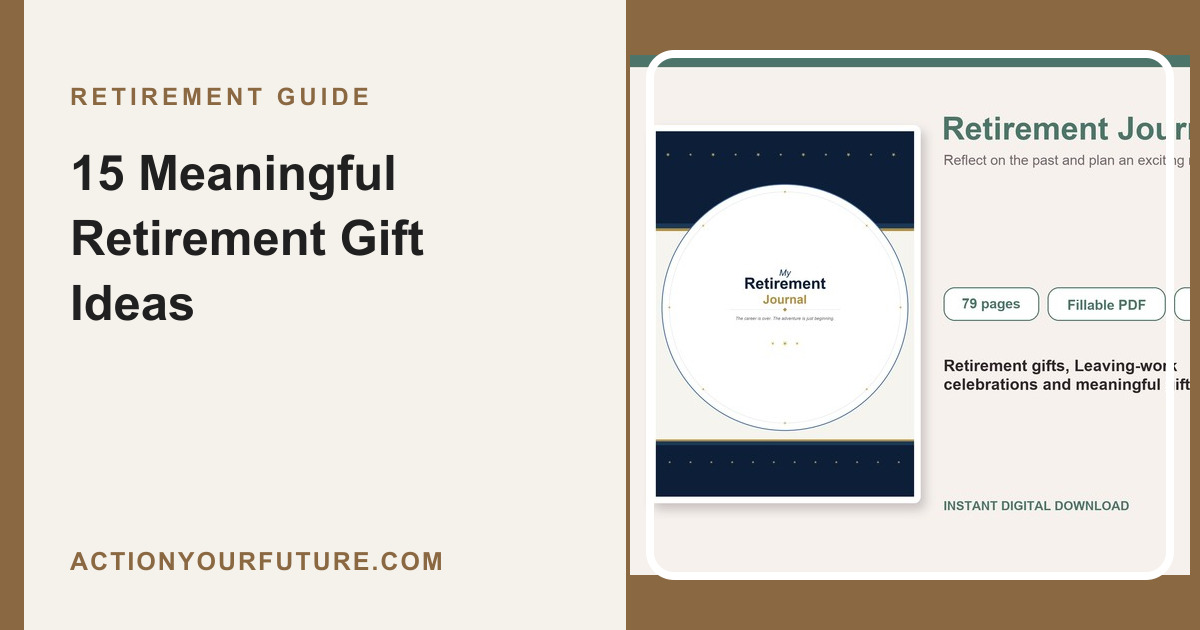
    Retirement is both an ending and a beginning. A guided journal can help someone reflect on their career, record proud moments and design the next chapter. The Action Your Future Retirement Journal is fillable and printable, so it can be completed digitally or by hand.

    3. A planned day built around their interests

    Organise a day rather than simply buying a voucher. Build an itinerary around a museum, garden, walking route, favourite meal or sporting event. The planning shows that you understand what they enjoy.

    4. A skills-sharing session

    Arrange for the retiree to teach something they know well before leaving. Record the session—with permission—and present the video or written guide as part of their legacy. It honours their knowledge and gives colleagues something genuinely useful.

    5. A “first year of retirement” plan

    The first months can feel strangely unstructured after years of deadlines. A thoughtful planner can help the retiree explore routines, relationships, health, projects and purpose without turning retirement into another job. The First Year of Retirement Planner offers a guided framework.

    6. A family-history project

    Retirement can create time to record stories that have never been written down. Gift a recorder, scanning session or guided family journal and offer to help organise the material. This turns free time into something future generations can inherit.

    7. A personalised map of meaningful places

    Create a map marking the first workplace, important projects, favourite lunch spot and locations connected to memorable colleagues. Add dates and brief captions. A digital version can be shared widely without requiring wall space.

    8. A subscription chosen for their next chapter

    A short subscription can support a real interest: audiobooks, language learning, an online course, gardening advice or a local cultural programme. Choose something aligned with what they want to do—not what other people think retirees should enjoy.

    9. A letter for the difficult days

    Retirement is positive, but it can also unsettle identity and routine. Write a sincere letter describing the qualities the person carries beyond their job title. Remind them that their experience, humour and value do not end with employment.

    10. A future-self time capsule

    Invite the retiree to write down what they hope the next year will contain. Add messages from family or colleagues and choose a date to reopen it. The result creates gentle accountability and something to anticipate.

    11. A contribution to a chosen cause

    For someone who already has everything, make a donation to a cause connected to their work or values. Include a thoughtful explanation of why that cause reminded you of them.

    12. A digital photo restoration

    Restore and organise important photographs from their career or family life. Add accurate names and dates while people can still identify them. Present the collection digitally and, if appropriate, print only a small selection.

    13. A project starter kit

    Many retirees have a project they have postponed for years: writing, woodworking, family research, painting, music or travel planning. Build a modest starter kit around that specific ambition, including the first practical step.

    14. A year of monthly invitations

    Instead of one farewell event, ask friends, relatives or colleagues to each choose a month and arrange a coffee, walk or meal. This creates connection after the initial celebrations have ended, when the change may feel more noticeable.

    15. A collection of lessons learned

    Ask the retiree to answer questions about leadership, mistakes, career changes, difficult conversations and proud moments. Turn the answers into a short document or recording. It is both a gift to them and a resource for those who follow.

    How to choose the right retirement gift

    Think about the person’s desired future rather than relying only on their past job. Do they want to travel, slow down, spend time with grandchildren, build something or contribute differently? Avoid gifts that create obligations unless you know they welcome them.

    A thoughtful message also matters more than price. Explain why you chose the gift and what you hope it enables. That turns even a simple journal, day out or collection of letters into a genuine marker of transition.

    A gift for the next chapter

    Retirement deserves more than a joke mug. It deserves recognition, gratitude and permission to imagine a different kind of meaningful life. Explore the fillable Retirement Journal and the First Year of Retirement Planner for practical, instant-download gifts.

  • How to Preserve Family Stories Before They Are Lost

    How to Preserve Family Stories Before They Are Lost

    Every family has an archive, even when no one calls it that. It lives in half-remembered stories, names written on the back of photographs, recipes made without measurements and phrases that only make sense to the people who were there.

    The danger is not usually that anyone chooses to erase these memories. They disappear quietly. A relative dies, a box is cleared out, an old phone stops working or younger family members assume they will ask the questions “one day.” Preserving family stories does not require expensive equipment or expert research. It requires a simple process and the willingness to begin.

    1. Start with the people, not the paperwork

    Documents tell you when something happened. People tell you what it felt like. Begin with the oldest relatives or anyone who holds a large part of the family’s shared memory. Ask about childhood homes, work, courtship, migration, celebrations, difficult periods and the small habits of people who are no longer here.

    Do not limit yourself to major milestones. Future generations may be just as fascinated by what breakfast looked like, how clothes were washed, where children played and what happened on an ordinary Friday night.

    2. Make interviews feel like conversations

    A list of questions helps, but a rigid interview can make people self-conscious. Start with a photograph or familiar object and let the conversation unfold. Useful prompts include:

    • Who is in this photograph, and what were they like?
    • What did your home feel like when you were a child?
    • Which family tradition mattered most?
    • What changed your life unexpectedly?
    • What lesson should the younger generation remember?

    Ask permission before recording. A phone voice recorder is often enough. If someone dislikes being recorded, take brief notes and write the story properly while it is still fresh.

    3. Capture the voice as well as the facts

    A polished summary is useful, but a person’s exact expressions carry personality. Keep memorable phrases, jokes, sayings and descriptions. Note where the conversation took place and who was present. These details give a future reader context and make the account feel human.

    When dates are uncertain, label them honestly: “around 1968” is better than an invented exact year. Different relatives may remember the same event differently. Preserve both perspectives rather than forcing one official version.

    4. Digitise photographs carefully

    Scan important photographs at a good resolution or photograph them in bright, even light. Record the names of the people, approximate date, place and event. A perfectly scanned image without names quickly becomes a mystery.

    Create filenames that remain useful outside any particular app, such as 1974-grandma-lina-wedding-leeds.jpg. Keep the original images unchanged and edit copies if you need to crop or improve them.

    5. Preserve letters, certificates and recipes

    Letters reveal relationships and everyday concerns that official records miss. Certificates provide reliable dates and names. Handwritten recipes preserve both food and family culture. Photograph or scan both sides of documents and add a short explanation of why each item matters.

    For recipes, record the missing knowledge: what “a handful” means, how the mixture should look and which occasions the dish belonged to. A fillable family recipe book can turn scattered favourites into an organised keepsake.

    6. Build one clear family archive

    A simple folder system is more valuable than an elaborate system nobody understands. You might organise files by family branch, person or decade. Include a plain text document explaining the structure and spelling out family relationships.

    Use at least two backups in different places. A practical approach is one copy on your computer, one external drive and one reputable cloud account. Check the archive each year and move files away from obsolete formats or devices.

    7. Create a timeline

    A family timeline helps separate overlapping generations and connects personal events with the wider world. Add births, moves, marriages, jobs, schools, military service and major turning points. Leave space for uncertainty and future discoveries.

    Timelines also reveal gaps. You may realise that everyone knows where a grandparent lived in the 1980s but nobody knows why they moved there. That missing link becomes your next interview question.

    8. Include difficult history with care

    Family history is rarely entirely comfortable. There may be estrangement, poverty, discrimination, addiction, war or choices people regret. Do not pressure anyone to disclose what they want to keep private. When recording difficult events, distinguish between documented fact, personal memory and family rumour.

    The goal is not to create heroes and villains. It is to preserve an honest, compassionate account that helps later generations understand the circumstances people faced.

    9. Turn information into stories people will read

    A database is useful, but stories create connection. Instead of writing only “Michael moved to London in 1972,” include why he moved, what he carried, where he slept on the first night and what surprised him about the city.

    Combine photographs, short chapters, quotations and scanned documents. You can create a printed book, a private family website, a shared digital folder or individual life-story journals.

    10. Share the archive before it is finished

    A family archive is never truly complete. Share an early version and invite relatives to correct names, identify photographs and contribute memories. Giving people access also prevents the entire collection from depending on one person or one device.

    Begin with one conversation

    You do not need to preserve the whole family this weekend. Choose one person, one hour and five questions. That conversation may reveal stories nobody realised were at risk of being lost.

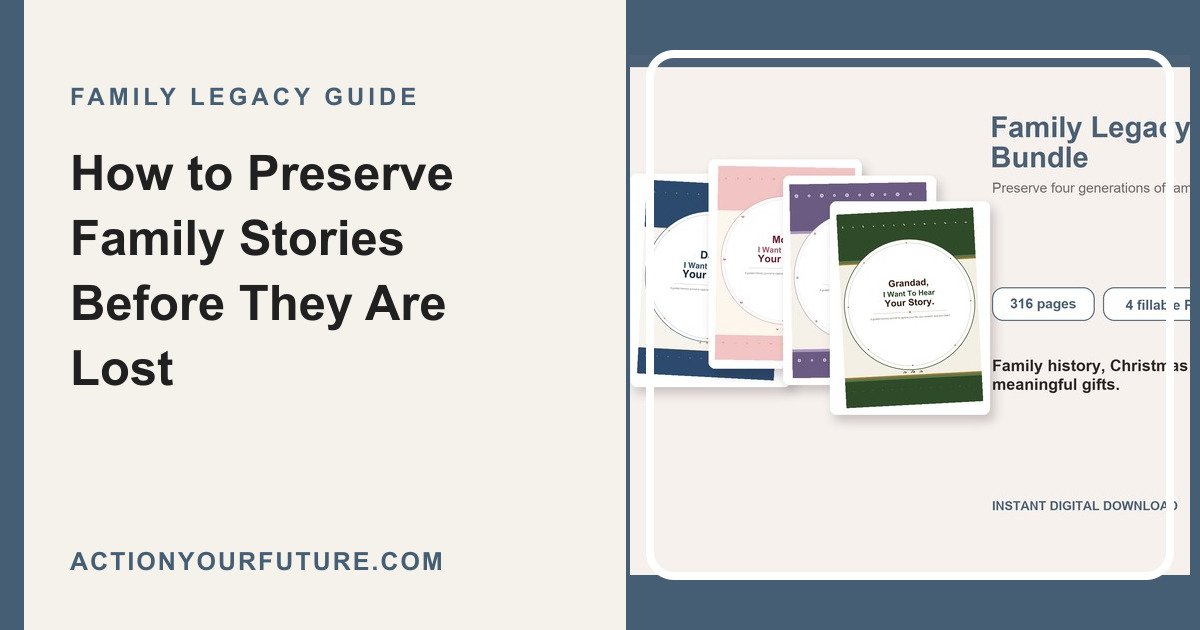
    To make the process easier, the Family Legacy Story Bundle contains guided fillable journals for Dad, Mom, Grandma and Grandad. You can also start with our 75 questions to ask your dad or our guide to questions to ask your grandma.
  • 60 Questions to Ask Your Grandma About Her Life

    60 Questions to Ask Your Grandma About Her Life

    Your grandma has lived through a world that may be very different from the one you know. She may remember relatives whose names are fading from family memory, traditions nobody has written down and moments that shaped the family long before you were born.

    Yet conversations often remain focused on everyday updates. Thoughtful questions create permission to go deeper. You do not need to ask all 60 at once. Choose a few, listen carefully and follow the stories that bring energy to her voice.

    Before you begin

    Ask whether she is comfortable being recorded. If not, make notes afterwards. Bring photographs, recipes or familiar objects to help unlock memories. Avoid correcting her while she is speaking; dates and names can be checked later. If a question touches a painful subject, let her decide whether to continue.

    Childhood and home

    1. What is your earliest memory?
    2. Where did you grow up, and what was your home like?
    3. What did a normal morning look like when you were a child?
    4. Who lived in your household?
    5. What chores were you expected to do?
    6. Where did children play?
    7. What was your favourite toy or game?
    8. What meal reminds you most of childhood?
    9. How did your family celebrate birthdays?
    10. What did your parents worry about?
    11. Which family rule did you dislike?
    12. What made you feel safe?

    School and growing up

    1. What were you like at school?
    2. Which teacher do you remember best?
    3. What subject did you enjoy most?
    4. What opportunities were available to girls at the time?
    5. Who was your closest friend?
    6. What did teenagers do for fun?
    7. What music or fashion did you love?
    8. What did you dream of doing when you grew up?
    9. When did you first feel independent?
    10. What was considered rebellious?
    11. What advice did adults give you that turned out to be true?
    12. What would you tell your teenage self?

    Family, love and relationships

    1. How did you meet the person you first fell in love with?
    2. What was dating like then?
    3. What do you remember about your wedding or early adult life?
    4. How did becoming a parent change you?
    5. What was the hardest part of raising a family?
    6. Which family moment still makes you laugh?
    7. What tradition mattered most in your home?
    8. Who gave you the best relationship advice?
    9. What makes a marriage or partnership last?
    10. How did families stay connected before mobile phones?
    11. What do you hope your grandchildren understand about love?
    12. Which person in the family are you most like?

    Work, change and resilience

    1. What was your first job?
    2. What did you buy with your first wages?
    3. Which part of your work made you proud?
    4. What barriers did women face?
    5. Which invention changed your daily life most?
    6. What historical event do you remember most clearly?
    7. Did your family ever have to move or start again?
    8. When did you have to be braver than you felt?
    9. Who helped you through a difficult period?
    10. What practical skill has served you best?
    11. What did your generation understand about saving or making do?
    12. What challenge taught you the most?

    Traditions, identity and everyday wisdom

    1. Which recipe should our family never lose?
    2. What saying did your parents or grandparents repeat?
    3. What family story should every grandchild know?
    4. Which holiday tradition would you like us to continue?
    5. What place has always felt like home?
    6. What are you proudest of?
    7. What have you changed your mind about?
    8. What ordinary thing are you most grateful for?
    9. What does a good life mean to you?
    10. What do people misunderstand about getting older?
    11. How would you like future generations to remember you?
    12. What final piece of advice would you leave for the family?

    Questions that invite better stories

    If an answer is short, gently ask, “What happened next?”, “How did that feel?” or “Who else was there?” Specific sensory questions can also help: What could she hear from her bedroom? What did Sunday lunch smell like? What clothes did she wear on her first day at work?

    Do not treat the conversation as a race through a checklist. One detailed story is more valuable than twenty rushed answers.

    Preserve her answers in her own words

    Afterwards, label recordings and photographs with names and dates. Write a short summary while the conversation is fresh, and share it with her so she can add or correct details. Store copies in more than one place and invite other relatives to contribute their questions.

    The Grandma, I Want to Hear Your Story fillable journal gives her a private, guided way to type or write memories at her own pace. If you want to record several generations, use the Family Legacy Story Bundle.

    For the wider project, read how to preserve family stories before they are lost.

  • How to Create a Pet Memorial Journal After a Loss

    How to Create a Pet Memorial Journal After a Loss

    Losing a pet can leave an enormous absence. Their routines were woven into the day: the sound of their paws, the place they slept, the way they asked for attention and the small behaviours nobody else would notice. When those details suddenly stop, grief can feel both intense and strangely invisible to other people.

    A pet memorial journal gives those memories somewhere safe to live. It is not about forcing yourself to “move on” or making every page beautiful. It is a private place to remember the full relationship—funny, ordinary, difficult and deeply loved.

    Begin when the time feels right

    There is no correct day to start. Some people need to write immediately; others cannot approach photographs for weeks or months. You can begin with one sentence and close the journal. You can also ask someone you trust to help collect material until you are ready.

    Grief does not follow a tidy order. A journal should support you, not become another task you feel guilty about avoiding.

    Choose a format that feels manageable

    A blank notebook offers freedom, while a guided journal removes the pressure of deciding what to write. A digital document may be easier if handwriting feels tiring or if you want to add photographs. A printed version can feel more tangible and private.

    You can combine formats: type longer memories, keep a handwritten page for personal notes and save photographs in a digital folder.

    Record the basic story

    Start with the facts that frame your pet’s life:

    • Their name, nicknames and how those names developed
    • When and how they joined your family
    • Their breed or appearance
    • The places they lived
    • People and animals they loved
    • Important health events
    • The dates you want your family to remember

    If dates are uncertain, approximate ones are fine. This is a memory book, not an official record.

    Capture personality through small details

    The most meaningful memories are often ordinary. Write about the exact way your pet greeted you, where they waited at mealtimes, which toy they always chose and what they did when they knew they were in trouble.

    Useful prompts include:

    • What made them instantly excited?
    • What were they afraid of?
    • How did they comfort you?
    • Which sound or expression was uniquely theirs?
    • What habit used to annoy you but now makes you smile?
    • What did a perfect day look like for them?

    These details recreate a living personality more powerfully than a formal summary.

    Tell the story of how you changed each other

    Pets influence the rhythm of a household and sometimes the direction of a life. Perhaps they helped you through illness, encouraged you outside, introduced you to neighbours or taught a child about gentleness and responsibility.

    Write about who you were when the relationship began and what became different because they were there. This is not about proving that the loss had a purpose. It is about recognising the depth of the bond.

    Add photographs with context

    Choose images that show personality rather than only perfect portraits. Include the blurred photograph that captures excitement, the favourite sleeping position and the ordinary corner of the home they claimed.

    Add names, places and short captions. Instead of “at the beach,” write “First trip to Bournemouth, when Milo barked at every wave.” Context turns an image into a memory someone else can understand.

    Include difficult memories without letting them take over

    Illness, ageing and end-of-life decisions can dominate the mind after a loss. You may want to record what happened, questions you asked and the care you gave. Writing can help separate the final chapter from the whole life.

    Be gentle with guilt. Many loving decisions are made with incomplete information under painful circumstances. If certain details feel overwhelming, leave a page blank or return later. The journal belongs to you.

    Create a page of gratitude

    List what you are grateful to your pet for: companionship, laughter, routine, protection, patience or simply their presence. You might write a letter beginning, “Thank you for…” and allow it to be as simple or emotional as it needs to be.

    Gratitude does not cancel grief. Both can exist together.

    Invite family members to contribute

    Children and adults may remember different versions of the same pet. Give each person a page for a story, drawing, photograph or message. This can validate grief within the household and preserve details one person alone would miss.

    Do not pressure anyone to participate. People grieve differently, even when they loved the same animal.

    Decide how the journal will be kept

    You might store it with a collar, tag, favourite photograph or condolence cards. If the journal is digital, keep a backup and use filenames that will remain understandable. Some people create a printed copy for the family and retain a private section for themselves.

    A gentle place for remembrance

    A memorial journal does not need a final page. You can add memories when they return unexpectedly, even years later. The aim is not to finish grieving. It is to give love and memory a form that can remain.

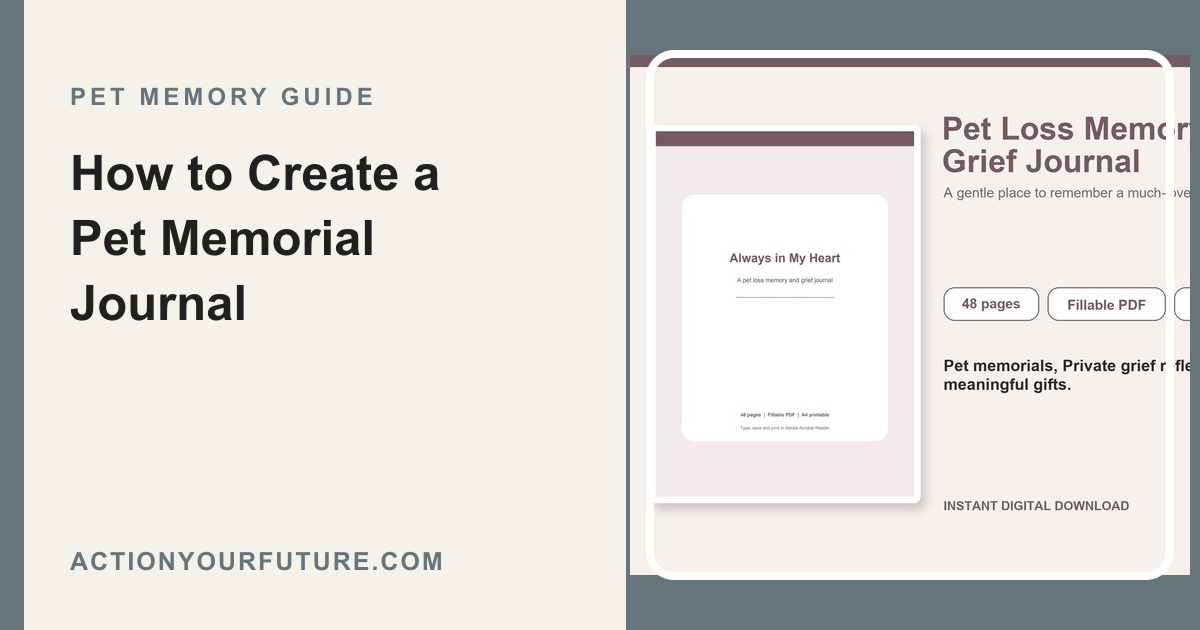
    The Pet Loss Memory & Grief Journal provides compassionate guided pages for photographs, memories, reflection and a lasting tribute. For happier ongoing memories, the Pet Memory Book helps record a companion’s personality and adventures throughout their life.

    If grief is seriously affecting your safety or ability to function, consider speaking with a qualified health professional or a trusted support service. A journal can be supportive, but it is not a replacement for professional care.

  • 75 Questions to Ask Your Dad About His Life

    75 Questions to Ask Your Dad About His Life

    Most of us know our dads through the role they play in our lives. We know the advice they repeat, the routines they keep and the stories they tell most often. But behind “Dad” is a whole person with a childhood, private ambitions, difficult decisions, unexpected friendships and memories we may never have heard.

    Asking the right questions can turn an ordinary conversation into something your family will treasure. You do not need to conduct a formal interview or complete every question at once. Choose a few, listen without rushing and let one answer lead naturally to another.

    How to have a meaningful conversation with your dad

    Pick a comfortable moment when neither of you is distracted. A quiet drive, Sunday lunch or evening cup of tea may work better than announcing a serious “interview.” Ask open questions, give him time to think and resist the urge to correct dates or fill every silence. If he is comfortable with it, record the conversation or write down the key details afterwards.

    Childhood and family

    1. What is your earliest memory?
    2. What was the home you grew up in like?
    3. What did an ordinary day look like when you were a child?
    4. Who made you feel safest when you were young?
    5. What games did you play with your friends?
    6. What family tradition did you enjoy most?
    7. What meal instantly takes you back to childhood?
    8. What were your parents like when no one else was around?
    9. What did your family worry about when you were growing up?
    10. What did your family celebrate well?
    11. What rules did you have at home?
    12. What trouble did you get into as a child?
    13. Who was the funniest person in your family?
    14. What did your grandparents teach you?
    15. What part of your childhood would you love to experience again?

    School, friendship and growing up

    1. What were you like at school?
    2. Which teacher had the greatest influence on you?
    3. What subject came naturally to you?
    4. What did you find difficult as a teenager?
    5. Who was your closest childhood friend?
    6. What did you do together for fun?
    7. What music, films or fashions defined your teenage years?
    8. When did you first feel like an adult?
    9. What did you dream of becoming?
    10. What advice would you give your teenage self?
    11. Did you ever feel different from the people around you?
    12. What was your first important success?
    13. What was your first major disappointment?
    14. Who believed in you before you believed in yourself?
    15. What freedom did you have that young people today might not understand?

    Work, money and important decisions

    1. What was your first paid job?
    2. What did you buy with your first wages?
    3. How did you choose your career?
    4. Which job taught you the most?
    5. What achievement are you most proud of?
    6. Was there a risk you are glad you took?
    7. Was there an opportunity you wish you had accepted?
    8. Who was the best leader or manager you worked with?
    9. What did work teach you about people?
    10. What money lesson did you learn the hard way?
    11. What does success mean to you now?
    12. Which decision changed the direction of your life?
    13. How did you cope when plans went wrong?
    14. What skill has served you throughout your life?
    15. What would you do differently if you started your working life again?

    Love, parenthood and relationships

    1. What do you remember about falling in love for the first time?
    2. How did you know you wanted a family?
    3. What did becoming a dad feel like?
    4. What were you most afraid of as a new parent?
    5. What moment made you especially proud to be my dad?
    6. What did parenthood teach you about yourself?
    7. What family moment still makes you laugh?
    8. What was harder about being a parent than you expected?
    9. What do you wish you had said more often?
    10. What makes a relationship last?
    11. How do you repair things after an argument?
    12. Who has shown you the greatest loyalty?
    13. What quality do you value most in a friend?
    14. How has your understanding of love changed?
    15. What do you hope our family always keeps doing?

    Values, wisdom and legacy

    1. What belief has guided most of your decisions?
    2. What does a good life look like to you?
    3. When have you had to be braver than you felt?
    4. What helped you through your most difficult period?
    5. What have you changed your mind about?
    6. What are you still curious about?
    7. What ordinary thing are you most grateful for?
    8. Which historical event most affected your life?
    9. What do you think people misunderstand about your generation?
    10. What should our family never forget?
    11. Which story about your life do you most want remembered?
    12. What values do you hope I pass on?
    13. What unfinished dream still matters to you?
    14. How would you like future generations to describe you?
    15. If you could leave one message for the family, what would it be?

    Turn the answers into a family keepsake

    Do not worry about creating a perfect biography. Dates can be checked later and stories can be added over time. What matters is capturing his voice, the details only he knows and the meaning behind the events.

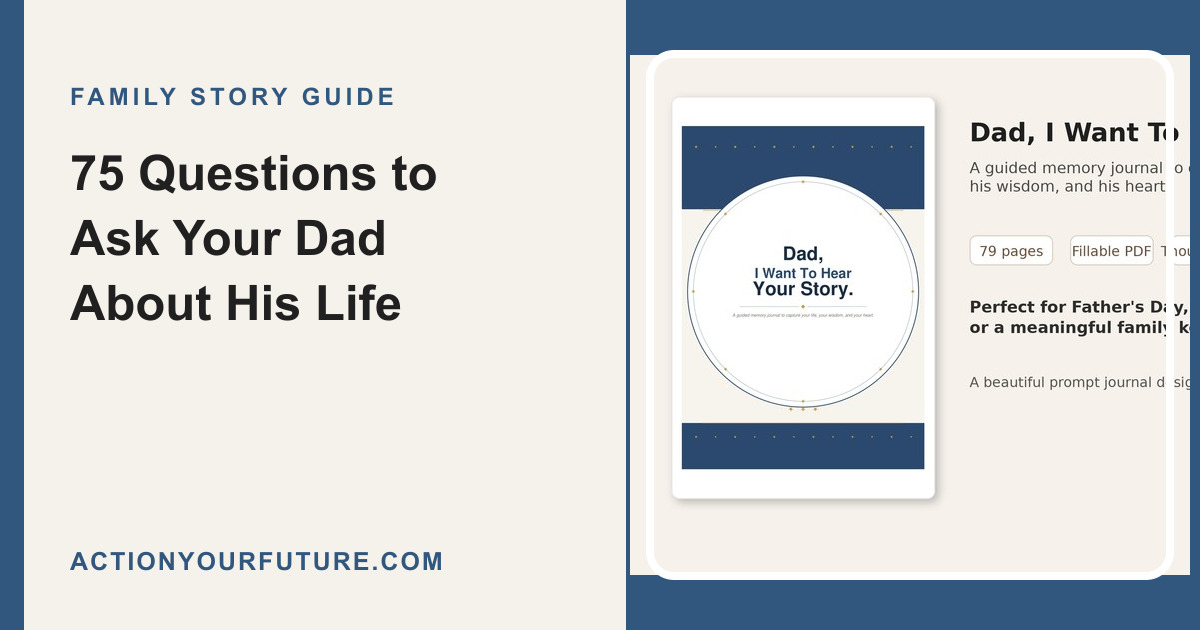
    If your dad prefers writing or typing in his own time, the Dad, I Want to Hear Your Story fillable journal provides guided prompts in a printable and fillable PDF. For several generations, explore the Family Legacy Story Bundle.

    You may also enjoy our guide to preserving family stories before they are lost.