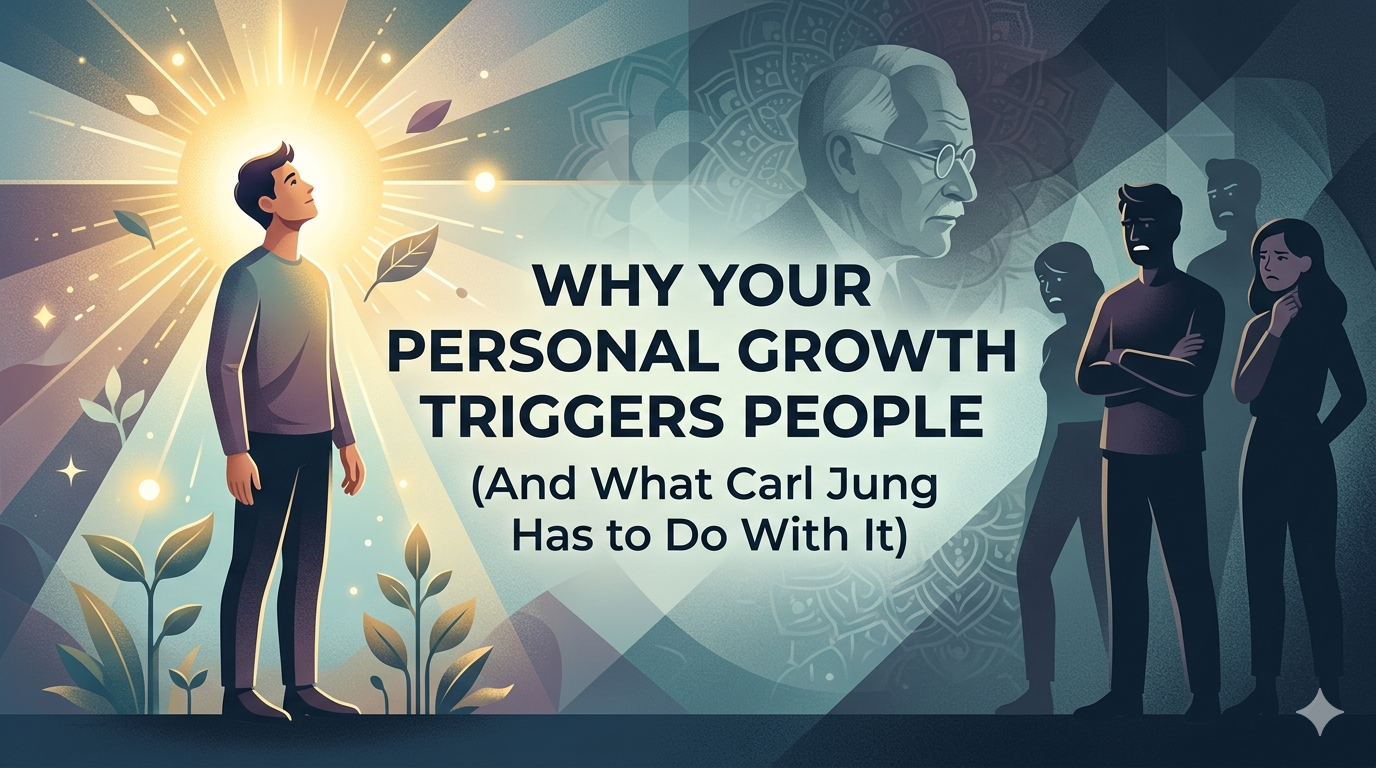
Why Your Personal Growth Triggers People
(And What Carl Jung Has to Do With It)
There is a moment most people who are working on themselves never forget. You walk into a room full of people you’ve known for years—coworkers, old friends, maybe even family—and something feels off.
It’s not dramatic. It’s just slightly out of tune. Conversations feel rehearsed. Smiles arrive a beat too late. There is a low-grade chill in the air.
You replay the whole thing in your head. You didn’t start a fight. You didn’t say anything offensive. Yet, the distance was real. Here is what nobody tells you about that experience: It wasn’t a misunderstanding, and it wasn’t paranoia.
What you picked up on is one of the oldest and most consistent patterns in human psychology—a pattern the Swiss psychiatrist Carl Jung spent decades studying. Once you understand what’s actually driving it, the confusion disappears. Not because things get easier, but because you finally stop blaming yourself for something that was never about you.
The Hidden Architecture of Human Discomfort
Most of us grew up with a simple model for conflict: someone does something mean, a promise is broken, or a lie is told. Conflict has a visible cause. But Jung found something far more disturbing beneath the surface.
He argued that the most powerful form of social hostility has almost nothing to do with what you actually did. It has everything to do with what your presence makes other people feel about themselves. To understand why, you have to understand two versions of the self:
The Persona Latin for “mask,” this is the face we curate for public life. It’s reasonable, decent, and put-together. It is the identity we construct and defend over the years.
The Shadow This is everything else. It’s the parts of you that didn’t make the cut—the buried anger, the secret envy, the fear of being ordinary. The shadow isn’t inherently evil; it’s just the accumulation of everything a person has rejected about themselves to maintain their preferred Persona.
Here is the critical thing Jung understood: The shadow never goes away. When someone else’s presence brushes up against what a person is hiding from themselves, their psychological system reacts defensively. It reacts with something that feels a lot like hatred.
Why does your self-awareness turn you into a threat? Because the more perceptive you become, the more clearly you see people. And to someone deeply identified with their Persona, your presence alone is a kind of exposure. They don’t confront their discomfort internally; instead, their mind finds a simpler solution. It attributes the problem to you. Suddenly, you aren’t growing; you’re “arrogant,” “judgmental,” or “weird.” Jung called this Projection.
7 Ways You Silently Trigger People
This dynamic doesn’t announce itself. It shows up in small, hard-to-name moments. Here are the seven ways your growth acts as a mirror that makes people uncomfortable:
1. You reflect what they’ve avoided.
Imagine you’ve gotten serious about your boundaries, your health, or your finances. You aren’t lecturing anyone, but suddenly, the jokes from friends get a little sharper. Comments become dismissive. “You’re obsessed,” or “You’re too serious.” Your discipline reflects their avoidance.
2. You represent what they gave up on.
Resentment almost universally runs upward. People rarely resent someone struggling more than they are. They resent the person who represents what they know they could have done. Your existence quietly indicts the choices everyone around you made.
3. You stopped needing their approval.
When you stop chasing approval and stop calibrating your behavior to what others think, the emotional leverage disappears. From their perspective, your emotional independence feels like rejection.
4. They can’t predict you anymore.
Everyday social manipulation relies on predictable reactions. When you stop responding to the usual moves—without anger, but with calm observation—the entire script breaks down. It is deeply unsettling.
5. You refuse to maintain the “comfortable fiction.”
Every group operates on unspoken agreements to pretend certain toxic behaviors are normal. When you decline to laugh at what isn’t funny, or refuse to agree with something you genuinely disagree with, you break the agreement.
6. You started saying “No.”
When you start drawing lines and saying no, they don’t say, “I liked it better when I could walk all over you.” They say you’ve become cold, difficult, or selfish.
7. You’re moving forward, and the gap is showing.
You naturally create distance from people who are standing still. The gap asks them a silent question: “Why am I still the same?” To deflect it, their mind turns it into a judgment against you.
The Path Forward: Individuation
If you take a step back, the common thread is clear: the resentment you are experiencing isn’t a response to your behavior. It is a response to the psychological pressure your presence creates. You are triggering people by becoming more honest, more aware, and more yourself.
Jung believed that the deepest purpose of human development was a process called Individuation. It is the process of becoming whole—integrating the shadow instead of hiding it, dropping the persona that no longer serves you, and moving toward an authentic self.
Individuation is rare because it is incredibly uncomfortable. It requires living without the security of everyone’s approval.
What to Do When You Recognize This Pattern
When you realize that someone’s hostility is rooted in their own shadow, it doesn’t automatically make it painless. We are wired for belonging, and feeling quietly excluded hurts. The most common mistake people make is trying to shrink back down.
Don’t make yourself smaller to keep other people comfortable. The resentment won’t go away; it will just become more familiar. Instead:
- Let relationships evolve naturally. Not every connection from your past will make sense for your future.
- Stop interpreting every negative reaction as personal feedback. Differentiate between genuine care and the cold shoulder of someone who misses using you.
- Look for the people who move toward you. The same quality that makes you threatening to some makes you deeply compelling to people trying to find themselves.
- Do your own shadow work. It’s easy to get so focused on spotting projection in others that you forget to check yourself. Do the imperfect work of becoming more real.
“You can’t perform your way out of being a mirror. What you can do is stop flinching every time someone doesn’t like what they see in it.”
When you commit to this, the exhaustion of maintaining performances lifts. You stop viewing the world through a fogged window. It isn’t a path without struggle, but it is the most important work you will ever do.
References & Further Reading
The concepts discussed in this article are rooted in analytical psychology. To explore the architecture of the self, projection, and the shadow deeper, consider these foundational texts:
- Jung, C. G. (1953). Two Essays on Analytical Psychology (Collected Works Vol. 7). Princeton University Press. (Explores the creation of the Persona and the concept of Individuation).
- Jung, C. G. (1959). The Archetypes and the Collective Unconscious (Collected Works Vol. 9 Part 1). Princeton University Press. (Definitive writings on the nature of the Shadow).
- Jung, C. G. (1964). Man and His Symbols. Dell Publishing. (An accessible, general introduction to Jungian concepts written for the public).
- von Franz, M.-L. (1980). Projection and Re-Collection in Jungian Psychology: Reflections of the Soul. Open Court. (A deep dive into the psychological mechanics of projecting our own traits onto others).
- Johnson, R. A. (1991). Owning Your Own Shadow: Understanding the Dark Side of the Psyche. HarperOne. (A practical, modern guide on how to integrate the shadow in daily life).
- Video Resource: Supplementary Exploration of Jungian Concepts (Further viewing on the psychological dynamics discussed in this post).
Leave a Reply